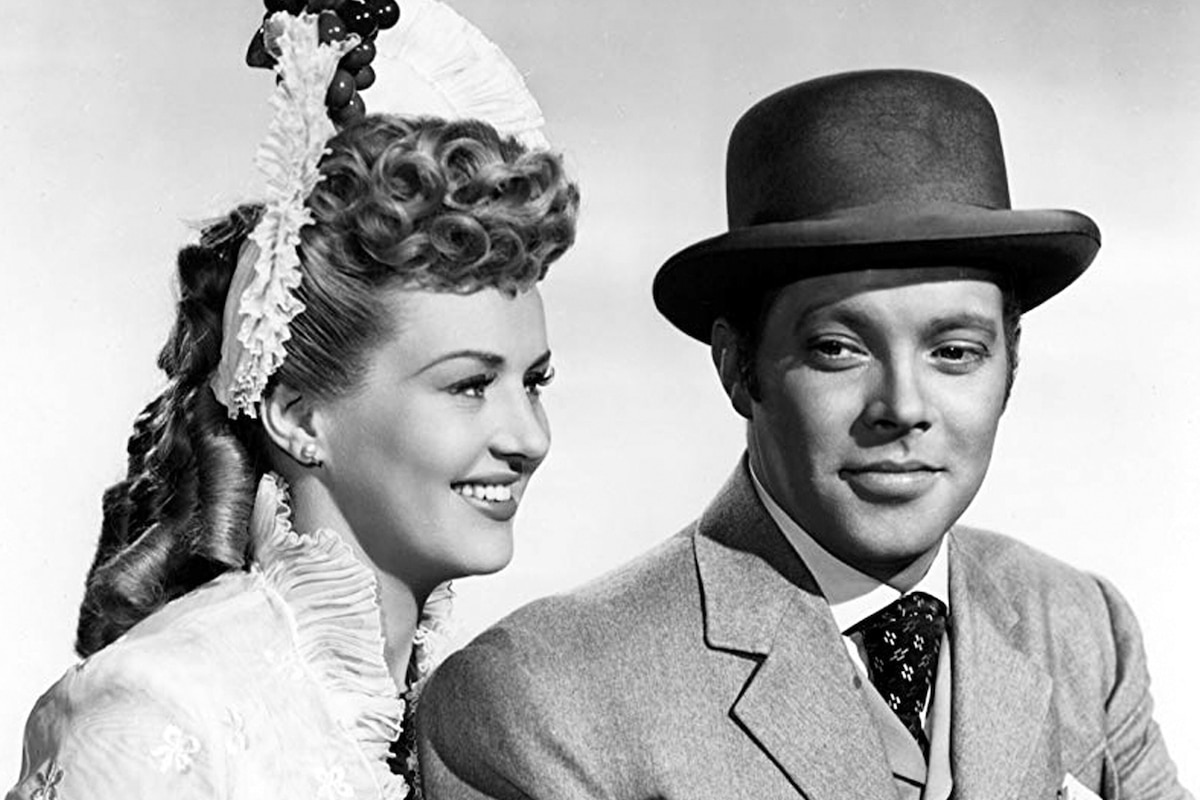
Betty Grable was roughly in the middle of her decade-long run as one of Hollywood's biggest stars when production began on this musical comedy about a young woman struggling for equal treatment in the workplace while becoming involved in the Women's Suffrage movement in 1874.
Don't mistake this for a hard-hitting proto-feminist tract. The picture is based on a screenplay by longtime scriptwriter Frederica Sagor Maas and her husband Ernest Maas about a pioneering young typist embroiled in a murder trial that attracts the attention of famed real-life activist Susan B. Anthony. Shopped around to a few studios and eventually bought by 20th Century-Fox, it languished for a few years until studio head Darryl F. Zanuck thought of turning it into a Grable vehicle. After several rewrites and the addition of eleven previously unpublished songs by George and Ira Gershwin, the result was what Sagor Maas, in her 1999 autobiography, called "another stupid boy-meets-girl Zanuck travesty."
Grable fans didn't seem to mind, and even though the film was not one of her biggest hits (because of her darker blonde hair and failure to show her legs, in the studio's opinion), it didn't keep her from being noted by the U.S. Treasury Department in 1947 as the highest-paid star in Hollywood, earning as much as $300,000 a year.
Cast member Porter Hall likewise had to be replaced when he suffered injuries in a car accident. Gene Lockhart took over his role.
Frederica Sagor Maas, who began her credited Hollywood career with the Clara Bow film The Plastic Age (1925), later named her autobiography for this production: The Shocking Miss Pilgrim: A Writer in Early Hollywood," published when she was 99.
According to several reports, this was Marilyn Monroe's first screen job, supplying a voice (likely cut from the final print) of a telephone operator. Grable and Monroe would eventually co-star in How to Marry a Millionaire (1953) when Grable's movie career was drawing to a close just as Monroe's was on the ascendant. By many accounts, Grable was kind and gracious to her young co-star, and one Hollywood legend has it that she gave Monroe her blessing to walk away with the picture with the encouragement, "Honey, I've had mine. Go get yours."
Grable's leading man here is Dick Haymes, an Argentine-born talent who became one of America's most popular singers. He had once been the featured vocalist for Harry James, the bandleader to whom Grable was married at the time. Haymes was offered a contract by Fox in 1945 following success with a Decca recording contract and his own radio show. This was his second picture with Grable. One of his biggest hits of the 1940s was a song from this film, "For You, For Me, Forevermore," a duet he sang in the movie with his leading lady. But when Decca decided to record three of the songs from The Shocking Miss Pilgrim, they released them with Haymes and Judy Garland instead of Betty Grable.
Director: George Seaton
Producer: William Perlberg
Screenplay: George Seaton, from a story by Frederica Sagor Maas and Ernest Maas
Cinematography: Leon Shamroy
Editing: Robert Simpson
Art Direction: James Basevi, Boris Leven
Music: David Raksin (uncredited), songs by George and Ira Gershwin
Cast: Betty Grable (Cynthia Pilgrim), Dick Haymes (John Pritchard), Anne Revere (Alice Pritchard), Allyn Joslyn (Leander Woolsey), Gene Lockhart (Saxon)
By Rob Nixon
The Shocking Miss Pilgrim
by Rob Nixon | March 02, 2020
SIGN UP FOR OUR NEWSLETTERS

CONNECT WITH TCM