What is it about a female trio in movies that appeals to Hollywood so much? Bette Davis had an early role in Three on a Match (1932) and Joan Crawford was one of the showgirls in Sally, Irene and Mary (1925). Three Americans try to bag men in Madrid in The Pleasure Seekers (1964), while three others learn to live without them in the California desert in the aptly named 3 Women (1977). New York is the setting for stories of three "career gals" seeking the big time in The Best of Everything (1959) and on the hunt for rich husbands in How to Marry a Millionaire (1953). And the kick-ass triple threat known as Charlie's Angels keeps reappearing on screens big and small.
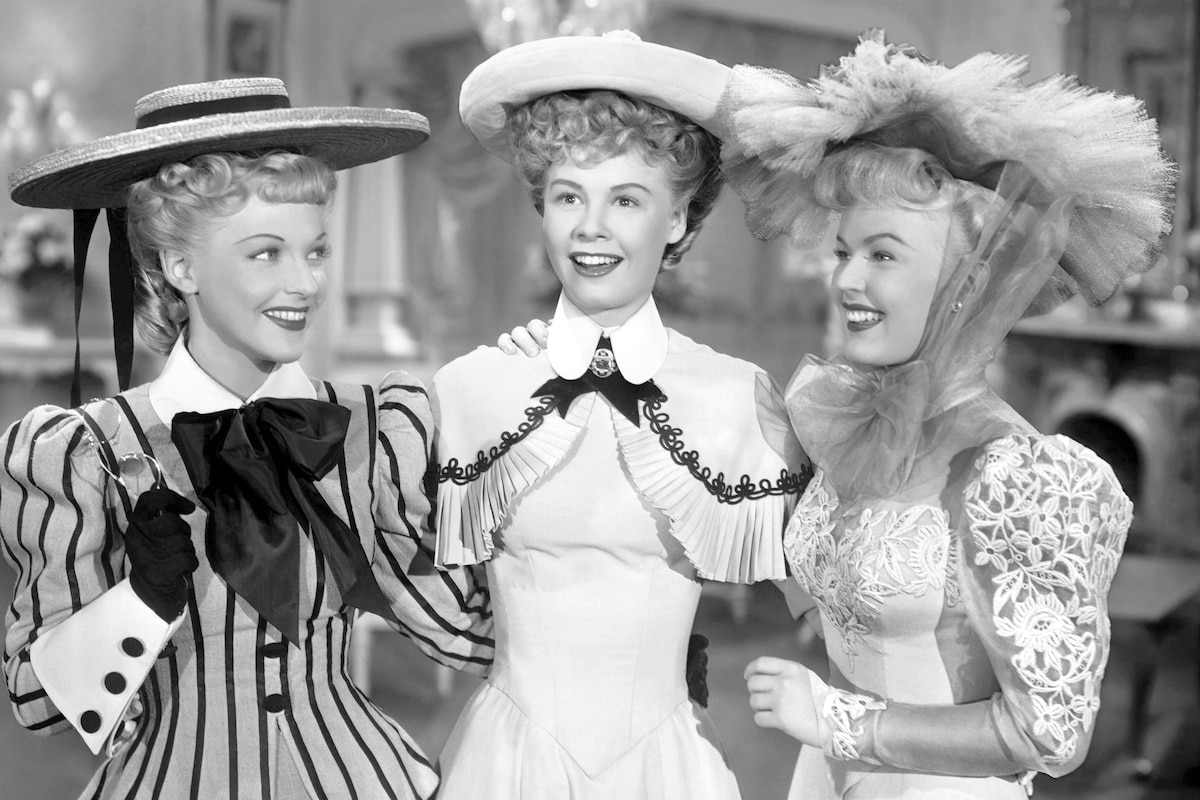
Then there's this entry from the mid-40s, a remake of Three Blind Mice (1938), in which a trio of sisters leave their rural community, pooling their inheritances to create new identities in order to snag wealthy husbands (apparently never having heard of wise investing as a practical alternative). If that sounds a lot like How to Marry a Millionaire (1953), the similarity is not so much either coincidence or outright stealing as it is a reflection of this ongoing movie obsession.
The fortune hunters here are played by June Haver, Vivian Blaine and Vera-Ellen. After inheriting a chicken farm from their aunt, they decide it's not worth quite enough to attract millionaires, so they leave their rural Red Bank, NJ, home for Atlantic City, where they check into a luxury hotel posing as a socialite, her secretary and her maid. Their reasoning is that if one of them can catch a rich guy, it will be easier for the others to do the same. Needless to say, in the end love - not money - conquers all.
The plot was reworked one other time prior to this in the Betty Grable hit Moon Over Miami (1941) with an aunt substituting for one of the sisters. All three film adaptations were based on a play that 20th Century-Fox bought for dirt cheap in 1937. Music was added for the Grable version, and all new songs were written for this one, including "You Make Me Feel So Young," anachronistic in style for the movie's 1902 setting but liked so well by Fox studio head Darryl F. Zanuck that it was mandated to appear three times in the picture. A decade later, Frank Sinatra would make it one of his signature standards.
Production of the film began with director John Brahm, who had just made a trio of notable thrillers, The Lodger (1944), Guest in the House (1944) and Hangover Square (1945). Apparently the moody tone of those films was unsuitable for a piece of fluff like Three Little Girls in Blue; Brahm was replaced by H. Bruce Humberstone (dropping the H in the credits), whose work on Fox musicals for Grable, Alice Faye and Sonja Henie was more in line with what this story needed.
The studio reportedly tried to cast ballet and Broadway star Harold Lang as the love interest for dancer Vera-Ellen, but he had stage commitments, so Charles Smith got the part. Both Smith and Vera-Ellen were dubbed in their musical numbers, as were George Montgomery and Frank Latimore, as the love interests of the other two sisters.
Top-billed Haver made several light musicals over the next few years but retired from the screen in 1953, first to try convent life and then to marry actor Fred MacMurray. Vivian Blaine made only a handful of movies after this, although she appeared on television into her 60s, with her most notable role being Miss Adelaide opposite Sinatra in Guys and Dolls (1955). Vera-Ellen did a string of hit musicals after this, dancing with the likes of Fred Astaire, Gene Kelly and Danny Kaye, but her career was also short-lived, brought to a halt by the waning appeal of musicals in the late 1950s, personal tragedies and an ongoing struggle with anorexia.
The cast member to emerge from this picture with the most longevity and acclaim was Celeste Holm, a stage star making her film debut in a small role. She went on to win a Best Supporting Actress Oscar for Gentleman's Agreement (1947) and appear in two Joseph L. Mankiewicz productions, A Letter to Three Wives (1949), in which she was heard but never seen, and All About Eve (1950), her third Academy nomination. She continued to work right up to her death in 2012 at the age of 95.
New York Times critic Bosley Crowther called the picture "just a sprightly and happy show" and singled out the "glitter" of its eye-popping Technicolor, a film process that got higher billing than any of the cast.
Director: Bruce Humberstone
Producer: Mack Gordon
Screenplay: Valentine Davies, from a play by Stephen Powys
Cinematography: Ernest Palmer
Editing: Barbara McLean
Art Direction: Lyle Wheeler, Joseph C. Wright
Songs: Mack Gordon (lyrics), Josef Myrow (music)
Cast: June Haver (Pam Charters), George Montgomery (Van Damm Smith), Vivian Blaine (Liz Charters), Celeste Holm (Miriam Harrington), Vera-Ellen (Myra Charters), Frank Latimore (Steve Harrington)
By Rob Nixon
Three Little Girls in Blue
by Rob Nixon | February 19, 2020
SIGN UP FOR OUR NEWSLETTERS

CONNECT WITH TCM