SHUT MY BIG MOUTH
Comedy star Joe E. Brown was a continual presence on movie screens through the 1930s. For six years he turned out several films a year for Warner Brothers; then he moved for two years to independent producer David L. Loew, before heading to Columbia for three more pictures. After making the first Columbia film, So You Won't Talk (1940), Brown was injured in a car accident and had to take two years off to recover. His next movie, seen as a comeback, was Shut My Big Mouth (1942), a Western parody.
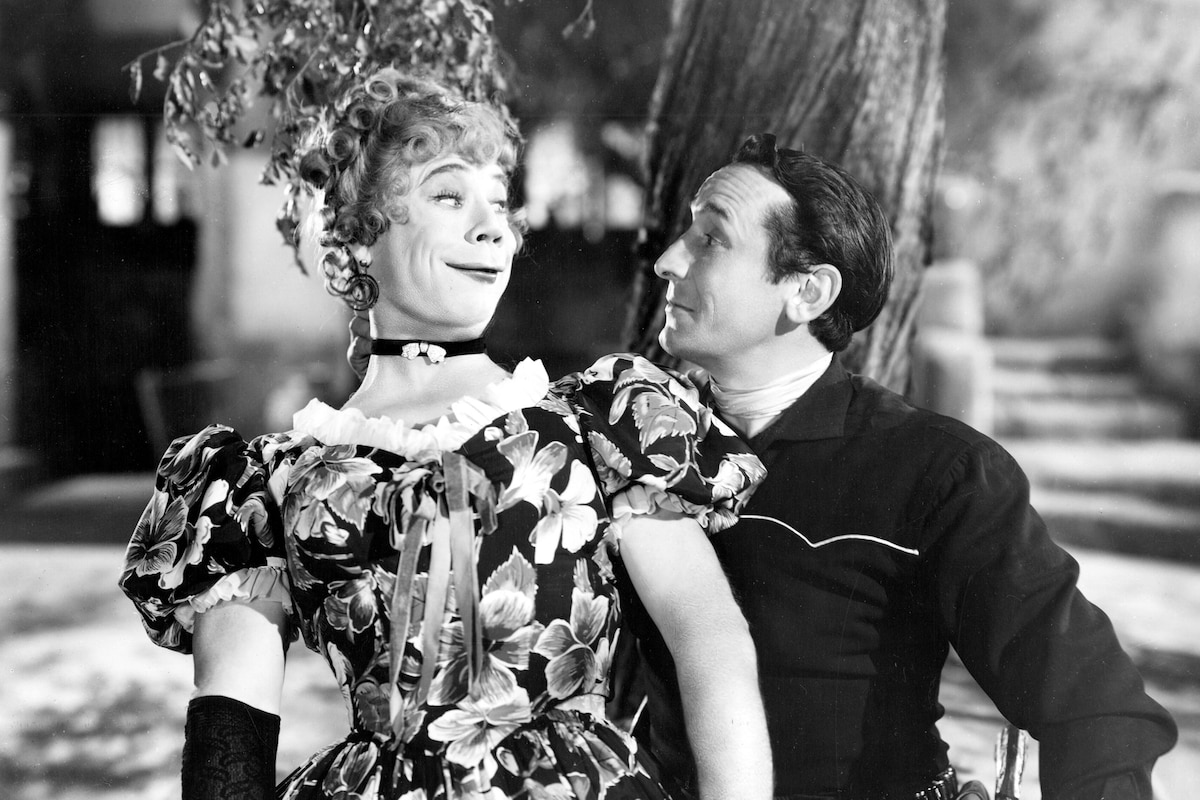
Brown plays Wellington Holmes, a timid horticulturist who aims to beautify the open spaces of the West. Thanks to a comic plot turn, he finds himself appointed marshal of Big Bluff and expected to bring in the masked bandit Buckskin Bill (Victor Jory). Desperate to escape, Wellington disguises himself as a feisty woman, leading to ever more comic hijinks, including an adoption by Indians who christen him "Chief Cave in the Face."
A Columbia press release stated, "Producer Robert Sparks has provided a ladies' hairdresser to care for the star's wigs, a wardrobe woman to keep his ten changes of dresses and gowns in condition, and even a lady's dressing room in which Brown may lounge between takes on the set."
Shut My Big Mouth began filming in November 1941 and finished three days before the attack on Pearl Harbor. By the time the picture opened in February 1942, Brown was entertaining American troops at army bases in Alaska - the first performer to do so. Brown spent much time during the war entertaining American armed forces worldwide, becoming one of only two civilians to receive the Bronze Star during World War II.
Film historian Leonard Maltin, in his book The Great Movie Comedians, described the essence of Brown's appeal. "Brown developed a screen personality reminiscent of the silent clowns," Maltin wrote, "and significantly, his popularity endured far longer than many of his stage colleagues... Brown projected likability, innocence, and American stick-to-itiveness in his frequent role as an outcast or underdog. These had been key ingredients in the success of the silent clowns, and they helped endear Joe E. Brown to movie audiences in the talkie era who begged for some relief from the constant chatter and wisecrack dialogue that Hollywood supplied... Other comedians in film history have been cleverer, more skillful, more artistic. But none could match Joe E. Brown for establishing such immediate and enduring rapport with his audience."
Shut My Big Mouth was seen as a welcome return for Brown and was a modest commercial success. "Joe E. Brown returns to the screen after a lengthy absence in the type of role he does best," declared Variety. "A lot of fun. Charles Barton's direction has a tongue-in-cheek style, and capably pokes fun at time-hallowed western plots."
This was actress Adele Mara's second credited film role, after Blondie Goes to College (1942). Future stars Lloyd Bridges and Forrest Tucker are billed far down in the list. This was Tucker's fifth movie; Bridges had appeared in more than twenty over the previous two years but had mostly been uncredited.
By Jeremy Arnold
SOURCES:
Wes D. Gehring, Joe E. Brown: Film Comedian and Baseball Buffoon
Leonard Maltin, The Great Movie Comedians
James Robert Parish and William T. Leonard, The Funsters
Shut My Big Mouth
by Jeremy Arnold | February 16, 2020
SIGN UP FOR OUR NEWSLETTERS

CONNECT WITH TCM