While producer George Pal was in production on Destination Moon (1950), he bought the rights from Paramount to another science fiction property, the 1932 novel When Worlds Collide, written by Philip Wylie and Edwin Balmer. Paramount agreed to the sale because the studio didn't see much potential in science fiction at this time; in fact, studio president Barney Balaban had turned down Destination Moon, forcing Pal to go with the lower-rung distributor Eagle Lion. Furthermore, When Worlds Collide had been languishing at Paramount practically since its publication. The studio had originally bought it for Cecil B. DeMille, who intended to direct a version of it entitled The End of the World; that production was canceled after the release of RKO's Deluge (1933), which was seen as too similar.
Destination Moon opened in New York at a cinema across the street from Balaban's office. When Balaban saw long lines of moviegoers, Pal recalled, "he remembered passing on it, realized his mistake, and sent one of his aides...to make a deal with me." In other words, Paramount now bought back When Worlds Collide, this time with Pal attached. (Pal said he made a profit on the basis of that sale alone.)
Destination Moon was hailed as a notable science fiction movie because it treated the subject of space travel intelligently and believably. (It was one of the few sci-fi films that Stanley Kubrick studied at length when he was researching 2001: A Space Odyssey [1968].) When Worlds Collide also has a fairly credible treatment of an extraordinary idea. Scientists discover a rogue star, Bellus, heading toward Earth. A collision is inevitable, but the star has a planet, Zyra, likely with an Earth-like atmosphere. Mankind's only hope is to send people by rocket to colonize Zyra. The world doesn't believe the scientists, so a private team gets funding to build a spacecraft; it will function as a sort of Noah's Ark, with humans, animals, plants, tools and so forth. But there's only room for forty-odd people, and now the world is starting to believe the disaster will happen... The story also works in a love triangle between a pilot (Richard Derr), a doctor (Peter Hansen) and an astronomer's daughter (Barbara Rush), though at a certain point, the special effects become the star of the show.
George Pal later explained that he had first commissioned a screenplay by Jack Moffitt: "I hired him to write it before I signed my contract with Paramount. It was an excellent script, much closer to the book. When I signed with the studio, the story department assigned Sydney Boehm to rewrite the script. Sydney changed the story quite a bit. But since I was a greenhorn in pictures and a newcomer to Paramount, I went along with the story department's suggestions. I wish we had used the original script."
Moffitt's script would have been much more expensive to produce, with more world settings than appear in the finished picture. But the film as it exists is still considered one of the better sci-fi offerings of the era, especially impressive for being made on a relatively low budget of under $1 million. Director Rudolph Mate, a former cinematographer, had transitioned to directing in 1947 and his pictures (mostly film noir dramas and westerns to this point) generally featured a strong pictorial sense and good pacing.
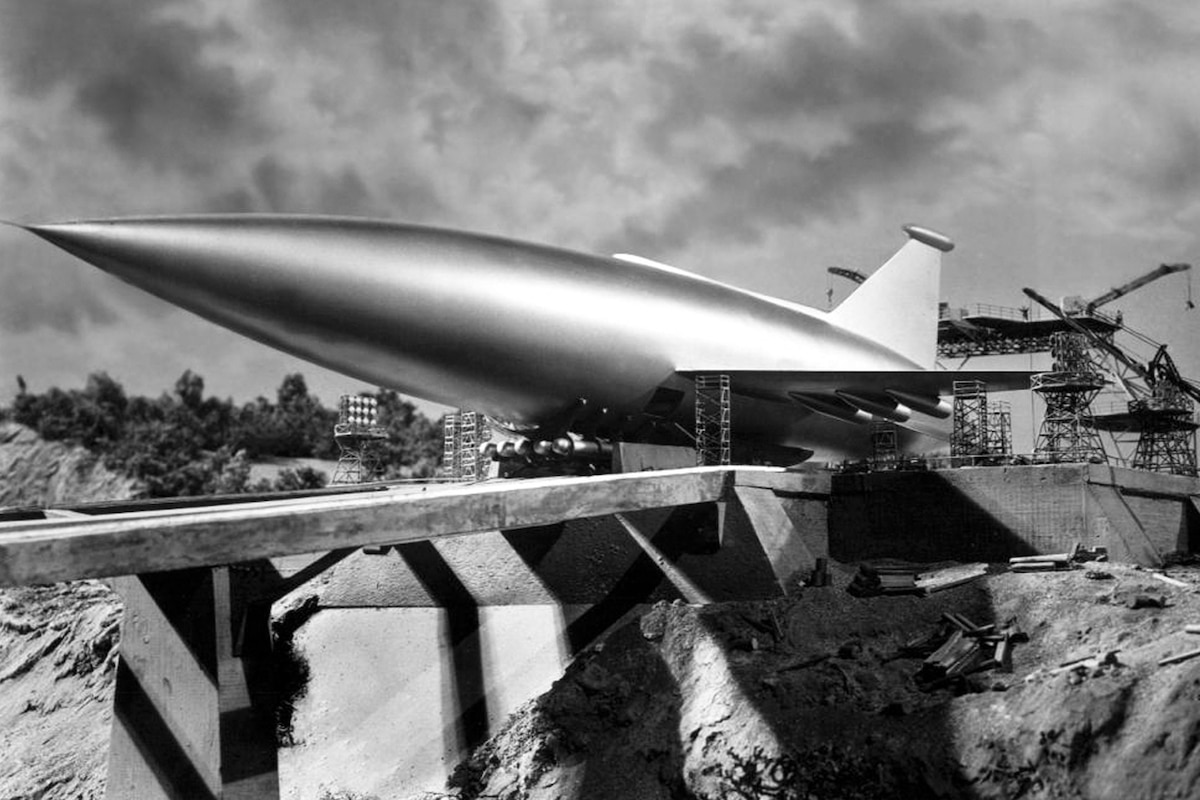
This film's science fiction visuals were conceived by artist Chesley Bonestell, who painted elaborate images of scenes brought to life with impressive production design and colors. One of his most striking ideas was for the rocket to take off not vertically but horizontally, on a mile-long ramp (700 feet in real life). Special effects artists Gordon Jennings and Harry Barndollar worked from Bonestell's ideas to create Oscar-winning effects of Earth's destruction, though to keep costs down they also incorporated significant stock footage. Among the disaster images are earthquakes, volcanoes and a tidal wave devastating Times Square.
Pal later recalled how the Times Square deluge was achieved: "We took a scene from an old Samuel Goldwyn picture and froze the frame. Then we built a replica in black of the buildings, and we dumped water in from two tanks. Then frame by frame we rotoscoped it and did hand-painted mattes. The whole sequence cost only $1,800." For the earthquake effects, a stage was designed on wheels and springs, then shaken by a giant pile driver.
A final sequence on Zyra is literally a Bonestell sketch. Pal said the end of the shoot was rushed because Destination Moon received an Oscar for special effects during production and Paramount suddenly wanted to hurry When Worlds Collide to release to ride the other film's coattails. Pal was so rushed that he was forced to accept a rewritten, abbreviated ending to the story. Further, there was no time for the construction of a planned miniature of the spaceship on the planet. For the preview screening, all Pal could do was to insert a Chesley Bonestell concept painting in place of that shot. After the preview tested through the roof, with no complaints about the painting shot, Paramount left it in for the release version, refusing Pal's request of $5,000 to shoot the miniature.
Pal was disappointed, but the film opened to good box office reviews and critical praise. "George Pal repeats in even greater measure the imagination and box office possibilities of his Destination Moon," said Variety. "An expertly wrought example of top showmanship. Film definitely establishes [George Pal] as a top quality producer, entirely at home in the science-fiction film field." The Los Angeles Daily News deemed When Worlds Collide "unquestionably the best science-fiction film yet produced."
Later on, Pal hoped to film a sequel drawn from the novel's sequel, After Worlds Collide, but when Conquest of Space (1955) failed at the box office, Paramount canceled the plan.
By Jeremy Arnold
SOURCES:
Robert S. Birchard, Cecil B. DeMille's Hollywood
Ezra Goodman, "Behind the Camera." Daily News, Dec. 25, 1950
Phil Hardy, The Overlook Film Encyclopedia: Science Fiction
Gail Morgan Hickman, The Films of George Pal
Theresa M. Moore, Science Fiction Films of the 20th Century: 1950-1954
Bill Warren, Keep Watching the Skies! American Science Fiction Movies of the Fifties
When Worlds Collide
by Jeremy Arnold | February 12, 2020
SIGN UP FOR OUR NEWSLETTERS

CONNECT WITH TCM