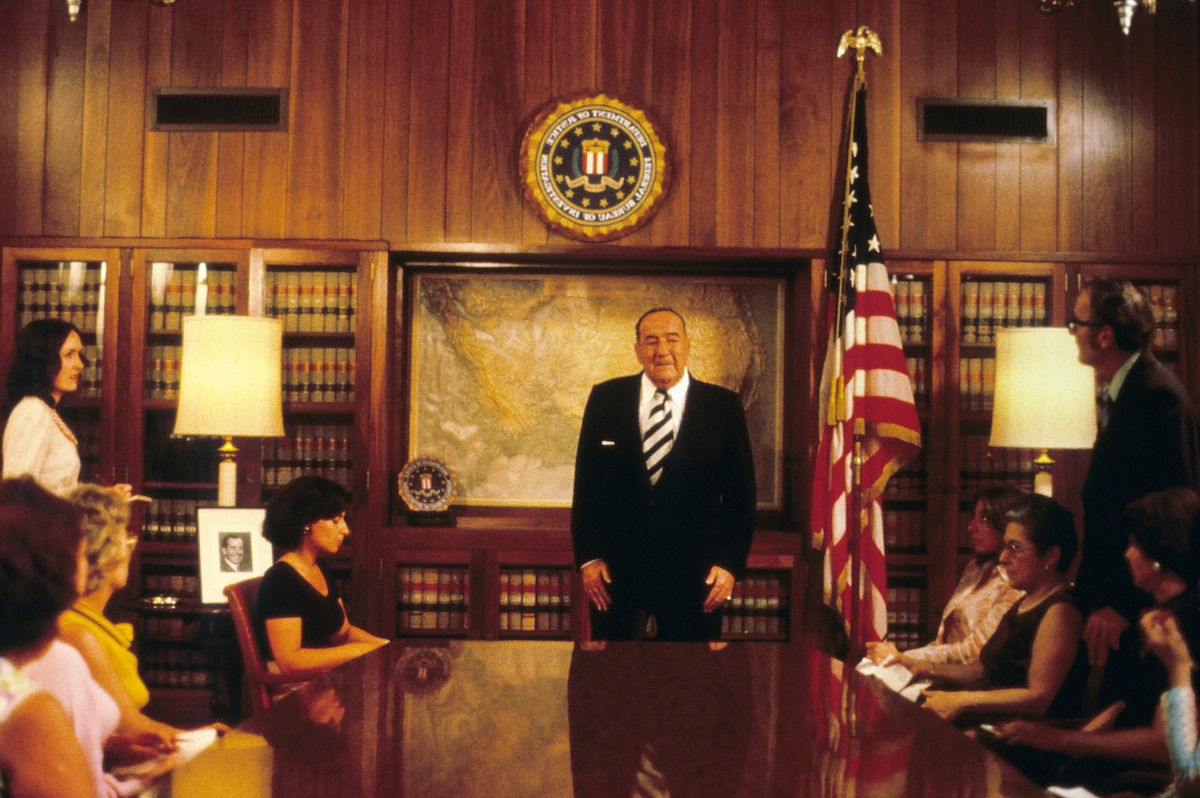
Plagued with scandal and controversy, the life and career of J. Edgar Hoover, the first director of the FBI, was rife with filmmaking potential. Five years after Hoover's death, Larry Cohen brought his story to the big screen with The Private Files of J. Edgar Hoover (1977). The film chronicles over 40 years in Hoover's life from his appointment as director to his death in 1972. High points include his war against gangsters during the Great Depression, his pursuit of communists (the Red Scare) and government homosexuals (the Lavender Scare), uncovering mafia connections and striking fear in the hearts of presidents and other people in positions of power. The film also sheds light on Hoover's fixation with his mother, his obsessive devotion to his work, his potential homosexuality, his close relationship with Clyde Tolson and his fascination with taping FBI targets during their most intimate moments. Hoover was known to say "there are no secrets in government," yet he himself was a fiercely private man. Cohen's film blows open the lid to reveal the man behind the myth.
For the lead role of J. Edgar Hoover, Cohen considered Robert Duvall and Charles Durning. George C. Scott contacted Cohen with interest in the part but by that point Cohen had already cast Broderick Crawford. In an interview, Cohen said, "Broderick Crawford was letter perfect, never missed a call and was always on time." This was a plum role for an actor who might otherwise have been considered past his prime. After his success with Born Yesterday (1950) and the TV show Highway Patrol, which ended in 1959, a leading part in a big production was an opportunity not to be missed. James Wainwright was cast as young Hoover, a television actor with only a handful of movie roles to his name. Both Crawford and Wainwright bore close resemblances not only to Hoover but to each other.
Cohen and his team took great pains to build a fine ensemble cast that would play all the key figures in Hoover's life. These include: Robert F. Kennedy (Michael Parks), John F. Kennedy (William Jordan), Martin Luther King Jr. (Raymond St. Jacques), President Franklin D. Roosevelt (Howard Da Silva), President Lyndon B. Johnson (Andrew Duggan), Walter Winchell (Lloyd Gough), Senator Joseph McCarthy (George Wallace), Hoover's rival Melvin Purvis (Michael Sacks) and Hoover's mom (June Havoc). Fictional characters included spurned love interests Florence Hollister, a wealthy widow played by Celeste Holm and Carrie DeWitt, a prostitute played by Ronee Blakley. Jose Ferrer plays Lionel McCoy, Hoover's lifelong friend, and Rip Torn narrates as Dwight Webb Jr. In his final film role, Dan Dailey plays Clyde Tolson, FBI Deputy Director and longtime partner of Hoover. It's also the final film for Jack Cassidy who died shortly before the film was released.
The Private Files of J. Edgar Hoover was written, produced and directed by Cohen who worked his way up from writing teleplays and TV scripts to directing low-budget horror films and bigger productions. This movie combines Cohen's classic pulp style with a documentary style of filmmaking. The original plan to make a three-hour movie at $3 million was changed to a more reasonable 111 minutes and $1 million. Cohen hired composer Miklos Rozsa who wrote a dramatic score performed by the London Philharmonic Symphony.
For Cohen, authenticity was key. He hired John M. Crewdson, an FBI expert and writer as his technical advisor and even included figures from Hoover's life including his barber and the waiter at his favorite restaurant. Cohen wanted to film in Hoover's world but that was easier said than done. According to an article in the Los Angeles Times, Cohen wanted to recreate the RFK assassination at the Ambassador Hotel in Los Angeles but was denied by hotel management. Getting permission from the federal government to film at the FBI headquarters, the Department of Justice building and the FBI training Academy was no easy task. This is where the casting of Dan Dailey came in handy. When First Lady Betty Ford, a big fan of Dailey's, heard he was in town, she invited him and Broderick Crawford for lunch at the White House. Seizing on this opportunity, Cohen called the Department of Justice asking about access to the locations he sought and name dropping this recent connection with the First Lady. In an later interview, Cohen remembered, "they put me on hold and then came back to say, 'When do you want to come?' We filmed everywhere after that!" When not filming historical reenactments on the MGM backlot, shortly before it was demolished, Cohen shot at The Mayflower Hotel and The Sheraton Hotel, two locations Hoover frequented and Hoover's home. The film wrapped up in just four weeks and on budget.
MGM, 20th Century-Fox and Warner Bros., all liked the film but turned it down in fear of the FBI's potential wrath, so it was American International Pictures (AIP) that came to the rescue and picked up Cohen's film for distribution. They made the big mistake of screening it at the Kennedy Center in Washington D.C. to an audience of government officials who didn't care for how the film painted the U.S. government in an unflattering light. The film was nothing if not politicized depicting politicians as dishonest and hypocritical. Cohen said, "there were no good guys, all bad guys." At the start of the film the following warning appears: "This motion picture was filmed on actual locations at the F.B.I. but without the approval or censorship of the Bureau."
The Private Files of J. Edgar Hoover had a limited run in five cities. It did not perform well and quickly moved to TV. It got mixed reviews with Variety claiming the film "may be the motion picture industry's first historical horror story." According to a 2017 interview with Larry Cohen, The Washington Post tried to destroy the movie. He said, "at the end of the movie it stated Woodward and Bernstein got all their information from the FBI. And it turned out years later that Deep Throat was Mark Felt, the acting director of the FBI at the time." Cohen was clearly ahead of his time. The film was deemed profitable due to some clever maneuvering on the part of AIP who sold the film to a tax shelter group. Cohen got a $150,000 bonus right off the bat and the film netted $400,000 in profits despite its unsuccessful theatrical run. Over the years, the film has enjoyed repertory and festival screenings in the US and abroad and is considered one of Cohen's underrated achievements.
By Raquel Stecher
The Private Files of J. Edgar Hoover
by Raquel Stecher | December 18, 2019
SIGN UP FOR OUR NEWSLETTERS

CONNECT WITH TCM