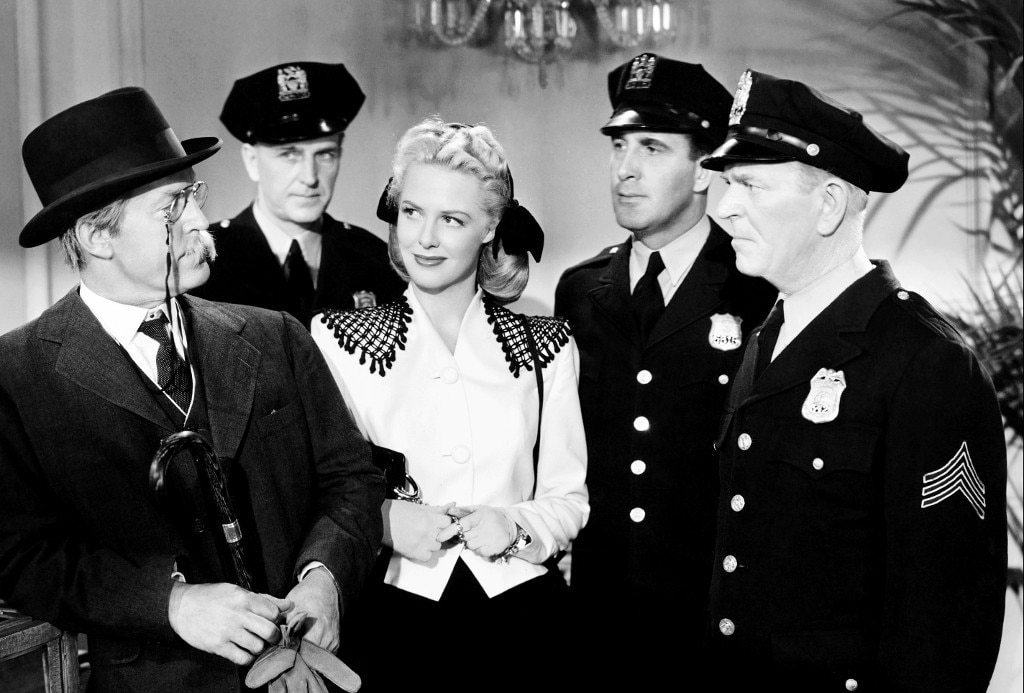
One of Columbia Pictures' most enduring sleuths, Boston Blackie, tried to solve a jewelry theft to support the war effort in the 1944 B-movie, One Mysterious Night, the seventh of the studio's 14 Boston Blackie films. With star Chester Morris turning in his usual solid, witty performance in his most famous role and an auspicious debut behind the cameras, the film remains one of the most interesting in the series.
One of the first stars of the talking film era, Morris had been nominated for a Best Actor Oscar®, for Alibi (1929) at the third annual Academy Award race. He had also co-starred with Wallace Beery in MGM's seminal prison film, The Big House (1930). By the late '30s, however, he had moved into low-budget films, which made the security of Columbia's Boston Blackie series a very welcome thing.
He wasn't the screen's first Boston Blackie, however. Jack Boyle had introduced the character in the 1919 short story "Boston Blackie's Mary" as a hard-nosed prison inmate before featuring him in other stories as a warm-hearted thief. The character had appeared in a series of silent films starting in 1918, with Bert Lytell, who also had introduced the Lone Wolf to the screen, Lionel Barrymore and others. In 1941, Columbia dusted off the concept, turning Blackie into a wisecracking adventurer in Meet Boston Blackie. The film teamed Morris with Richard Lane, who would play his friendly nemesis in the police department, Inspector Farraday, in all 14 films. George E. Stone, an off-screen character who had become a friend of writer Damon Runyon while in vaudeville, joined the team as Blackie's sidekick, The Runt, in the same year's Confessions of Boston Blackie.
Columbia's Boston Blackie films were noted for their speed, the spirited playing of the leads and their often improbable plots, possibly made on the theory that if things moved quickly enough audiences wouldn't question such absurd developments as a pair of runaway crooks eluding the police by pretending to be tailor's dummies. They also were noted for showcasing young talent who would often go on to greater things at Columbia or other studios. Among the future names turning up in the series were director Edward Dmytryk and actors Larry Parks, Lloyd Bridges, Forrest Tucker, Steve Cochran, Nina Foch and Patricia Barry. In One Mysterious Night, Dorothy Malone (billed as Maloney), played an early role more than a decade before she would win an Oscar® for Written on the Wind (1956) or star in the first prime-time soap opera, Peyton Place.
The biggest new name in the film, however, was director Budd Boetticher, making his official directing debut with his given name, Oscar. After studying bullfighting in Mexico, Boetticher had gotten into films when his parents tried to save him from that dangerous occupation by getting him a job coaching Tyrone Power on his bullfighting moves in Blood and Sand (1941). He also helped choreograph Rita Hayworth's paso doble dance with Anthony Quinn. That led to other production jobs and a growing reputation for his ability to handle crowd scenes. He arrived at Columbia when director George Stevens requested him as an assistant director on The More the Merrier (1943). During production, Boetticher had a run-in with the studio's notoriously nasty head, Harry Cohn. When the younger man refused to give in to Cohn's bullying, the executive was impressed and put him under contract, saying, "Kid, I guess I'm the SOB who's going to have to make something out of you.".
Boetticher learned the ropes at Columbia by doing second unit work and producing. Then he got to fill in for Lew Landers directing scenes on the World War II thriller U-Boat Prisoner (1944). Cohn was sufficiently impressed to move him into the director's chair permanently with One Mysterious Night.
Although the move offered Boetticher a great opportunity, and he would go on to direct an acclaimed series of Westerns starring Randolph Scott in the '50s and '60s, the director never looked back on his first credited directing job with undue nostalgia. Years later, he told a film class at the University of Southern California that he started his career with a review that said, "This film wasn't released. It escaped." Several filmmakers have laid claim to that pan, but there's no question about the New York Times review, which labeled the film "as unsatisfying as a blank cartridge in a gunman's gat....much sound and very little fury."
Producer: Ted Richmond
Director: Budd Boetticher
Screenplay: Paul Yawitz
Based on the character created by Jack Boyle
Cinematography: L.W. O'Connell
Art Direction: Lionel Banks, George Brooks
Music: Mischa Bakaleinikoff
Cast: Chester Morris (Boston Blackie), Richard Lane (Inspector Farraday), Janis Carter (Dorothy Anderson), William Wright (Paul Martens), Robert Williams (Matt Healy), George E. Stone (The Runt), Dorothy Malone (Eileen Daley), Joseph Crehan (Jumbo Madigan).
BW-61m.
by Frank Miller
One Mysterious Night
by Frank Miller | February 01, 2007
SIGN UP FOR OUR NEWSLETTERS

CONNECT WITH TCM