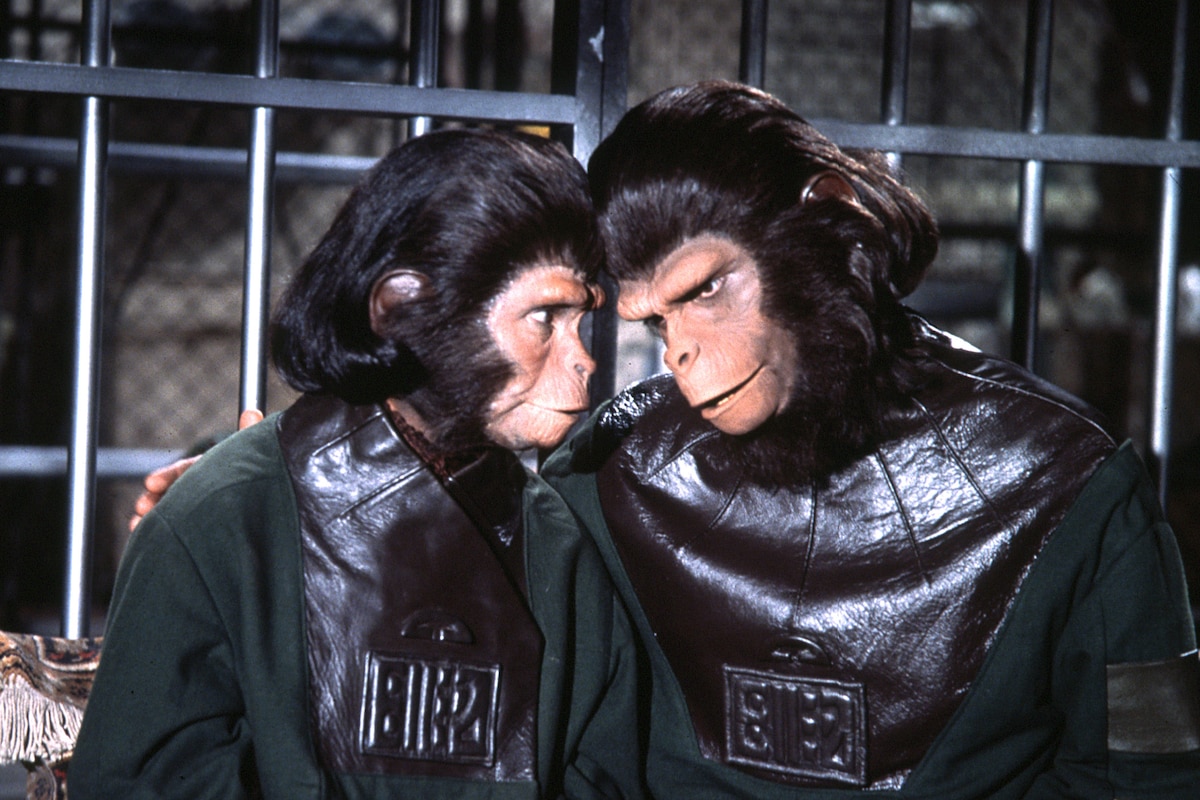
Beneath the Planet of the Apes (1970) ends with the destruction of Earth, so screenwriter Paul Dehn was surprised to receive a telegram that read, "Apes exist, sequel required." 20th Century-Fox was eager to keep the franchise going for a third entry, though at a significantly lower budget. Thus Escape from the Planet of the Apes (1971) was born, one which takes place in contemporary Los Angeles after intellectual chimpanzees Cornelius (Roddy McDowall) and Zira (Kim Hunter) travel back in time. Unlike the apocalyptic scenarios of the first two films, Escape from the Planet of the Apes is a light fish-out-of-water comedy for most of its running time, a charming change of pace for the at-times heavy handed series.
In Planet of the Apes Revisited, associate producer Frank Capra Jr. described the challenge that awaited the production: "We can't be in the future too much, because that costs money; we can't be too far in the past because that costs money. So we were pretty well constrained to do a few apes in the present time." So Paul Dehn came up with the scenario that Cornelius, Zira and the scientist Milo (Sal Mineo) flew away from Earth before it exploded at the end of Beneath the Planet of the Apes, commandeering George Taylor's (Charlton Heston) ship from the first film (previously established as being able to travel through time). A scene where the apes witness the Earth's demise from the ship was apparently shot but cut from the final release. Capra thought the sequence "just didn't seem to fit. This was not a science fiction piece as much as the others."
Cornelius and Zira end up in the hands of the US Army, who are amply befuddled and hand them over to the Los Angeles Zoo for safekeeping. There they come under the care of Dr. Lewis Dixon (Bradford Dillman) and Dr. Stephanie Branton (Natalie Trundy), who are immediately sympathetic to their situation. Once word gets out that the two apes can speak English, and eloquently so, they become national celebrities, having their every move tracked by the paparazzi. The majority of the film deals with their integration into society, whether it's going shopping for clothes or learning about the pleasures of alcoholic beverages. Roddy McDowall and Kim Hunter bring such a frazzled charm to Cornelius' and Zira's relationship that these low-stakes scenes of cultural education are the most engaging of the movie. When Zira discovers she is pregnant, the film shifts into a different paranoid thriller tone as the duo must hide out inside abandoned ships on the outskirts of town. But Hunter and McDowall retain their chemistry, and the chimp baby is simply adorable - the baby Yoda of its day.
The reason they have to hide out is Dr. Otto Hasslein (Eric Braeden), who was assigned to the presidential board to study the apes' arrival. Deeply skeptical of the apes' motives and obsessed with the future obsolescence of humanity, he sees the simian couple as threats and slowly convinces top brass that eliminating them is for the betterment of humankind. Dr. Dixon helps Cornelius and Zira escape, eventually placing them in the care of circus operator Armando (Ricardo Montalban), who will appear in future entries in the series.
Montalban is the most charismatic actor in the film, able to convey more with an eyebrow than Dillman can with a whole feature-length of screen time. Armando is a profoundly empathetic personality who forms an immediate emotional connection with Cornelius and Zira. Montalban uses his saucer eyes puddling up with tears at the thought of separating from them, even as the film's final shot twist guarantees his involvement in future generations of apes.
Escape from the Planet of the Apes was a financial success, earning $12 million on a $2 million budget, though it ended up grossing less than its predecessor, Beneath the Planet of the Apes. The reasons for this, according to producer Arthur P. Jacobs, were that, "First, there were some who were disappointed in the second picture. Second, it's really not so much science fiction as the others were, and I think that was a letdown for some kids.... It was an intimate picture, not a spectacle. Third, I think Fox took the attitude it was presold, therefore not spending too much money in selling it."
I would tend to ascribe it to his second reason, as the film, for most of its running time, seems more like a Paul Mazursky relationship drama than a dystopian science-fiction extravaganza. And that's what makes it a unique entry in the series. The filmmakers took a chance on an unusually small-scale script from Paul Dehn that focuses on the everyday struggles of being a stranger in a strange land.
By R. Emmet Sweeney
Escape from the Planet of the Apes
by R. Emmet Sweeney | December 14, 2019
SIGN UP FOR OUR NEWSLETTERS

CONNECT WITH TCM