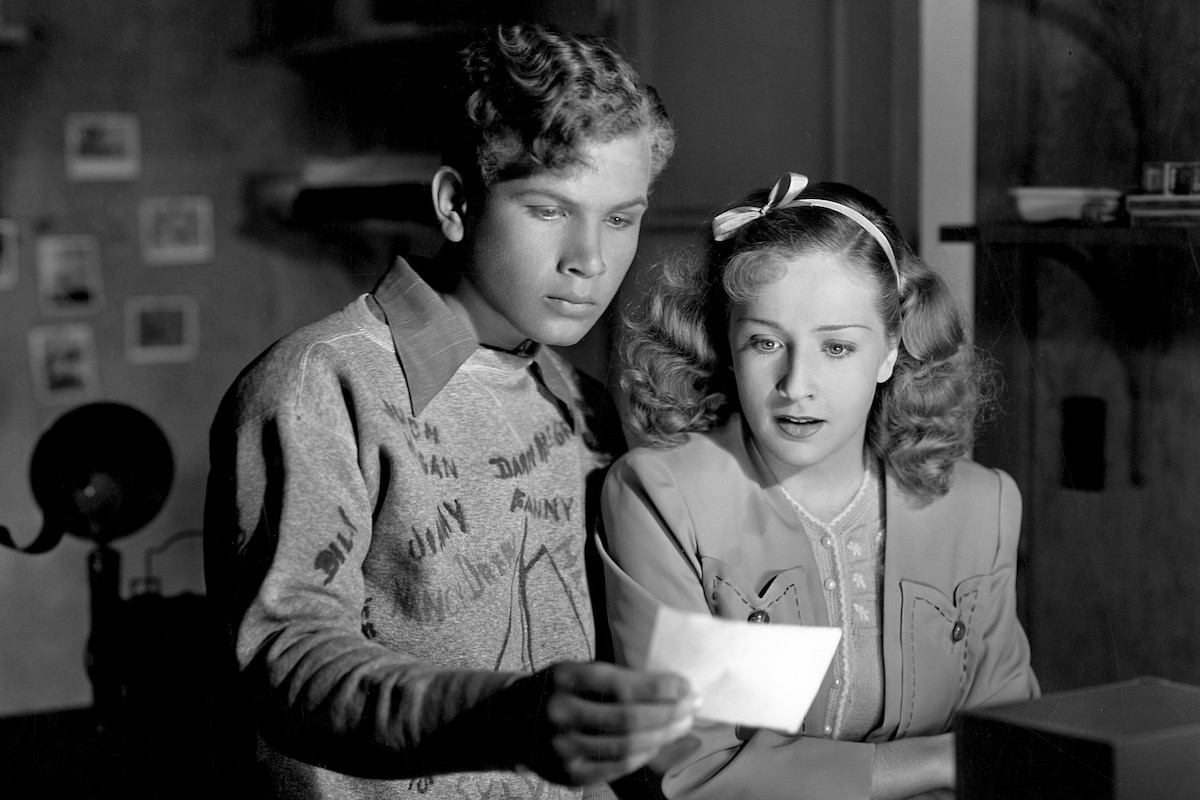
In Nancy Drew and the Hidden Staircase (1939), the fourth and final film in the popular Warner Bros. series directed by William Clemens, plucky teenage girl sleuth Nancy Drew (Bonita Granville) helps the elderly Turnbull sisters solve the mystery of their "haunted" mansion. Widely considered to be the best of the Nancy Drew films, Nancy Drew and the Hidden Staircase has plenty of suspense, plot twists and humor to keep any fan of the detective genre satisfied.
The Nancy Drew films grew out of the popular juvenile book series aimed at young girls. The books were the brainchild of publisher Edward Stratemeyer, founder of the Stratemeyer Syndicate, with the first one, The Secret of the Old Clock, published in 1930. Stratemeyer outlined the first four Nancy Drew stories himself, but enlisted writer Mildred Wirt Benson to flesh them out into full manuscripts under the pen name Carolyn Keene. Stratemeyer's daughter, Harriet Stratemeyer Adams, then edited the completed books for final publication. They were an immediate sensation with young readers, and Warner Bros. snapped up the movie rights to the series in 1938.
Warner Bros. made its first Nancy Drew film, Nancy Drew Detective, in 1938 starring Bonita Granville as Nancy and Frankie Thomas as her boyfriend, Ted Nickerson. The low-budget film was originally intended as a B-movie second half of a double bill. However, it proved popular enough with audiences that the studio quickly cranked out three more in succession with the same cast and crew.
Nancy Drew and the Hidden Staircase was based on the second book in the Nancy Drew series, The Hidden Staircase. In fact, despite the abundance of original source material, Nancy Drew and the Hidden Staircase was the only one of the Warner Bros. films to actually take its story from one of the books, though significant changes were made by screenwriter Kenneth Gamet.
15-year-old former child actress Bonita Granville portrayed Nancy Drew in all four movies. She made a strong impression as the feisty girl detective, bringing charm and energy to the part. Earlier in her career, Granville had been nominated for an Academy Award for her performance in These Three (1936) as an attention-starved school girl who spreads devastating lies about her teachers. Nancy Drew and the Hidden Staircase was the last film Granville made at Warner Bros. before moving to MGM. It was the last time Nancy Drew appeared on the big screen.
Of all the films in the Nancy Drew series, Nancy Drew and the Hidden Staircase received the most favorable reviews. "Characters are all nicely cast and competent, including John Litel, as Bonita's father, and Frank Orth as the plucky police captain," said Variety. "Director William Clemens keeps the film moving at a speedy clip and gets in some nice comedy touches." Fast-paced and vibrant, Nancy Drew and the Hidden Staircase holds up surprisingly well today and captures the spirit of the original books, still thriving after 75 years.
Producer: Bryan Foy, Hal B. Wallis, Jack L. Warner
Director: William Clemens
Screenplay: Mildred Wirt Benson (story), Kenneth Gamet
Cinematography: L. William O'Connell
Film Editing: Louis Hesse
Art Direction: Ted Smith
Music: Heinz Roemheld
Cast: Bonita Granville (Nancy Drew), Frankie Thomas (Ted Nickerson), John Litel (Carson Drew), Frank Orth (Captain Tweedy), Renie Riano (Effie Schneider), Vera Lewis (Miss Rosemary Turnbull).
BW-60m.
by Andrea Passafiume
Nancy Drew and the Hidden Staircase
by Andrea Passafiume | January 30, 2007
SIGN UP FOR OUR NEWSLETTERS

CONNECT WITH TCM