A bloody mob killing in Chicago on Valentine's Day 1929 marked the end of America's romance with glamorous big-city crime czars. The newspapers that had previously glorified gangsters like Alphonse Capone, now lobbied against them with a vengeance. The press instead began to make legends of rural and provincial robbers--Bonnie & Clyde, John Dillinger, Pretty Boy Floyd--petty thieves whose arrest photos made the F.B.I. look good. The 1934 enforcement of the Production Code more or less banned gangsters as central characters in Hollywood movies. It wasn't until the late 1950s that actors Rod Steiger and Neville Brand were allowed to play Al Capone on screen, using the famous hoodlum's actual name. The Billy Wilder comedy hit Some Like It Hot (1959) depicted the 1929 St. Valentine's Day Massacre, but gave the killers funny names, like 'Toothpick Charlie.'
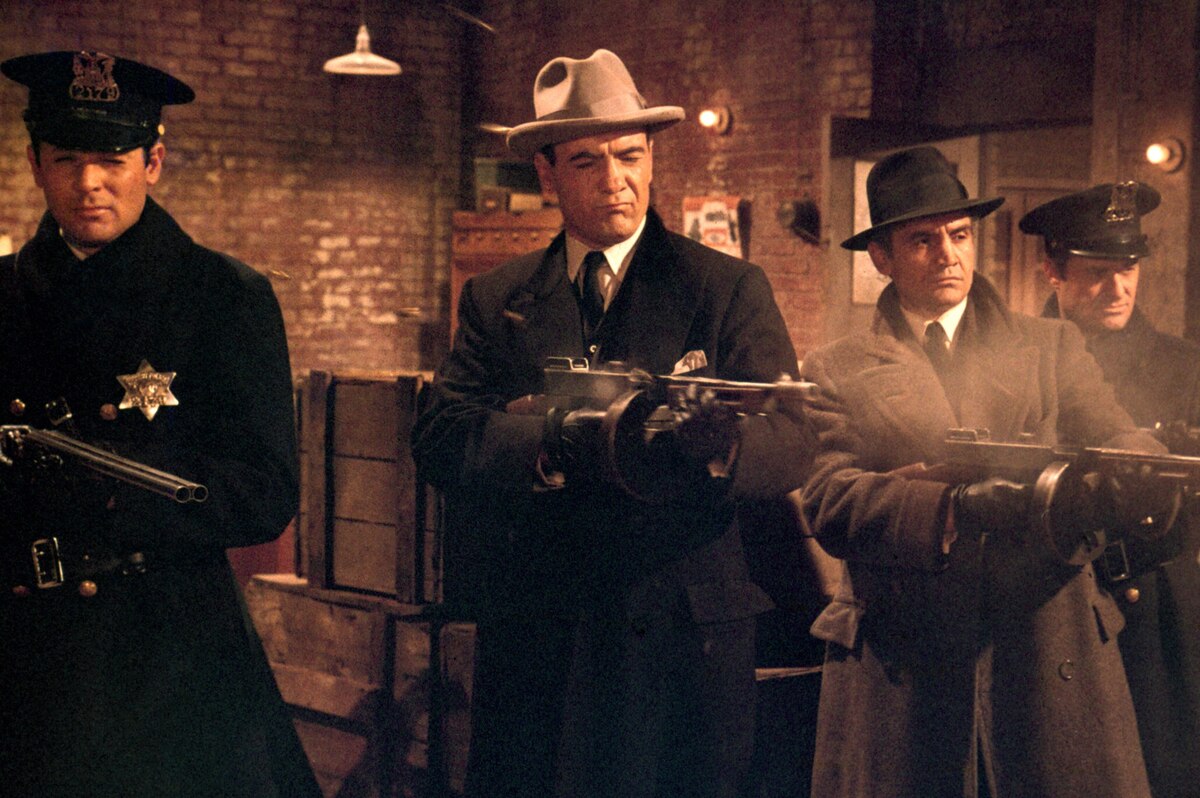
Gangland's most notorious Day of Infamy got its own film with 1967's The St. Valentine's Day Massacre, a 20th Century-Fox release produced and directed by Roger Corman. Ten years before, Corman had been directing tiny exploitation movies for drive-in double bills, including two micro-budgeted gangster films: Machine-Gun Kelly (1958) and I Mobster (1959). A series of color Edgar Allan Poe thrillers then earned Corman critical praise as a front-rank director, and he was wooed by the big studios. After spending idle months at Columbia, ignored by the front office, Corman moved to Fox, where his ambitious gangster project found favor. Released months before MGM's The Dirty Dozen and Warner Bros.' Bonnie & Clyde, The St. Valentine's Day Massacre led the pack in a breakout year for violent movie fare.
Corman always had a radical streak. Fresh from costume horror, he had just enlivened the 'biker gang' sub-genre with The Wild Angels (1966), an edgy thriller that incorporated a swastika in its main title art. With The St. Valentine's Day Massacre, the retelling of events in 1929 Chicago strike an equally subversive tone. Using dry, ironic narration, screenwriter Howard Browne lays out the actual historical clash between the rival gangs of Al Capone (Jason Robards Jr.) and Bugs Moran (Ralph Meeker). Flashbacks relate the bloody 1924 killing of florist-gangster Dion O'Bannion (John Agar) and the 1926 rub-out of hoodlum Hymie Weiss (Reed Hadley). Corman re-stages events from classic gangster films in their original contexts, thereby contrasting historical events with Hollywood myth. Hood Peter Gusenberg (George Segal) harasses a speakeasy owner just as James Cagney had in The Public Enemy (1931). One authentic attempt to assassinate Al Capone takes the form of a parade of cars (22 in all) filing past an Italian restaurant with machine guns blazing, as was depicted in the classic Scarface (1932).
The documentary approach required a large cast. Corman signed familiar actors from crime movies: Richard Bakalyan, Harold J. Stone, Joe Turkel. Ethnic specialists Frank Silvera, Kurt Kreuger, Alexander D'Arcy and Alex Rocco helped Corman emphasize the variety of immigrants that packed Chicago in the 1920s.
Corman took advantage of his first assignment for a big studio to reward loyal actor friends eager to work on a mainstream production: Bruce Dern, Leo Gordon, Jonathan Haze, Dick Miller, Barboura Morris. At this time, Jack Nicholson was ready to quit acting and concentrate on a writing career. Rather than take the larger role that Corman offered, he chose a minor character with the most working days, to maximize his take-home pay.
Corman wanted Orson Welles to play Capone, but Fox nixed Welles on the grounds that he was too unpredictable and didn't take direction. The lead part went to Jason Robards Jr., a fine actor who did not at all resemble Capone. To appear frightening, Robards had to shout his dialogue.
The St. Valentine's Day Massacre moves from one violent set-piece to another, as the grim narrator compares gangland behavior to that of nations conducting foreign policy. When the fateful February 14 arrives, each victim is introduced with the phrase, "On the last day of his life..." Capone is shown killing with a straight razor and a baseball bat, but the famed mass murder is filmed with discretion. The most expressive image is a post-execution close-up of smoke curling from the barrel of a shotgun. Barboura Morris's screams and a whimpering dog express the idea of an unimaginable atrocity.
Corman's frugality curbs some aspects of the production. Sets are under-dressed, costumes are off-the-rack and ladies' hairstyles are anachronistic. To avoid shooting delays, most of the lighting is high-key and flat. Chicago's newly-minted film critic Roger Ebert thought the movie less realistic than the old-time gangster films that had been filmed on similar fake Hollywood street sets.
Roger Corman was proud of his movie but did not continue as a director-for-hire. He didn't enjoy the studio's arbitrary oversight or having his casting decisions second-guessed. He also had no power to question Fox's reports that the relatively inexpensive, widely-screened The St. Valentine's Day Massacre did not turn a profit. Roger returned to directing independently but became unhappy when American-International Pictures began editing his work behind his back. He then vacated the director's chair to concentrate on running his own distribution company, New World, hiring a new generation of film-school graduates to churn out hundreds of highly profitable exploitation pictures.
By Glenn Erickson
The St. Valentine's Day Massacre
by Glenn Erickson | December 10, 2019
SIGN UP FOR OUR NEWSLETTERS

CONNECT WITH TCM