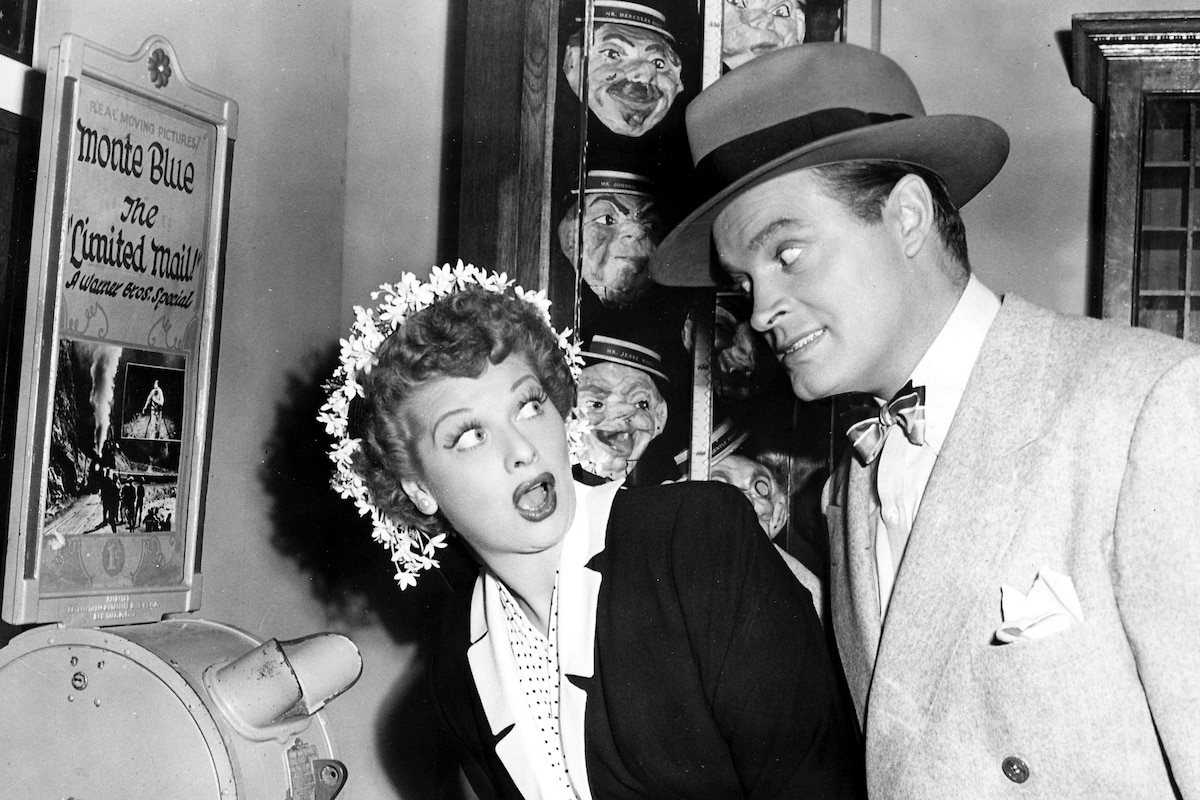
Sorrowful Jones (1949) (also known as Damon Runyon's Sorrowful Jones) was the first of four films that paired Lucille Ball and Bob Hope, who would go on to star together in Fancy Pants (1950), The Facts of Life (1960) and Critic's Choice (1963). Based on newspaperman and author Damon Runyon's short story Little Miss Marker, which first appeared in the March 26, 1932 issue of Collier's magazine, Sorrowful Jones was adapted for film under its original title by Paramount with Adolphe Menjou and Shirley Temple in 1934 (and later remade in 1962 as Forty Pounds of Trouble and again as Little Miss Marker in 1980). Sorrowful Jones has Hope starring as the title character, a New York bookie who runs an illegal gambling operation out of a barber shop and accepts a "marker" on a bet from a gambler named Orville Smith (Paul Lees). The marker is his four-year-old daughter, Martha Jane (Mary Jane Saunders). Gangster Big Steve (Bruce Cabot) and his henchman Once Over Sam (Tom Pedi) murder Smith when he learns that Big Steve is doping horses to win races, leaving the bachelor Jones with a child on his hands. Jones needs his ex-girlfriend, Gladys O'Neill (Ball) to help him take care of Martha Jane and keep her safe when the child's life is threatened by Big Steve when he learns who she is. Also in the cast are William Demarest, Thomas Gomez and Houseley Stevenson.
Directed by Sidney Lanfield, Sorrowful Jones began its life as an adaptation by Gladys Lehman, Sam Hellman and William R. Lipman, which Melville Shavelson, Edmund L. Hartmann and Jack Rose used to create the screenplay. Production took place on the Paramount lot in Hollywood on a relatively short schedule from April 7th to early June of 1948. Bob Hope would later remember the film in his memoir as being "memorable for two reasons: it was my first time out in a semi-serious role; and it was my first movie with Lucille Ball. The story was from Damon Runyon, and I had a great fondness for him." Ball nearly missed out on her chance to appear in Sorrowful Jones; she learned that Paramount had not chosen an actress to play opposite Hope only days before production was scheduled to begin, but once she found out, she campaigned hard with the front office for the role. The studio was reluctant to cast her until Hope told them that "[s]he'd be tops. I want her to get it." Columnist and broadcaster Walter Winchell did the opening narration for the film, but rather than accept a salary for his work, he chose instead to donate it to the Damon Runyon Cancer Fund (now The Damon Runyon Cancer Research Foundation), which Winchell had founded in his friend's memory just after Runyon's death on December 10, 1946.
When Sorrowful Jones premiered in New York on June 5, 1949, it was met with grudging approval by Bosley Crowther, the irascible New York Times film critic who wrote, "a serious student of the late Damon Runyon's works, in which the story of Little Miss Marker is somewhere near the top, might even find it difficult to recognize a Runyon character in this film. Certainly the Sorrowful of the story is not apparent in the shape of Mr. Hope. But once this distinction is realized and the customer is prepared to forget that Little Miss Marker --and Mr. Runyon--had a strict brand of sentiment, then Mr. Hope's own personal Sorrowful--and this film--should be hugely enjoyed. [...] Three energetic gag-writers have provided him with a script that is loaded with farce situations and explosively funny gag lines. And Sidney Lanfield, the director, has kept the camera virtually handcuffed to him." Life magazine agreed, saying that Hope showed "unexpected talents."
Hope and Ball would repeat their Sorrowful Jones roles later in the year when they appeared in the Lux Radio Theater adaptation in November 1949. Shortly after completion of Sorrowful Jones, Lucille Ball would begin a new radio program, My Favorite Husband, which would be the inspiration for I Love Lucy.
By Lorraine LoBianco
Sorrowful Jones
by Lorraine LoBianco | November 26, 2019
SIGN UP FOR OUR NEWSLETTERS

CONNECT WITH TCM