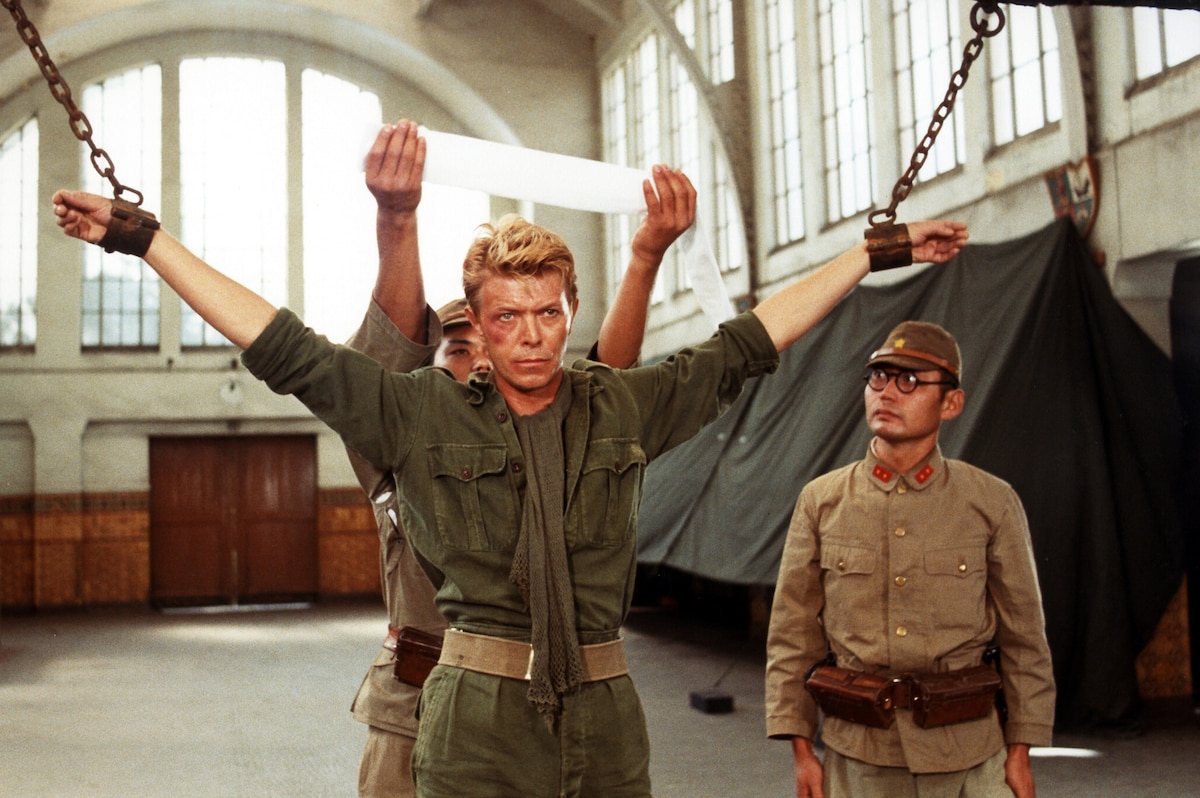
Merry Christmas, Mr. Lawrence was one of the best films of 1983 but you wouldn't know it from its relative obscurity in today's discussions of the best war movies ever made. At the time, it suffered by comparison to The Bridge on the River Kwai (1957), made 26 years earlier and a staple on cable television at the time. But Merry Christmas, Mr. Lawrence is about as similar to The Bridge on the River Kwai as The Longest Day (1962) is to Saving Private Ryan (1998). That is to say, yes, they're both about British soldiers in a Japanese prisoner camp but that's about all they have in common. Merry Christmas, Mr. Lawrence is about divergent cultural traditions, clashing ideologies, sexual tension and friendship in a way that most other war movies only touch upon.
The characters in the camp are Major Jack Celliers (David Bowie), Lieutenant Colonel John Lawrence (Tom Conti), Captain Yonoi (Ryûichi Sakamoto) and Sergeant Hara (Takeshi Kitano). These four characters-- two British, two Japanese-- interact in ways that have nothing to do with military battles of will but instead confusion over intentions, desires and motives. The movie has little, if anything, to do with war and everything to do with the relationships of the men.
All four leads do exceptional work, but it should be noted that Bowie, coming off his Broadway success in The Elephant Man, proved once again that he was as natural an actor as he was a musician and artist. In fact, if anything, it confirmed that Bowie was one of the most talented artists of the 20th century, woefully underused as an actor when his gifts were obvious from the start.
Tom Conti is perfect, as is Takeshi Kitano but special attention should also be paid to Ryûichi Sakamoto, who not only acts in the movie but provided the musical score, his first musical score. Four years later, his score for The Last Emperor, composed with David Byrne and Cong Su, would win an Oscar. He would go on to do the score decades later for another Oscar winner, The Revenant (2015).
The director of the film, Nagisa Ôshima, who also co-wrote the screenplay, was previously known for the provocative and controversial In the Realm of the Senses (1976), a film that dealt with such explicit sexual themes that most countries and film festivals showed it in edited forms, while Belgium outright banned it. Merry Christmas, Mr. Lawrence didn't have that kind of controversial content but is perhaps more provocative a film in terms of ideas.
Having both Bowie and Sakamoto alone should make Merry Christmas, Mr. Lawrence a must see but there's so much more to take in with this film. From the great performances to the spiritual and cultural themes, from the direction to the music, there is a lot more to recommend with this film than most others. It's too bad it has taken so long for everyone to catch on.
Director: Nagisa Ôshima
Produced: Terry Glinwood, Masato Hara , Geoffrey Nethercott, Eiko Oshima, Jeremy Thomas
Writing: Nagisa Ôshima, Paul Mayersberg
Music: Ryûichi Sakamoto
Cinematography: Tôichirô Narushima
Film Editing: Tomoyo Oshima
Production Design: Shigemasa Toda
Art Direction: Andrew Sanders
Cast: David Bowie (Celliers), Tom Conti (Lawrence), Ryûichi Sakamoto (Yonoi), Takeshi Kitano (Hara), Jack Thompson (Hicksley), Johnny Ohkura (Kanemoto), Alistair Browning (De Jong), James Malcolm (Celliers' Brother), Chris Broun (Celliers 12 Years), Yûya Uchida (Commandant of Military Prison), Ryûnosuke Kaneda (President of the Court), Takashi Naitô (Lieutenant Iwata), Tamio Ishikura (Prosecutor), Rokkô Toura (Interpreter), Kan Mikami (Lieutenant Ito)
By Greg Ferrara
Merry Christmas, Mr. Lawrence
by Greg Ferrara | November 22, 2019
SIGN UP FOR OUR NEWSLETTERS

CONNECT WITH TCM