Although it's pretty tame by today's
standards, Edward Albee's drama Who's
Afraid of Virginia Woolf? sparked a lot
of controversy when it premiered on
Broadway in 1962, and again when Mike
Nichols's movie arrived in 1966.
As a stage production, it started off with
a bang, winning the Tony and New York Drama
Critics' Circle awards for best play of
1962. Then it won the Pulitzer Prize for
Drama-until the Pulitzer advisory board
vetoed the accolade, complaining about the
play's foul-mouthed dialogue and oversexed
atmosphere. Score one for the
puritans.
As a film, Who's Afraid of Virginia
Woolf? broke Hollywood taboos by
spewing words like "bugger" and "goddamn,"
becoming the first picture released to
theaters with an adults-only warning tag.
But aside from that, the puritans didn't
win this round. The movie got enthusiastic
reviews, racked up good box-office grosses,
and earned a whopping thirteen Academy
Award nominations, five of which turned
into wins. Along with the European art film
Blowup, which included female
nudity, it put a final nail into the coffin
of the Production Code censorship office,
paving the way for the MPAA ratings system
inaugurated two years later.
Nichols's movie, available on DVD from
Warner Bros. Home Video, stays quite close
to Albee's play, focusing on two married
couples who cuss, taunt, bicker, and battle
their way through a long, hard-drinking
night in an old house on a college campus.
The home belongs to George, a middle-aged
professor with a stalled-out career, and
Martha, whose fondness for fighting words
is exceeded only by her taste for
alcohol.
Their guests for the evening are Nick, a
newcomer to the faculty, and Honey, a
vulnerable loser who's extremely bad at
holding her brandy. Fueled by booze and
cigarettes, the four of them lurch through
a series of abusive verbal games. By the
end of the party we realize that George and
Martha are linked by equal measures of love
and hostility, and that no matter how
well-matched Nick and Honey seem at first
glance, their marriage probably won't last
another year. We also learn that George and
Martha share a deeply concealed secret, and
its revelation marks an unsettling change
in their emotional future.
Preproduction of the film was almost as
dramatic as Albee's play. After deciding
that the Broadway hit could be adapted into
a first-rate movie, writer-producer Ernest
Lehman acquired the rights and Warner Bros.
honcho Jack Warner told Albee he wanted to
cast Bette Davis and James Mason in the
leads. This was a great idea-in the first
scene Martha does a wild Bette Davis
imitation-but Lehman wanted Elizabeth
Taylor and Richard Burton, a dream team
from the publicity angle, since their
high-voltage star power and increasingly
rocky marriage were getting ink in every
publication around.
They jumped at the parts. Then the quirky
stage actress Sandy Dennis agreed to play
Honey, and George Segal took on Nick after
Robert Redford rejected the role because he
thought the character's constant
humiliation would be bad for his image. In
its riskiest choice, the studio asked young
Mike Nichols to direct-it was his first
movie-and he immediately said yes, even
though this meant postponing his own
production of The Graduate for a
year.
Although the play's reputation for rough
language and sexual hijinks gave Who's
Afraid of Virginia Woolf? lots of free
publicity, everyone at Warner Bros. knew
the dialogue would have to be toned down.
Lehman adapted the script himself, opening
the story up with scenes in new locations
(a car, a backyard, a saloon) and making
numerous changes that Nichols promptly
unmade, preferring to stay as close as
possible to Albee's original. It's a good
thing he did, since at least one of
Lehman's changes-transforming George and
Martha's secret from a pathetic fantasy to
a run-of-the-mill misfortune-would have
destroyed a key element of the drama's
metaphorical meaning.
As things turned out, the movie keeps the
play's corrosive cleverness and scalding
wit mostly intact, preserving the tone of
its blistering language, if not all of the
razor-sharp dialogue. Taylor and Burton are
absolutely perfect as Martha and George,
giving the best screen performances of
their careers-even though, as Albee points
out in a DVD extra, Taylor was twenty years
too young for her part and Burton was five
years too old for his. Nichols's directing
is brilliant, especially for a debut film,
and Haskell Wexler richly deserved his
Oscar for best black-and-white
cinematography. (This was the last year
separate Oscars were given for color and
black-and-white camerawork.)
Who's Afraid of Virginia Woolf? is
the high point of Warner's marvelous
Elizabeth Taylor & Richard Burton Film
Collection, which also includes the
duo's two previous pictures, The
V.I.P.s and The Sandpiper, and
The Comedians, made in 1967. Among
the extras are two commentary tracks--one
by Wexler, who discusses everything from
technical matters to gossip, and one by
Nichols, who talks with Steven Soderbergh
about the picture's history. Both
commentaries are worthwhile, partly for the
information they provide and partly for the
disagreements they reveal. For example, a
couple of exterior shots show George and
Martha's car parked in the driveway with
its right-turn signal still blinking.
Wexler takes great pride in saying this was
his idea, while Nichols says it was
his brainstorm, planned weeks in
advance.
Who's right? It doesn't matter, but it's
fascinating to hear such diametrically
different accounts. It's even more
fascinating to hear Nichols admit how
ignorant he was about filmmaking at the
time-worrying that if he set up a tight
shot in a doorway, for instance, the
opening door might knock the camera for a
loop. (He hadn't heard about long lenses
yet.) This kind of good-natured candor is
what high-level commentary tracks are all
about, and Nichols's dialogue with
Soderbergh is an excellent specimen,
supplementing an excellent movie.
For more information about Who's Afraid
of Virginia Woolf?, visit Warner
Video. To order Who's Afraid of
Virginia Woolf?, go to
TCM
Shopping.
by Mikita Brottman and David Sterritt
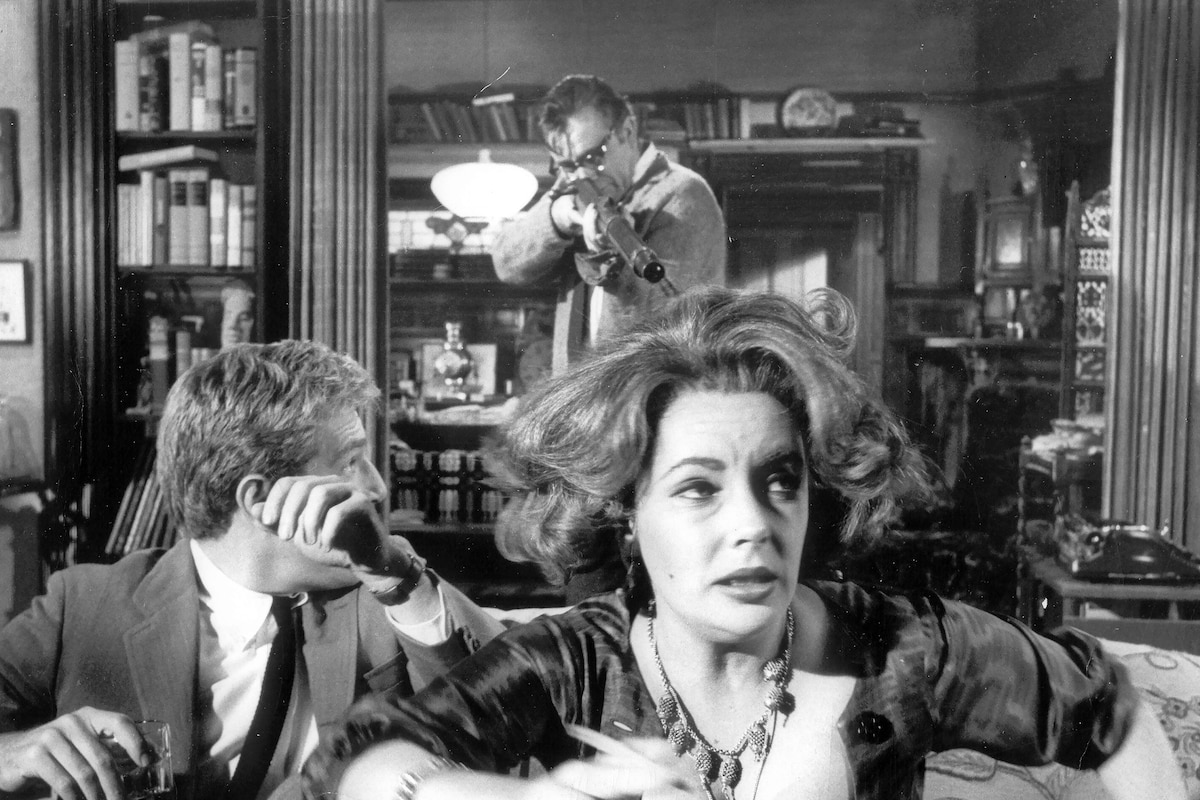
Who's Afraid of Virginia Woolf? - Elizabeth Taylor and Richard Burton in WHO'S AFRAID OF VIRGINIA WOOLF? - Special Edition on DVD
by Mikita Brottman and David Sterritt | January 25, 2007
SIGN UP FOR OUR NEWSLETTERS

CONNECT WITH TCM