Alice Faye's sixth and final pairing with Don Ameche turned out to be one of their best, a
delightful piece of escapism now available on DVD. What makes That Night in Rio (1941)
especially satisfying is that it has a clever and funny story to go along with its musical
numbers. In fact, it's as much a screwball comedy as it is a musical.
The plot (a close remake of the 1935 film Folies Bergere, starring Maurice Chevalier)
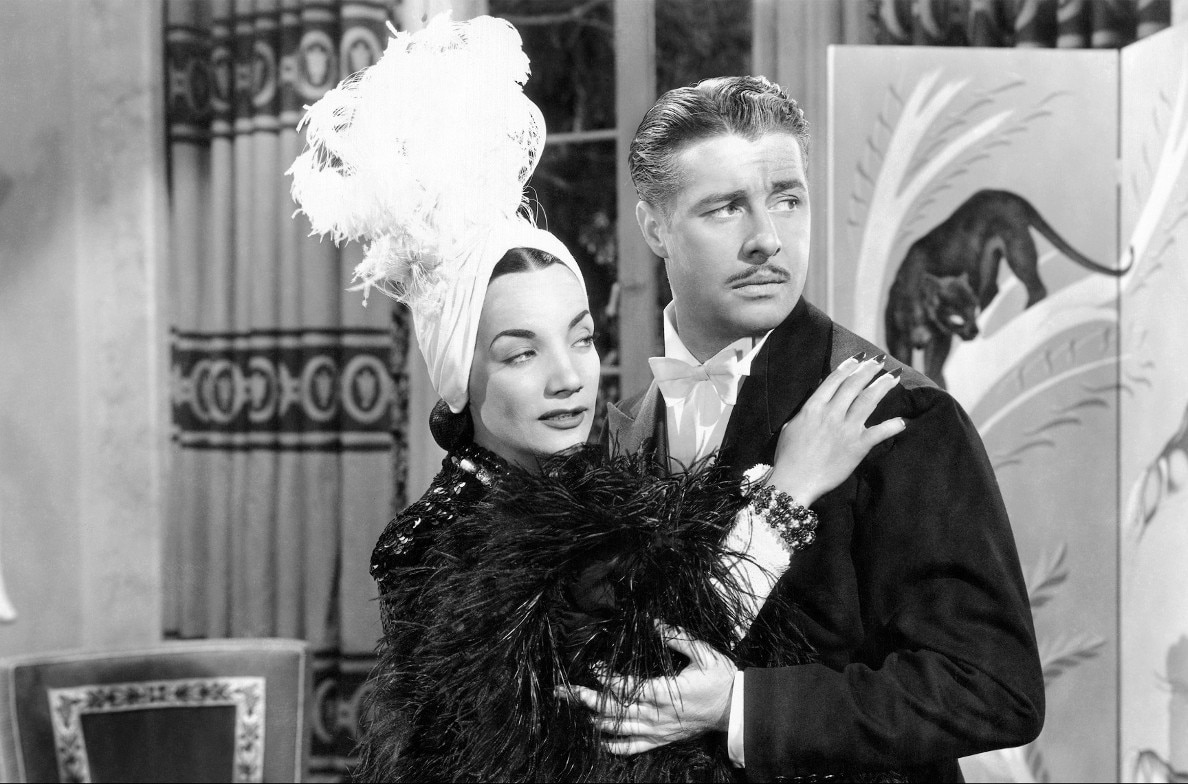
finds Don Ameche in a dual role: he's debonair businessman Baron Duarte, as well as nightclub
performer Larry Martin, famed for his uncanny impersonation of the baron. When the baron's
important business deal goes awry, he must leave town to raise some emergency cash. Fearful
that knowledge of his absence would cause a stock meltdown, the baron's minions (including
S.Z. Sakall) hire Larry to impersonate him for real. The baron's estranged wife, Cecilia
(Alice Faye), finds out about this plan but doesn't at first let on that she knows, while
Larry's girlfriend Carmen (Carmen Miranda) loses her fiery temper when she catches him with
Cecilia. It's only a matter of time before the baron returns and everything gets even more
mixed up, with both Don Ameches flirting with both women, and delicious double entendres
flying all around (which actually pushed the limits of the production code once or
twice).
Ameche has far more screen time than Faye in this picture, and he is wonderfully appealing.
He later called That Night in Rio his favorite of all his movies. Faye doesn't sing
much - her character is not a performer like Ameche's or Miranda's - but she looks great and
is as captivating as ever in her second Technicolor film. (Hollywood Cavalcade, 1939,
was the first.) Faye biographer Jane Lenz Elder has written that one outfit worn by Faye in
this movie was "perhaps the most lustrous ensemble [she] ever wore in films" - a gold lame
evening dress and an elaborate jeweled necklace. Elder quotes one critic's description of it
as "a scandalous dress [she] fills to overflowing." Faye had by now been divorced from Tony
Martin, and during filming she was introduced to bandleader Phil Harris; the two were soon
married, and their union would last 54 years.
This was Carmen Miranda's second American picture, following Down Argentine Way
(1940), and she was already extremely popular. Here she performs three numbers, including the
famous "I Yi, Yi, Yi, Yi (I Like You Very Much)." The entire score by Mack Gordon and Harry
Warren is bouncy and pleasing; it doesn't have many songs, but it does have good ones
including "Chica Chica Boom Chic," "They Met in Rio," "Boa Noite (Good Night)", and "Cai-Cai"
(another Carmen Miranda number). The opening number, "Chica Chica Boom Chic," is so
spectacular that the movie never tops it. Miranda, Ameche and an army of dancers wearing
every color of the rainbow sing and dance their way through Hermes Pan's elaborate
choreography with mighty zest, and the sequence goes on far longer than you'd expect - not
that you'll be complaining.
Also in the cast is Maria Montez in a small role as a dancer whom the baron recognizes as an
old flame just from seeing her legs! And supposedly Tyrone Power is there in the nightclub
scene, somewhere, though this reviewer couldn't find him. As a joke, Power visited the set
and inserted himself into the background of a shot without telling director Irving
Cummings.
That Night in Rio's glamorous costumes, sets, and makeup in Fox Technicolor have all
been preserved by the excellent transfer. The movie is available as a stand-alone DVD and as
part of Fox Home Entertainment's The Alice Faye Collection, a set which also includes On
the Avenue (1937), Lillian Russell (1940) and The Gang's All Here (1943).
Gang's, unfortunately, has received only a middling-quality picture transfer, but the
other titles look mostly good and come with many bells and whistles.
The extras packaged with That Night in Rio include a stills gallery, a trailer, a
restoration comparison, a deleted musical number between Faye and Ameche, and a loving
featurette called Alice Faye - A Life Off Screen. This provides a vivid sense of her
life and values, and includes coments from her daughters and various historians. After
leaving Fox in 1945, Faye returned to radio and had a successful weekly show with husband
Phil Harris. (Excerpts are included here.) She returned to the studio in 1962 for the movie
State Fair, which she regretted, and in her later years became a spokeswoman for
Pfizer, traveling the country and encouraging older women to stay active. She even appeared
in a 20-minute short film for the company in which she reminisced over her career and
introduced her favorite clips while also talking up the health benefits of physical activity.
The short can be seen as an extra on another disc in the collection.
As for the deleted number, it's a reprise of "Chica Chica Boom Chic," and while it isn't that
revelatory, it's still nice to see a little bit of dancing from Faye because there isn't any
in the finished film.
For more information about That Night in Rio, visit Fox Home Entertainment. To order That Night in Rio, go to
TCM Shopping.
by Jeremy Arnold
That Night in Rio - Alice Faye & Don Ameche in THAT NIGHT IN RIO on DVD
by Jeremy Arnold | January 25, 2007
SIGN UP FOR OUR NEWSLETTERS

CONNECT WITH TCM