Producer George Pal's elaborate H. G. Wells adaptation The Time Machine was produced at Metro-Goldwyn-Mayer in 1960; the costly film was a big hit thanks in part to an extensive publicity campaign by MGM. Low budget studio AIP (American International Pictures) was able to piggyback on that publicity by distributing their own time travel picture, Beyond the Time Barrier (1960) at nearly the same time in July of 1960. Better yet, AIP did not even have to produce the film themselves--they acquired it by paying little more than lab costs. The movie they sent out to drive-ins and small theaters that summer was an ambitious science fiction entry--independently produced outside of Hollywood but helmed by a soon-to-be-favorite cult director, strikingly designed by an Academy Award winner, and featuring makeup by one of the most respected artists in movie history. Despite the storied personalities involved with the production, Beyond the Time Barrier remains obscure to this day.
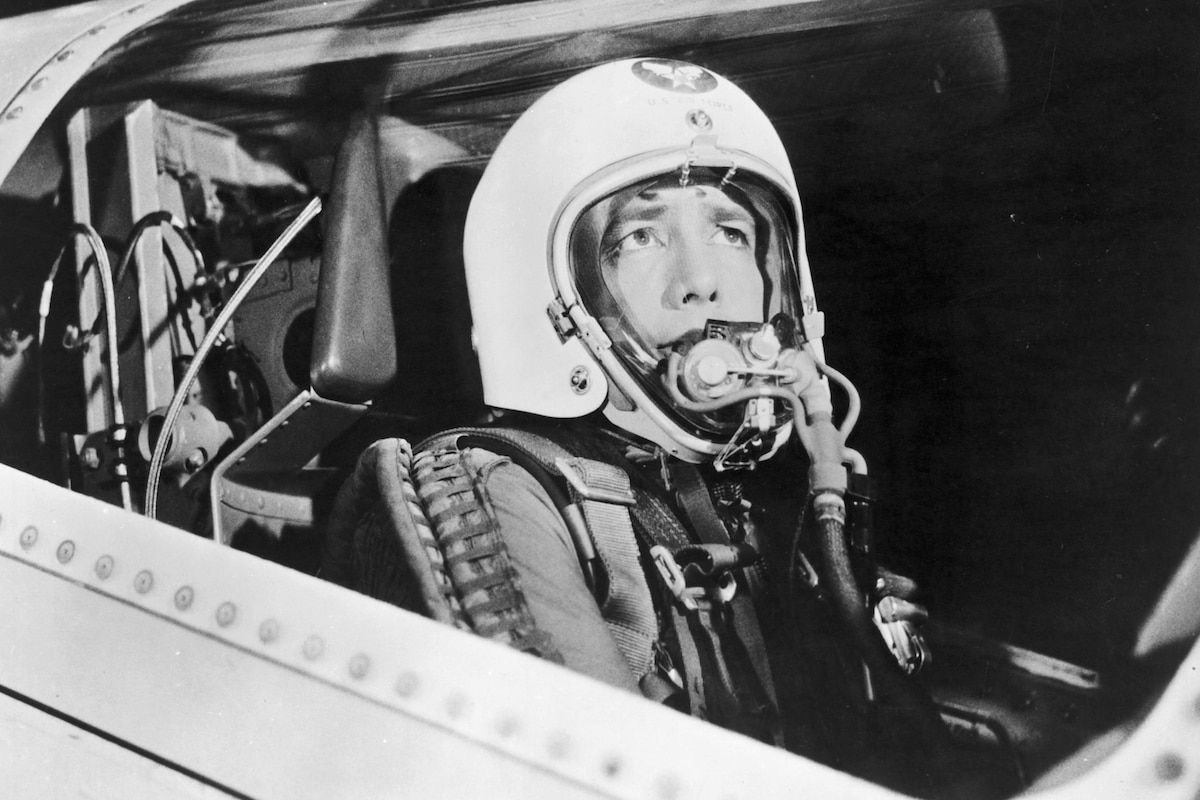
Synopsis: In 1961, Air Force test pilot Major William Allison (Robert Clarke) takes off from Sands Air Force Base in an experimental aircraft, the X-80, and heads for the edge of outer space. Testing a new high-speed rocket engine, the craft breaks the time barrier, although Allison is unaware and confused to see the base he took off from deserted and in shambles when he lands. He is captured and taken to an underground Citadel where he is accused of being a spy by the Supreme (Vladimir Sokoloff) and his Captain ("Red" Morgan). Allison is finally told that the year is 2024 and that a plague struck the Earth in 1971 when a buildup of atomic radiation destroyed the ozone layer and cosmic rays bombarded the planet. Survivors went underground; some were heavily-scarred mutants (kept in an enclosed pit in the Citadel), while others became sterile due to the effects of cosmic rays. The Supreme's granddaughter Princess Trirene (Darlene Tompkins) is not sterile and Allison is soon considered a possible means of re-populating the planet. Meanwhile, a trio of renegade time-traveling scientists (Stephen Bekassy, John Van Dreelen and Arianne Arden), also imprisoned as spies, intend to make an escape back to their own time using Allison's aircraft.
Beyond the Time Barrier came about thanks to actor-turned-producer Robert Clarke. In 1958 Clarke produced, directed and starred in a monster-on-the-loose picture called The Hideous Sun Demon. He branched out into producing after acting in (and receiving four percent of the producer's share of the profits from) the inept The Astounding She-Monster (1957); as he wrote in his autobiography, "if a shoestring picture like [that] could make a pile of money, why wouldn't a picture of my own, made with a bit more of an eye toward quality?" While he was correct in his estimation that he could turn out a better monster movie on a low budget, the multi-tasking involved proved to be very taxing. While shopping his film around to distributors, he met the owners of an outfit called Miller Consolidated Pictures, who picked up The Hideous Sun Demon and also brought Clarke on to produce more pictures for their company. Clarke submitted a script he had for a science fiction story called The Time Barrier by a young writer named Arthur C. Pierce. A group of investors from Dallas, Texas chose this script out of a group of four submitted by Miller Consolidated for consideration, and a budget of $125,000 was drawn up to produce the film--on the condition that it would be shot in Texas. ($100,000 was allocated for a second picture, The Amazing Transparent Man, to be shot immediately after with the same crew.)
Clarke had no desire to direct again, so veteran low-budget filmmaker Edgar G. Ulmer was brought on to the project. Clarke had already worked with Ulmer on one of the first science fiction films of the 1950s cycle, the atmospheric The Man from Planet X (1951). Ulmer was nearing the end of his career and just a few years later in the 1960s he would be "discovered" by cinephiles and lauded for such B-movie achievements as Bluebeard (1944), Detour (1945) and The Strange Woman (1946). The lead roles of Beyond the Time Barrier were cast in Los Angeles while secondary parts were filled in Texas. Darlene Tompkins was cast as the mute, telepathic Princess Trirene following an audition for Clarke and Ulmer in which (as she told interviewer Tom Weaver) she "...would have to stare into space like I was looking at somebody, or act as if I saw somebody fall down, or saw somebody crying, or I had to look like I was in love--or whatever--while I stared into space." Tompkins was just one of many young Hollywood actresses who were seen for the part, including Leslie Parrish and--ironically--Yvette Mimieux, who would soon win the role as the female lead in The Time Machine. Ulmer cast his daughter Arianne as the conniving Capt. Markova; she turns in one of the best performances in the film. One of the oddest casting choices (and one Clarke admitted was done to save money) was to give a major speaking role to stuntman Boyd 'Red' Morgan--his Oklahoma drawl seems decidedly out-of-place for a man of the future.
The requirement to shoot Beyond the Time Barrier in Texas proved to be fortuitous in terms of the locations required. The Air Force Base scenes were filmed at Carswell Field in Fort Worth and the dilapidated state of the base as seen in the future was easily simulated by another nearby location: an abandoned World War II-era training field. For the extensive interior shots, there were no large, professional soundstages available so the crew built sets and filmed at the Texas Centennial Fairgrounds in Dallas, where large halls had been erected for the 1936 event. Clarke noted that "the big, barn-like structures looked like warehouses, and somebody had the bright idea that we could use them as soundstages and shoot our underground city scenes there. The only problem was that, when you spoke in those large, empty buildings, your voice sounded as though you were in a giant cave or deep well. The sound man was resourceful, though, and he had the production crew hang a lot of old Air Force surplus parachutes all around to absorb some of the sound."
Pierce's script originally described the underground world of 2024 as rounded stone tunnels, but Ulmer had the idea that they should be more otherworldly and based on science. He wanted the recurring motif of the "look of the future" to take the shape of a triangle. As quoted by Robert Skotak (in his chapter about the film in The Films of Edgar G. Ulmer edited by Bernd Herzogenrath), Ulmer wrote, "The triangle is one of the most important figures in geometry and in higher mathematics... I think that in the future, everything will be built in the most economical form, the most scientifically practical. ...I wanted to use that shape as much as possible. With respect to Beyond the Time Barrier, I [perhaps] overdid myself with the settings." To implement the idea onscreen, Clarke and Ulmer hired Academy Award-winning art director and production designer Ernst Fegte, whose lengthy credits dated to the silent era and included such films as The Lady Eve (1941), I Married a Witch (1942), Five Graves to Cairo (1943), The Uninvited (1944) and Destination Moon (1950). Working with a limited budget but the expansive space in the Fairgrounds buildings, Fegte devised a series of enormous inverted pyramids that repeated the triangle shapes Ulmer desired and could also be rearranged to form alternating corridors and open spaces. They were constructed inexpensively from wood frames covered in muslin. As Fegte related, "I really went back to what I could remember of The Cabinet of Dr. Caligari [1920]--which was a fabulous movie--and things of that nature. The look of these films - the lighting and sets. Expressionistic, yes. And Beyond the Time Barrier conveyed a feeling, the emotions exactly. That's what I tried to do here in a modest way, but I just didn't have the money..." Ulmer's daughter later commented on Beyond the Time Barrier, "Dad chose in this film--not in all of them, but in this film--a real theatrical quality, because it was a minimalistic study, almost a German Expression film, unlike a Detour [1945], where he'd go for a very natural quality. This is much more stylistic..."
Another veteran Hollywood professional was brought to Texas for the filming--makeup man Jack Pierce, a legend in the industry for his work at Universal in the 1930s and '40s on such creations as Frankenstein's monster, the Wolf Man, the Mummy and many other iconic characters. The script called for an old-age makeup, so Clarke hired Pierce, who had been freelancing since the mid-1940s after being ignominiously fired from Universal. Aside from the specialty makeup that was his stock-in-trade, Pierce also worked with Darlene Tompkins, who remembered, "I don't think I've ever seen anyone so happy to be doing that craft. He really loved it, he gave me the impression that this was the most important thing that there was...as opposed to other makeup people I have worked with, people who treat each new assignment as 'just another job.'" Pierce, however, did not do the makeup for the mutants that appeared in the film, who wore ill-fitting bald caps that were not properly blended with makeup. The poor work in the mutant sequence is a distraction and a stark reminder of the inconsistencies that can crop up in low-budget independent productions. As Clarke later remarked, "it was probably the poorest part of the movie."
Ulmer and his team in Texas shot Beyond the Time Barrier (as well as The Amazing Transparent Man) on faith--the footage was shipped straight to the lab in Los Angeles until editing could begin; there were no "dailies" screened in Texas during production. At the same time, the Miller Consolidated owners planned to self-distribute both pictures starting in late 1959. They and their general manager intended to open the films state by state, with big exploitation campaigns for each region. According to Clarke, the first opening in the Northwest was a financial bust due to snowstorms and "practically overnight, Miller Consolidated was on life support." The company could not pay their lab bills, so Sam Arkoff and AIP came in with a proposal to pay the lab fees and take over distribution of both pictures. AIP created new movie poster art for Beyond the Time Barrier and, more significantly, reedited the film to remove a flashback structure that Ulmer had devised, cutting five minutes of running time in the process. To beef up the number of mutants on view in the pit, AIP also edited in some mismatching footage of a group of lepers from Fritz Lang's The Indian Tomb (1959), which they had also recently acquired along with Lang's Tiger of Bengal (1959) and released in 1960 as Journey to the Lost City.
Critical reaction to Beyond the Time Barrier was mostly harsh. To further the "triangle" motif, Ulmer had the lab create triangular-shaped wipes for scene transitions, which was something of a throwback to silent era techniques or something seen in poverty-row movie serials. As the Monthly Film Bulletin commented, "...this tends to make the whole thing seem even more dated than it is." The writer in Daily Variety noted the darkness that Ulmer injected into the story, saying, "The only ingredient that distinguishes this effort from its many predecessors is the presence of a timely moral message... This preach-peace aspect is put over with some impact via the absence of the expected happy ending, but is preceded by too much quasi-scientific mumbo-jumbo and melodramatic absurdity..." The Hollywood Reporter also found fault with the script, saying, "Edgar G. Ulmer directs with what excitement he can, although with no clear conflicts laid out."
Edgar G. Ulmer may have been working at cross purposes in Beyond the Time Barrier, as it turns out. Shirley Ulmer, his wife and longtime script supervisor, once noted that "Edgar was a bleak visionary. The moors. Bronte. Brooding. This was Edgar. He always, always had to go emotionally to the most serious places." Taking the space opera script of Beyond the Time Barrier to a darker place made for a colder, more inaccessible film; it had no chance at the box-office against the warmth and humanity of George Pal's The Time Machine.
Producer: Robert Clarke
Director: Edgar G. Ulmer
Story & Screenplay: Arthur C. Pierce
Cinematography: Meredith M. Nicholson
Music: Darrell Calker
Film Editing: Jack Ruggiero
Production Design: Ernst Fegte
Makeup: Jack P. Pierce
Cast: Robert Clarke (Maj. William Allison), Darlene Tompkins (Princess Trirene), Arianne Arden (Capt. Markova), Vladimir Sokoloff (The Supreme), Stephen Bekassy (Gen. Karl Kruse), John Van Dreelen (Dr. Bourman).
BW-75m.
by John M. Miller
SOURCES:
"A Grave New World: Cast and Crew on the Making of Beyond the Time Barrier" by Robert Skotak, in The Films of Edgar G. Ulmer edited by Bernd Herzogenrath, Scarecrow Press, 2009.
Robert Clarke: To "B" or Not to "B"--A Film Actor's Odyssey by Robert Clarke and Tom Weaver, Midnight Marquee Press, 1996.
Tompkins Talks about Ulmer, Elvis and more--Interview with Darlene Tompkins by Tom Weaver, The Astounding B Monster Archive, www.bmonster.com/cult35
Keep Watching the Skies: The 21st Century Edition, Bill Warren, McFarland, 2010.
Beyond the Time Barrier
by John M. Miller | November 19, 2019
SIGN UP FOR OUR NEWSLETTERS

CONNECT WITH TCM