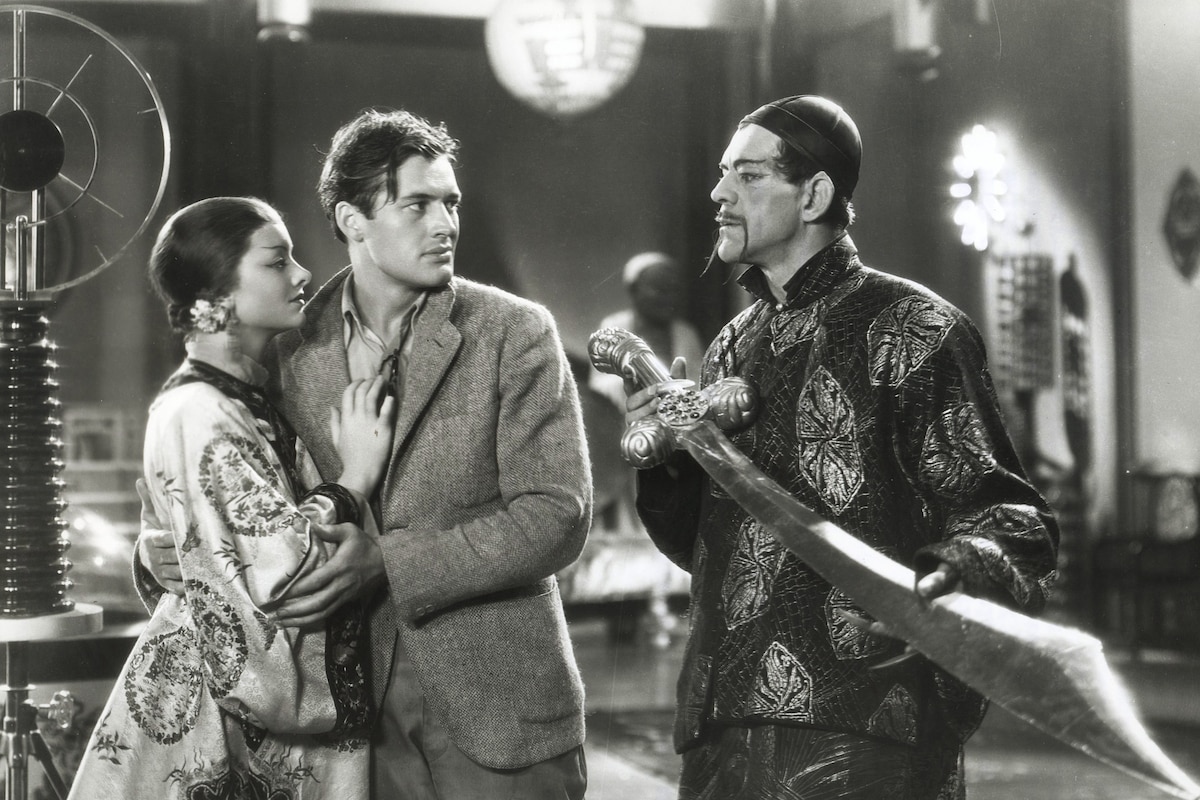
"Kill the white man and take his women!" So intones the "yellow menace" of the insidious Dr. Fu Manchu
as personified by Boris Karloff in this fabulously dishy, and all-too-rarely-seen 1932 thriller from the
Sax Rohmer source-well. Far from an early talkie waiting to be redeemed by the auteur theory, The
Mask of Fu Manchu is a sensational artifact for every reason except its director or directors
(there were three that we know of, in addition to the credited Charles Brabin). It was in fact very much
a calculated and market-driven studio product, one of several efforts MGM made during the first years of
the Depression to jump on the bandwagon driven by Universal's gothic-horror series. Produced by William
R. Hearst's Cosmopolitan Pictures, subject to a protracted and nettlesome shooting schedule, and
pot-stirred by more than the three credited screenwriters (one of whom, Irene Kuhn, was actually a
Hearst columnist for The New York Daily Mirror), the film is no work of art, and much more than
just another nostalgic bask in the gray heaven of '30s genre films. It is, most of all, an act of
popular outrageousness, a mercenary effort at attracting an audience jaded by poverty, hard times and
the excesses of the '20s. The Production Code had yet to fall into place, and studio heads Louis Mayer
and Irving Thalberg saw no reason not to test society's lust, or tolerance, for sex, torture, opium den
decadence, and xenophobic inflammation.
Of course, yesterday's screaming transgression is today's quaint camp, and The Mask of Fu Manchu
is paradise for viewers with a sweet tooth for absurd orientalist exotica played straight (well, more or
less), and remembrances of a day and age when thinly veiled hints of sadomasochism were scandalous. This
wasn't the first Fu Manchu film (it was actually the third American film based on the Rohmer villain; a
Euro-rash of adaptations starring Christopher Lee prospered in the '60s). But it is easily the most
well-known, thanks largely to the lisping Karloff and the retrospectively odd casting of Myrna Loy, two
years away from setting the mold for the ultimate modern wife in The Thin Man, as the Chinese
villain's "ugly and insignificant" nymphomaniac daughter, Fah Lo See. The story is classic Rohmer
nonsense, though not so silly that it hasn't inspired thousands of imitators, George Lucas among them:
holed up in his Gobi Desert fortress, the evil lisping megalomaniac endeavors to retrieve the sword of
Genghis Khan from its newly-excavated resting place, which means kidnapping and torturing various
intrepid British explorers, including stiff-upper-lip hero Nyland Smith (Lewis Stone).
Fu Manchu's ambitions are, of course, world domination and annihilation of the "accursed white race."
The version of the film we get today on DVD hasn't been seen in many years the smugly amused but
informative audio commentary by Greg Mank details the film's long history of erratic censorship, which
leaned toward eradicating cruel violence in the '30s and racial epithets and stereotypes in the '80s
(when the film was trimmed for videotape). Long-taboo scenes of bodily peril and slanderous dialogue are
once again part of the film's crazy fabric. The participation of Hearst, mass purveyor of the "yellow
peril" anti-immigration myth for years in his newspapers, and his columnist/lackey Kuhn, is no
coincidence The Mask of Fu Manchu might stand as the most virulently anti-Chinese film ever
made in Hollywood. At the time, however, trading white-yellow insults in flat-out pulp was A-OK, so long
as the peripheries of the story were tricked up with tarantulas and stainless steel torture devices for
the kids, and came bearing leering innuendo for their parents.
So, it's a sociological goldmine, innocently wallowing in bigotry in the way American culture happily
did until the postwar-WWII years and the awakenings of the civil-rights movement. (Fu Manchu exhorts his
Mongol army into an "uprising" but against what mass contingent of Caucasians, more than three decades
after the Boxer Rebellion, is not clear.) Still, it's difficult to hold the colonialist small-mindedness
of The Mask of Fu Manchu against it, particularly as Fu Manchu's evil minions emerge from museum
sarcophagi dressed as mummies to abduct a unwitting victim, the doctor himself sacrifices one of his
Nubian guards (all posed by designer Cedric Gibbons to resemble Oscar® statuettes) to retrieve
zombiefying snake venom, Fah Lo See practically snarls with feral lust watching the hunky hero get
flogged, and the Sino-Moderno-Art-Deco sets loom over the actors like a child's vision of the Museum of
Natural History. For some, the racy rudeness that so fired Mayer and Thalberg's commercial loins is the
movie's ace in the hole; for others, it's the enduring matinee daydream of torchlit catacombs, nightened
museums, pit helmets, jodhpurs, and booby-trapped marble palaces. Everybody wins.
For more information about The Mask of Fu Manchu, visit Warner Video. To order The Mask of Fu Manchu (which is
only available as part of the Hollywood Legends of Horror box set), go to
TCM Shopping.
by Michael Atkinson
The Mask of Fu Manchu - Boris Karloff in THE MASK OF FU MANCHU on DVD
by Michael Atkinson | January 19, 2007
SIGN UP FOR OUR NEWSLETTERS

CONNECT WITH TCM