With a title like Macao (1952) and a directing credit for Josef von
Sternberg, one might be forgiven for anticipating a film like the exotic
Sternberg productions of old, such as Shanghai Express (1935). But
the more important credit on Macao is that of the producer: Howard
Hughes. This is a Hughes production all the way, which means less
coherence and more over-the-top sensationalism. Sternberg, in fact, didn't
even complete work on the picture.
Macao, now available on DVD, stars Robert Mitchum and Jane Russell,
who had just appeared together in another Hughes production, His Kind of
Woman (1951). Macao is not as good a movie, but it's still
somewhat mysterious and provides another enjoyable pairing of the two
stars, who do make a great team. As commentator Eddie Muller says on his
audio track, Russell is "the female equivalent of Mitchum" with her
wisecracks and "tough-dame" demeanor.
Things start off on a tasty note with Mitchum happening by the ship cabin
where Russell is being manhandled by a lecherous oaf. Mitchum rescues her
and knocks the guy out, only to be pickpocketed by Russell. From then on,
they and another passenger, William Bendix, become caught up in a plot
involving stolen diamonds and mistaken identities in the East Asian port of
Macao, whose underworld is run by gambling house owner Brad Dexter. Gloria
Grahame is on hand as Dexter's girlfriend, and she is positively stunning;
unfortunately she isn't given much to do.
Josef von Sternberg was working infrequently at this point in his career
but still imposed his usual dictatorial rules on his cast and crew, such as
positively no eating or drinking on set. Mitchum finally brought in a
picnic basket one day and handed out food to everyone. "Do you want to get
fired?" Sternberg threatened. "No," said Mitchum, "you'll get
fired."
Alain Silver and Elizabeth Ward, in their book Film Noir: An
Encyclopedic Reference, say that Nicholas Ray was hired to re-shoot
almost the entire movie, while Andrew Sarris, in his book The Films of
Josef von Sternberg, writes that Ray merely took over "in the last
stages of production," shooting scenes like the climactic fistfight between
Mitchum and Dexter. ("This sort of thing was never Sternberg's cup of tea,"
Sarris notes.) For his part, Sternberg later wrote that the picture "was
made under the supervision of six different men in charge... Instead of
fingers in that pie, half a dozen clowns immersed various parts of their
anatomy in it. Their names do not appear in the list of credits."
In any event, Sternberg was indeed replaced at some point by Ray, and all
that remains of Sternberg's presence are glimmers of his old trademark
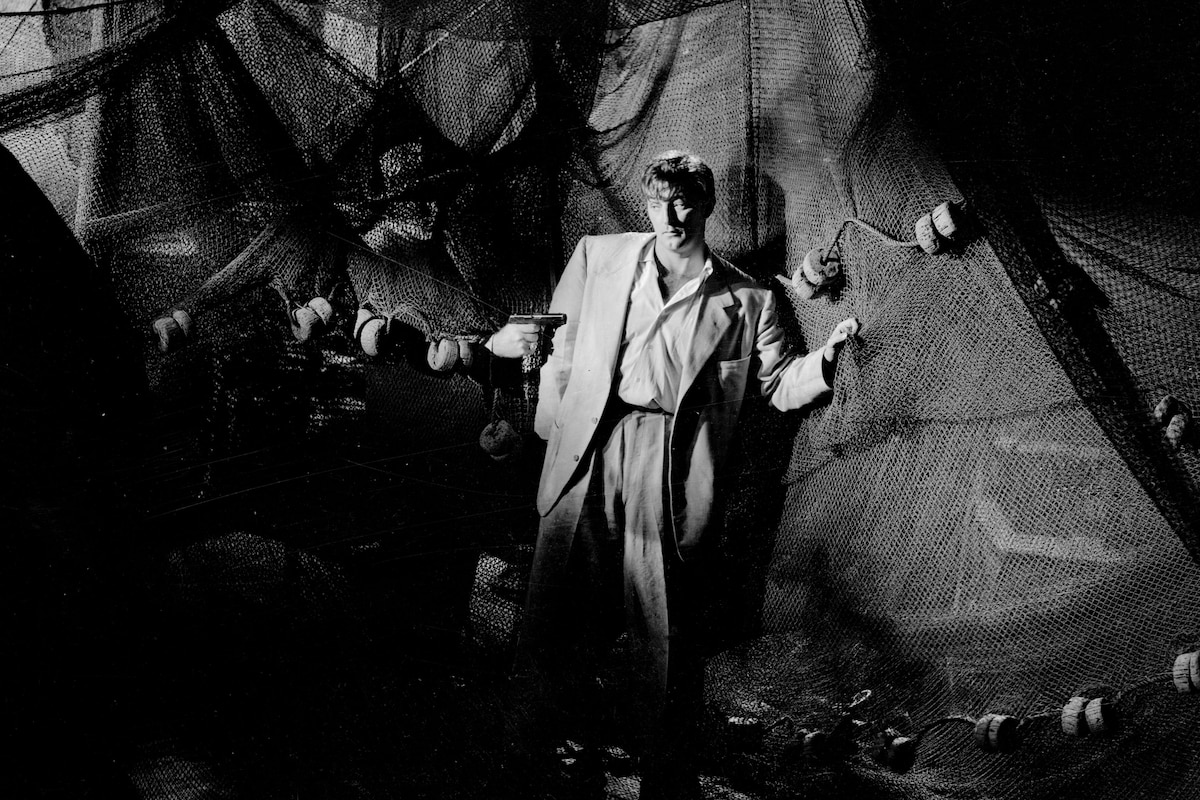
visual style. One can see it in the scenes at the docks, with shots made
through netting or veils; in a few shots on the street crammed with extras
in a Far East setting; and in shots of a gambling house with baskets
dropped down from above to pick up money, a la The Shanghai Gesture
(1929). But these are mere sporadic moments, and Macao really is not
a major Sternberg film in any way, shape or form.
On the DVD's very worthwhile commentary track, film noir authority Eddie
Muller discusses the movie with its writer, Stanley Rubin; occasional and
welcome comments by Jane Russell are edited in. The commentary is not
scene-specific, with the men instead going over the movie in general and
touching on a host of tangential subjects such as Howard Hughes, stories
about the stars (that lucky devil Rubin briefly dated Gloria Grahame), and
Rubin's career.
Rubin was attached to produce Macao as his first such effort, but
when Mitchum and Russell came on board, the studio decided it was too big a
picture for an inexperienced producer. Ultimately Rubin agreed to produce
The Narrow Margin (1952), a B film, instead -- a good transaction,
for The Narrow Margin is one of the finest noirs ever made, a movie
that moves like lightning from beginning to end. It also singlehandedly got
Rubin a new contract at Fox when Darryl Zanuck saw it and was impressed.
That was fortuitous for at around this same time, Rubin had a creative
falling-out with Howard Hughes over another picture, The Whip Hand.
(Rubin ended up taking his name off that film altogether.) Rubin is
eminently clear and lucid while relating all these tales, and Muller also
knows his stuff. Strangely, however, there is no discussion of Sternberg
being replaced by Nicholas Ray until Jane Russell refers to it in her
closing comment.
Also included on the DVD are a trailer and an episode of TCM's "Private
Screenings," with Mitchum and Russell interviewed by Robert Osbourne.
Mitchum recalls how he rewrote a few scenes for Macao after Nick Ray
took over the directing reigns. Mitchum and Russell remained great friends
right up to Mitchum's death.
Macao is available individually or as part of Warner Home Video's
Robert Mitchum: The Signature Collection, which also includes
Home From the Hill (1960), The Sundowners (1960), The Good
Guys and the Bad Guys (1969), The Yakuza (1975), and the
masterful film noir Angel Face (1952), a true must-see directed by
Otto Preminger. A number of commentaries and featurettes abound. Technical
quality and artwork are tops.
For more information about Macao, visit Warner Video. To order Macao,
go to
TCM Shopping.
by Jeremy Arnold
Macao - Robert Mitchum & Jane Russell in Josef von Sternberg's MACAO on DVD
by Jeremy Arnold | January 08, 2007
SIGN UP FOR OUR NEWSLETTERS

CONNECT WITH TCM