As producer Howard W. Koch described the arrangement with UA, the title of the picture came first: "We'd get a title, we'd show it to United Artists, and they'd say, 'Here's x number of dollars, go make it.' Then we'd write a script for it, check one member of the cast with UA, and then shoot the picture."
Allen Miner was the first scheduled director for The Black Sleep but he was replaced with Reginald Le Borg, because of Le Borg's previous experience in directing horror movies.
At the scripting stage, director Le Borg added the motivation for Dr. Cadman's experiments: "...I wrote the scene where Rathbone vows to his comatose wife that he is going to do everything he can to bring her back to life, even if he has to kill people to do it. You have to get empathy for a person like that. I think the scene helped the picture because it gave him stature - he wasn't just a madman."
The Black Sleep was filmed at Ziv studio in Hollywood, in February, 1956. The shooting schedule was just 12 days. The film was budgeted at $229,000. (Ultimately, the picture would come in $6,000 over budget, or at $235,000).
Producer Howard W. Koch on Lon Chaney: "...we really had a great relationship. He said to me, 'Look, I'll do anything you want. I know you guys have no money - just tell me how much and I'll show up.' Lon was also an amateur chef - he made the best chili in the world. If you loved his chili, he loved you."
Producer Howard W. Koch on John Carradine: "He was always a shifty kind of guy in life, and by 'shifty' I definitely do not mean that he was dishonest. But he lived the make-believe world of the actor. He really lived in a world of his own, in a dream world, and never faced reality."
While The Black Sleep is a bloodless movie, it does contain a very startling sight for a 1956 film: an exposed brain seeping cerebral fluid. Director Le Borg consulted with a neurosurgeon who described the fluid. On the set, "...we had a special effects man put a sponge and a hose beneath the operating table and, on cue, he had to squeeze the fluid out of the sponge through the hose and out the brain. That was a different type of horror..."
For the close-ups of Dr. Cadman's hands performing surgery on a prop exposed brain, an actual surgeon was used as a stand-in for Basil Rathbone.
The memorable makeups of Dr. Cadman's brain surgery victims were designed by California actor and artist (Nick) Volpe. As producer Howard W. Koch said: "He'd read the scripts and then he would draw the characters. Then we'd dress and make up the actors the way he drew them. A very interesting guy; he worked for no bucks, too, very inexpensively. But it helped us - we weren't the great talents of all time. We really needed his direction. ...today we'd have gotten an award for best makeup, because it was made for spit."
The Black Sleep was Bela Lugosi's first and only complete film role following his release from a Los Angeles hospital for drug detoxification; he had been addicted to morphine since the mid-1940s. He hoped that the film would be just the beginning of a comeback. Speaking to a reporter on the set, Lugosi said, "I keep telling myself I must believe I will make the grade again. If I stop believing for even a minute I find myself sinking into despair. It's fighting this feeling - a thing that comes to all former drug addicts - that saps my energy....God has been good and given me this second chance, and I'll do my best not to fail."
Bela Lugosi was very frustrated at not having any lines to speak in the The Black Sleep. He would plead with the director daily to be given some dialogue, ignoring the fact that it was integral to the plot that his character be mute. Lugosi admitted to a reporter that "...even with no lines to speak it's tiring just getting to the set each day. But everyone is kind and it's good to be working with old friends."
To placate Bela Lugosi's pleadings for a bigger part, director Le Borg shot a few close-ups of the actor. They were not used in the final film.
Director Reginald Le Borg on his cast of horror stars: "...each one wanted to steal the scene from the others. When they were together in a scene, each one tried to overact, and I had to hold them down because that would have spoiled the picture. At the end, when the monsters escape into the tower with Carradine shouting 'Kill! Kill! Kill!' they were all overacting in some way, but I let it go because it was an exciting scene and the end of the picture..."
Of the horror legends in the cast of The Black Sleep, the greatest animosity on view was between Bela Lugosi and Lon Chaney, Jr. Some felt there was lasting resentment over Chaney having inherited the Dracula role at Universal in Son of Dracula (1943). Witnesses on the set often saw words exchanged between the two - Chaney consistently referred to Lugosi as "Pop." According to set visitor Forrest J. Ackerman, on one occasion Chaney "...grabbed hold of poor Bela, who was not much more than a bag of bones, and flung him over his shoulder like a gunnysack!" Director Le Borg had to admit, "We kept them apart quite a bit."
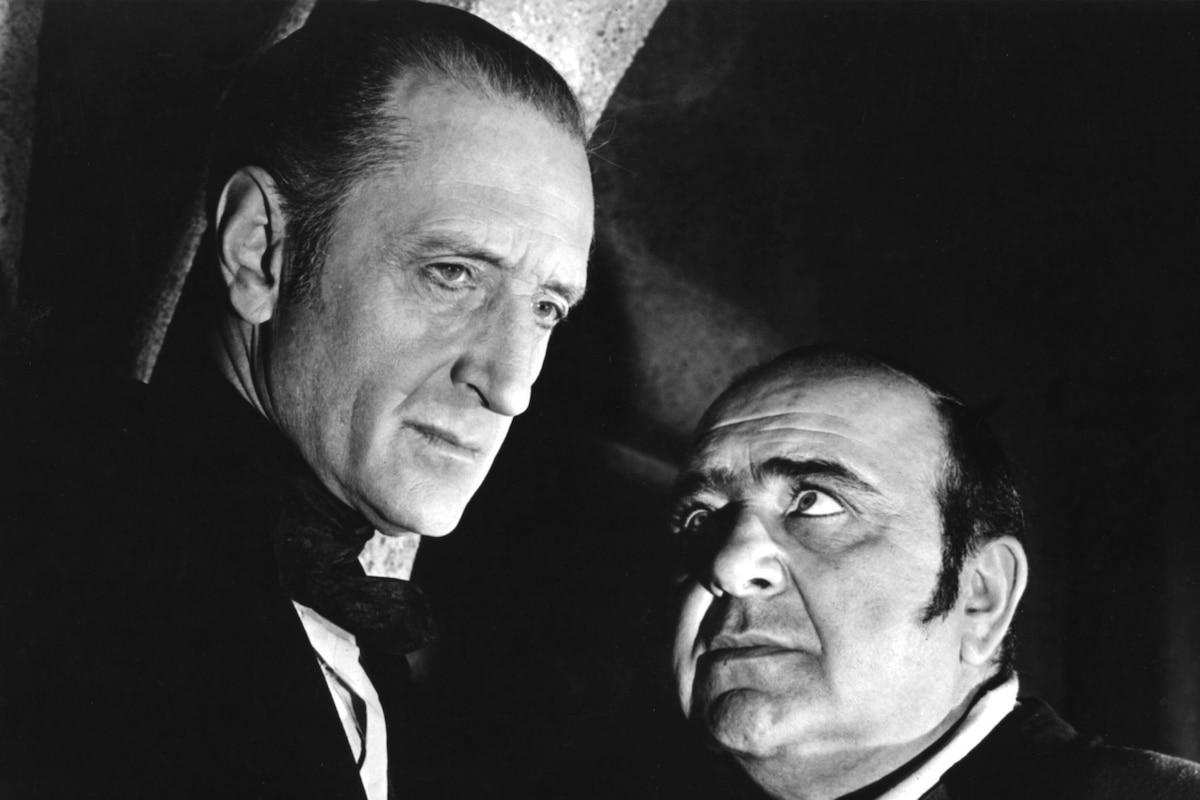
Director Reginald Le Borg recalled that Basil Rathbone would berate himself vocally if he blew a line. The cast and crew overheard Rathbone, after having problems during a long speech, angrily saying "Damn it, Basil! Get it right next time!"
Bela Lugosi's fifth and last wife, Hope, visited the set and later remarked that Lon Chaney "had big problems" with drinking, and, in fact, "They all drank like fish."
Director Reginald Le Borg later told interviewer Tom Weaver: "John Carradine I enjoyed working with, because he'd drink and then start spouting Shakespeare. When we finished shooting The Black Sleep, we had a party on the set and he imbibed quite a bit and started to do Shakespeare. I knew a little bit of Hamlet and joined in myself. He took me around and we spouted together. It was funny; he does become boisterous."
Compiled by John M. Miller
SOURCES:
AFI
The Films of Basil Rathbone: His Life and His Films by Michael B. Druxman
The Psychotronic Encyclopedia of Film
The Immortal Count: The Life and Films of Bela Lugosi by Arthur Lennig
Attack of the Monster Movie Makers: Interviews With 20 Genre Giants by Tom Weaver
The Horror People by John Brosnan
The Monster Show: A Cultural History of Horror by David J. Skal
John Carradine: The Films by Tom Weaver
Insider Info (The Black Sleep) - BEHIND THE SCENES
by John M. Miller | January 02, 2007
SIGN UP FOR OUR NEWSLETTERS

CONNECT WITH TCM