Prehysteria! (1993), Prehysteria! 2 (1994), Robot Jox 2 (1993), Ghoulies II (1987), Dracula's Dog (1978)...these are the titles horror fans associate with Albert Band. Add in the ones he produced and you can append the likes of Castle Freak (1995) and Zarkorr! The Invader (1996) to the list. And as a writer, The Red Badge of Courage (1951) for John Huston.
Wait a minute!
Yes, Mr. Albert Band has a schizophrenic addlepated CV, reflecting a catch-all career that spanned six decades, four countries, and more genres than you even knew existed.
The Albert Band Story starts in Paris, where the artist as a young man first got his start in the movies as an editor for the world's first movie studio, Pathé. By 1940, Band had emigrated to the US to take work in Hollywood as John Huston's assistant, gopher, and punching bag. As Huston's mistreated factotum he helped make The Asphalt Jungle (1950), scripted The Red Badge of Courage, and then graduated to solo director for his debut The Young Guns (this is the 1956 Russ Tamblyn-Gloria Talbott-Myron Healey one, not the 1988 Emilio Estevez-Charlie Sheen-Kiefer Sutherland one).
A few years after making I Bury the Living (1958), Band moved back to Europe: first to Sweden, and then to Italy. There he would specialize in Sword-and-Sandal pictures and Spaghetti Westerns. It is on the set of Hercules vs. the Sea Monster (1965) and The Tramplers (1966) that his kids would grow up. Richard Band would eventually turn his talents to composing film soundtracks, while Charles Band would found Empire and Full Moon Entertainment, producing and directing a popular run of low-budget direct-to-video thrillers. Albert Band would come to work for his son, directing the likes of Dracula's Dog for Charles' company.
Of all these varied experiences, posterity has nominated I Bury the Living as Albert Band's claim to fame. It was written and produced by Louis Garfinkle, who had his moment in the sun as one of several Oscar®-nominated screenwriters on the 1978 The Deer Hunter. His work on I Bury the Living won him no awards, but it displays the sure hand of a talented writer with a gift for authentic dialogue.
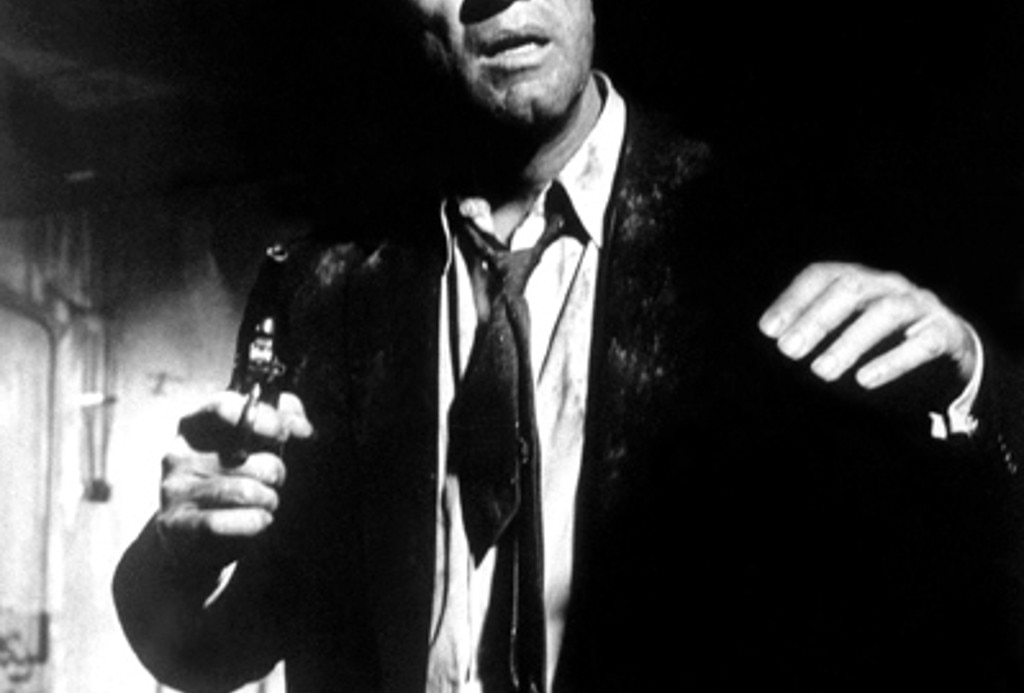
Perhaps that "authentic dialogue" would have sounded bizarre or goofy in the mouth of lesser actors, but Garfinkle and Band took pains to cast some talented folks-chief among them, Richard Boone, a craggle-faced middle-aged TV star who was a direct descendant of pioneer hero Daniel Boone. You don't look at that asteroid-like visage and think "movie star," but that's precisely his appeal-the guy seems genuine. Think Dennis Franz or Jerry Orbach-big time TV stars with serious acting chops but no more glamour than a janitor.
From 1954 to 1956 he starred in the grittily realistic hospital drama Medic. Boone's performance as Dr. Konrad Styner was so iconic, he was nearly typecast in doctor roles-if he hadn't gone and been an even bigger star in a completely different kind of role shortly thereafter. As the star of Have Gun Will Travel, Boone played a gentleman sociopath, your friendly neighborhood contract killer, in one of the nation's top rated shows.
In the 1950s, Westerns were the top draw-the equivalent kind of pop cultural phenomenon that reality TV is now. And Have Gun Will Travel was among the most popular TV westerns. So putting Richard Boone in your low-budget horror movie is attention-getting stunt casting along the same lines as putting Paris Hilton in House of Wax (2005)....except Boone could act.
Man could he act. A couple of years later he'd get his own show, The Richard Boone Show, written by the brilliant playwright Clifford Odets, in which CBS basically paid Boone to come in each week and show off what a hotshot thespian he was.
He uses those skills well in I Bury the Living, which is really an 80-minute long study of his character's deteriorating sense of self. His corrugated looks and smoke-ravaged voice are so far off from conventional Hollywood, if you can get past the implausibility of his being engaged to Peggy Maurer (reasonably attractive, unblemished, half his age) you can actually start to believe these disquieting things are really happening.
In an odder casting choice, Theodore Bikel plays Groundskeeper Andy, the allegedly ancient Scots caretaker. We are told Andy has been at his job for over forty years, but Bikel is ten years younger than Boone. And he's no Scot, Bikel's Austrian. But instead of hiring an elderly Scots actor for the role, they put Bikel in "old man" makeup and had him talk in an almost cartoonish Scots brogue. Why? Because like Boone, Bikel was a Grade A actor, and the producers wanted to employ promising talents on the upswing of their careers.
Bikel could turn off his Austrian accent like a faucet, and managed to win an Oscar® for his role as a Southern sheriff in The Defiant Ones (1958). He holds the record for appearances as Fiddler on the Roof's Tevye, and was in the original Broadway cast of The Sound of Music. And he's still at it, as fans of the Star Trek and Babylon 5 franchises can tell you.
Making a spartan office decorated by little more than a corkboard into the setting of a psychological horror story would seem to be a tall order. We're not talking about Dracula's castle or Frankenstein's lab here, but an ordinary sort of space that needs to seem pedestrian and innocent at first, and accumulate darker dimensions as the story progresses. Designer Edward Vorkapich and cinematographer Frederick Gately were more than up to the challenge. Gately had recently lensed The Naked Dawn (1955) for cult movie legend Edgar G. Ulmer, and would go on to photograph such TV faves as Bewitched, The Bionic Woman and Trapper John, M.D. Edward Vorkapich lent his eye for design, special effects, and editorial experimentation to a wide spattering of Hollywood productions, from Mr. Smith Goes to Washington (1939) to Dancing Lady (1933) to Joan of Arc (1948). He and Albert Band headed off to Sweden together at the end of this production to reteam on 1959's Face of Fire, which would be Vorkapich's sole cinematographer credit.
Augmenting Vorkapich and Gately's striking comic book-inspired visual design is an equally evocative gothic score by Gerald Fried. A storied Oscar®-nominated composer, Fried's work spans early classics by Stanley Kubrick to TV series such as Gilligan's Island. If you listen to Fried's jarring, insistent orchestrations in I Bury the Living closely, expect to hear hints of the famed "Kirk vs. Spock" fight theme from his later Star Trek work.
These were talented men, brought together for the occasion of a small film. Each of its makers brought their best game, day upon day, to craft a movie whose accomplishments outstripped its ambition. It remains as strong today as ever, one of the treasures to be found when searching in the margins of Hollywood's history.
by David Kalat
SOURCES:
www.1000misspenthours.com
www.horror-wood.com
www.thespinningimage.co.uk
www.50footdvd.com
www.dvdverdict.com
www.cinescape.com
www.museum.tv/archives (The Museum of Broadcast
Communications)
en.wikipedia.org
IMDB
Insider Info (I Bury the Living) - BEHIND THE SCENES
by David Kalat | January 02, 2007
SIGN UP FOR OUR NEWSLETTERS

CONNECT WITH TCM