John Carradine was born Richmond Reed Carradine in Manhattan's Greenwich Village on February 5, 1906. Raised in Poughkeepsie, Carradine's mother was a surgeon and his father an attorney who also dabbled in painting and poetry.
Carradine's early years were spent as a budding painter and sketch artist. Working his way to New Orleans, he made his regional theatre debut in 1925, later joining a Shakespearean repertory company.
Relocating to Los Angeles, Carradine had a habit of strolling Hollywood Boulevard while reciting passages from Shakespeare, a custom that resulted in the nickname "the Bard of the Boulevard."
Carradine made his first films billed as "John Peter Richmond," officially changing his name to John Carradine only when he signed a contract with Fox in 1935.
Early roles for Carradine were bits in the Universal horror films The Invisible Man (1933) and The Black Cat (1934).
From 1936 on, Carradine became a stock player for director John Ford, with memorable appearances in Ford's Stagecoach (1939) and The Grapes of Wrath (1940).
John Carradine had worked for director William Beaudine twenty years earlier, on the cut-rate Monogram chillers Voodoo Man (1944) with Bela Lugosi and The Face of Marble (1946).
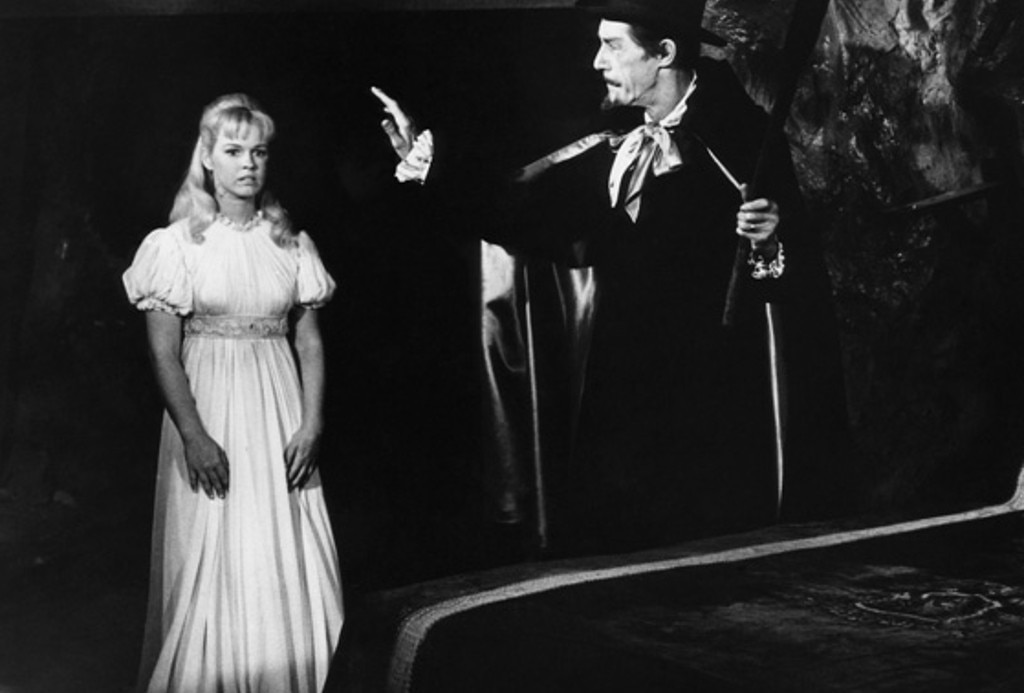
In Universal's The Mummy's Ghost (1944), Carradine's murderous high priest stalks reincarnated Egyptian princess Ananka, a role that went to his Billy the Kid versus Dracula costar Virginia Christine in Ghost's sequel The Mummy's Curse (1944).
Late in life, Carradine played melancholy werewolf Erle Kenton in Joe Dante's horror satire The Howling (1981). The character name was a coy reference to Carradine's House of Frankenstein (1944) and House of Dracula (1945) director Erle C. Kenton.
William Beaudine had begun his long career in motion pictures in 1909, earning $10 a week by sweeping sets and emptying cuspidors at New York's Biograph Studios.
Relocating to Hollywood, Beaudine was an extra in several silent films by D. W. Griffith as he worked his way up to the position of assistant director. By 1915, Beaudine had graduated to helming comic shorts and, by 1922, his first feature.
As a silent film director, Beaudine worked with Hollywood's biggest stars, including Rudolph Valentino, Theda Bara and Mary Pickford.
In 1926, Beaudine directed Pickford in the eerie Gothic orphan drama Sparrows, filmed on a massive swamp set built on the Pickford-Fairbanks Studio lot in Hollywood.
Beaudine's plans for retirement were nullified by the October 1929 stock market crash. With his savings wiped out, Beaudine was forced back to work for whatever meager salary was offered.
Earning far less than he had before the Great Depression, Beaudine worked quickly to finish films. His reputation for speeding through a film shoot and usually capturing scenes in one take inspired the nickname "One Shot."
Beaudine directed Dracula (1931) star Bela Lugosi in four movies: The Ape Man (1943), Ghosts on the Loose (1943), Voodoo Man (1944), and Bela Lugosi Meets a Brooklyn Gorilla (1952).
William "One-Shot" Beaudine ended his career directing episodes of such TV series as The Green Hornet and Lassie.
In his final years, Beaudine worked as a licensed real estate agent. He died on March 18, 1970, at the age of 78, considerably shy of his projected death at age 100.
Billy the Kid versus Dracula star Chuck Courtney was the son of Elizabeth Courtney, a costumer for Columbia Pictures. She reportedly fitted Marilyn Monroe for a gown in which the actress hoped to remarry baseball player Joe DiMaggio prior to her untimely death on August 5, 1962.
Beginning with bit parts in The Asphalt Jungle (1950), Five Against the House (1955) and Tea and Sympathy (1956), Courtney moved on to stunt work, with credits extending from Stanley Kubrick's Spartacus (1960) to Mom and Dad Save the World (1992).
A 22-year-old Chuck Courtney had been the star of William Beaudine's earlier oater Born to the Saddle (1953), alongside former Frankenstein monster Glenn Strange.
On the long-running series The Lone Ranger, Courtney played Dan Reid, nephew of Clayton Moore's masked lawman.
Courtney played a featured role in the earlier western-horror hybrid Teenage Monster (1958).
Courtney was a favored actor of John Wayne and Robert Conrad and received supporting roles in several of their vehicles.
In 1994, Courtney was the recipient of The Golden Boot Award for his significant contributions to westerns on both the big and small screens.
Debilitated by a series of strokes that left him all but speechless, Chuck Courtney took his own life in his North Hollywood home on January 19, 2000. He was 69.
Iowa-born actress Virginia Christine was no stranger to fright films, having appeared in Universal's The Mummy's Curse (1944) and House of Horrors (1946), as well as the sci-fi classic Invasion of the Body Snatchers (1956).
In 1964, Virginia Christine began her long run as Mrs. Olson, old world pitchwoman for Folger's Coffee in a series of television ads that lasted until 1971.
In 1970, Christine's hometown of Stanton, Ohio, celebrated its bicentennial by redesigning its water tower to resemble a coffee pot.
Second-string villain Bing Russell was the father of actor Kurt Russell. A veteran of many westerns, the elder Russell also played bits in the sci-fi classics Tarantula (1955) and The Deadly Mantis (1957).
Cast as "backwoods female pill-slinger" Doc Hull was Olive Carey, widow of actor Harry Carey, in her last film role.
Carey's son Harry Carey, Jr., who had costarred with John Wayne as one of The Three Godfathers (1948), contributed a cameo appearance to Billy the Kid versus Dracula as a stagecoach wagonmaster.
George Cisar, who plays ill-fated firewater salesman Joe Flake, was a veteran of such spookshows as The War of the Worlds (1953), The Werewolf (1956), The Giant Claw (1957) and Attack of the Giant Leeches (1959), as well as several Elvis Presley vehicles.
Seen briefly as an Indian squaw who falls victim to Carradine's perambulating revenant is Charlita Roeder, who had starred opposite the original Count Dracula in William Beaudine's Bela Lugosi Meets a Brooklyn Gorilla (1952).
Director of photography Lothrop B. Worth had previously lensed I Was a Teenage Frankenstein (1957).
Compiled by Richard Harland Smith
SOURCES:
John Carradine: The Films by Tom Weaver
William Beaudine: From Silents to Television by Wendy L. Marshall
"John Carradine: He Loved Acting and He Was Good At It" by Raymond Stanley (www.classicimages.com)
www.britmovie.co.uk
IMDB
en.wikipedia.org
In the Know (Billy the Kid vs. Dracula) - TRIVIA
by Richard Harland Smith | January 02, 2007
SIGN UP FOR OUR NEWSLETTERS

CONNECT WITH TCM