With a title like The World (2004), you wonder what the film is going to say. On the surface, the first world seen here by viewers is a sprawling park stretched along the leafy outskirts of Beijing. Replicas of the iconic Manhattan point, the Eiffel Tower and the Pyramids sit beneath the same smoggy sky, within sight of one another and connected by a train line. Behind them stretches a finger of Beijing skyline, but the distance between these two worlds is more than physical.
These images conjure thoughts of the various films set in and around landscapes where the buildings and architecture clash with the emptiness of the characters within them. Michelangelo Antonioni is one that springs to mind. But director Jia Zhangke's tone in The World is more grounded and rooted in documentary than the alien eeriness of L'Avventura (1960) or Red Desert (1964), perhaps they exist only a few degrees from each other. Characters wander through a changing world that is false and indifferent. The architecture exists at odds with their inner turmoil.
At the forefront of his nation's filmmaking industry, Zhangke made his bones in the Sixth Generation movement of Chinese cinema, initially directing a number of films "underground" without approval of the state. These filmmakers shot on the cheap and focused their cameras on the downtrodden and marginalized members of Chinese society.
In a move that legitimized these rebellious artists, the state gave Zhangke its okay to make this film in 2004. It's somewhat surprising, given that the story and setting don't paint the most flattering portrait of Chinese society. Its characters are security guards, dancers, managers - the people behind the scenes who make the ominously quiet Beijing World Park come to life. At night its lights stay on illuminating the salt pillars of the Twin Towers ("They were bombed on September 11, 2001, but we still have them," one worker proudly explains to his friend), the still face of the Sphinx, the underbelly of the Arc de Triomphe.
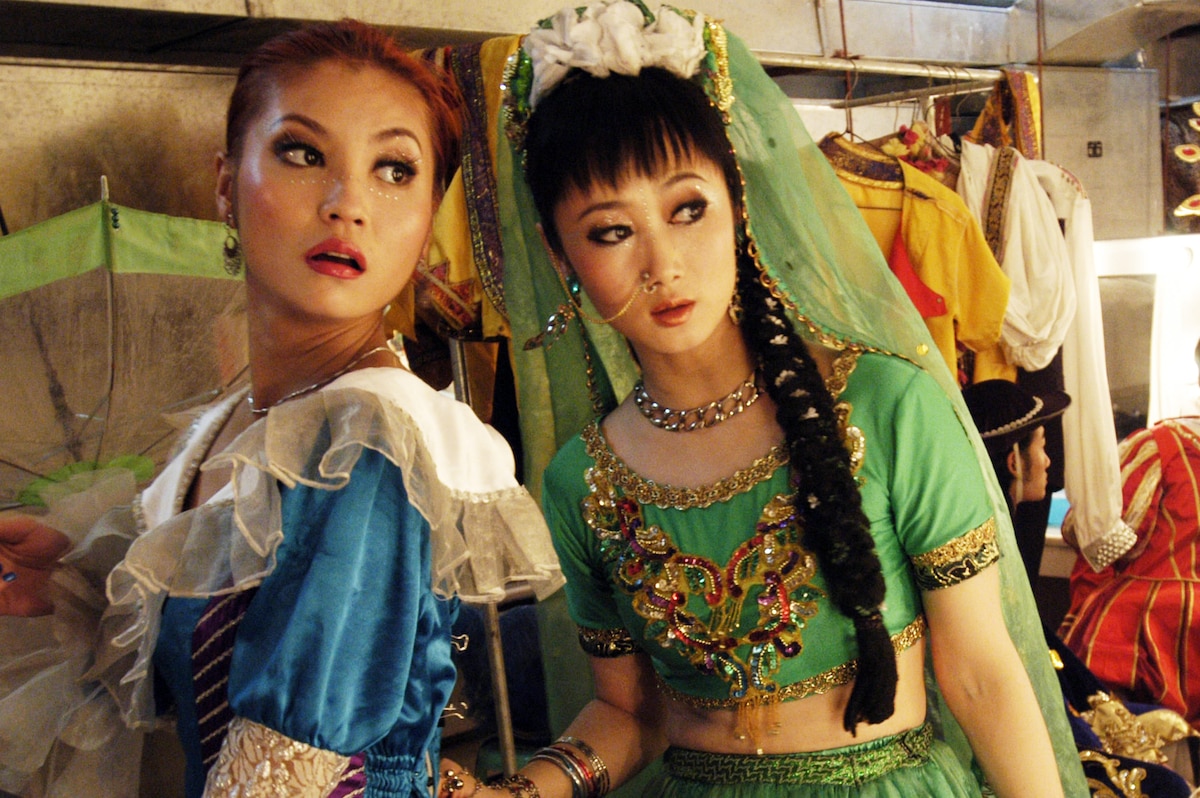
The main storyline concerns a disillusioned dancer, played by Zhangke's wife and collaborator Zhao Tao, and a temperamental security guard. Both hover around one another in a relationship that's far from healthy but seems to be the only spark in lives centered around a place of artifice. Other characters pepper the story, but Zhangke never seems to focus too much on jumping from plot point to plot point. It's in quiet, lingering scenes that Zhangke's filmmaking shines. One scene in particular, set aboard a moving bicycle, is pure magic and makes me recall moments in the past where all has been perfect, yet happiness still seems so unfairly, so inexplicably out of reach.
This is a "world" made with a motive in mind. Posters litter the dressing rooms and a voice buzzes through the usually empty plazas and faux Roman piazzas proudly announcing that anyone can see the world without ever leaving Beijing. Of course, we know that to travel is not to merely see attractions, but to engage with other people, immerse oneself in another culture and to learn about others, and perhaps oneself, in the process. The Beijing World Park encourages none of that. The workers here will most likely never be able to afford to travel far. They exist in a microcosm of their society, their dramas playing out inside fake French cafes and before the twinkling buildings of the miniature Manhattan skyline.
Zhangke includes animated sequences between actions. These usually introduce text conversations between characters and then become fantastical - almost as if to imitate the mental process of internalizing communications had over mobile devices. This was 2004, mind you. The world didn't know what was coming with communication, yet Zhangke may have had an inkling. Cell phones were bringing us closer while distancing us at the same time.
The World is but one line of Zhangke's impressive filmography, with A Touch of Sin (2013) and his latest feature, Ash is Purest White (2018), winning him global accolades and keeping China at the forefront of world cinema. It may feel like a slim film, concerned with a specific time and place. Yet in its specificity, it offers something extremely valuable: the realization that we're all connected, and that we've all felt the joys and pains that accompany being alive. For some reason that understanding is too hard to accept, so we keep circling, wandering and searching for something beyond.
By Thomas Davant
The World (2004)
by Thomas Davant | September 24, 2019
SIGN UP FOR OUR NEWSLETTERS

CONNECT WITH TCM