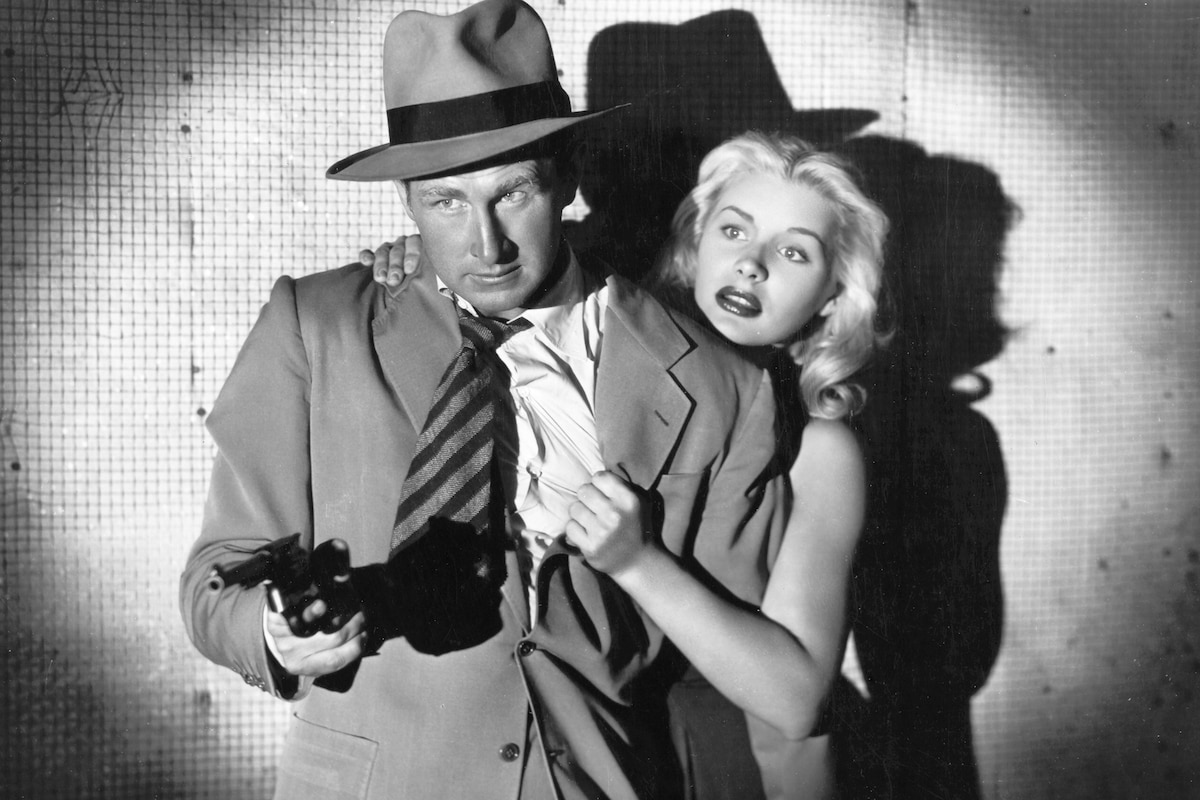
Poverty Row studio Eagle-Lion Films was eager to follow up the success of T-Men (1947), a film noir directed by Anthony Mann and starring Dennis O'Keefe, with a similar project. Like T-Men, Trapped (1949) pits the United States Department of the Treasury against counterfeiters whose crime poses a great threat to the American economy. A taut and compelling film noir, Trapped stars Lloyd Bridges as Tris Stewart, a notorious counterfeiter who is offered a shorter jail sentence in exchange for his assistance but decides to make a break for it instead. Barbara Payton plays opposite Bridges as the glamorous cigarette girl Meg Dixon who tries to help Tris escape to Mexico. Perhaps the juiciest role went to John Hoyt who plays the film's hero John Downey/Hackett, a Secret Service agent gone undercover to infiltrate the seedy world of counterfeiting. The climactic chase scene was filmed on location at the downtown Los Angeles Red Car barn, part of the trolley system that ran until 1953.
Producer Bryan Foy was inspired by a real counterfeiting case, the details of which are unknown, and traveled to New York City, Montreal and Washington D.C. to get the necessary clearance for the story and then handed off the idea to writers Earl Felton and George Zuckerman. Foy had developed a reputation as the "Keeper of the Bs." He ran the B unit at Warner Bros. before branching out to start his own independent production company. Felton was an established B-movie screenwriter having sold original story ideas and screenplays to various studios but mostly to Republic. Zuckerman on the other hand was brand new to the game. He was a novelist and short story writer and Trapped was his first foray into writing for a feature film.
At the helm of the picture was director Richard Fleischer who was on loan from RKO. Fleischer was the son of Betty Boop and Popeye animator Max Fleischer, and while raised in a show-business family, he was originally on track to become a psychiatrist. He traded medical school for the Yale School of Drama and was eventually hired to write and direct the RKO-Pathe documentary series This is America in 1943. He went on to have a long career in Hollywood where he dabbled in many genres but found a niche in 1940s and 1950s crime dramas including the celebrated film noir The Narrow Margin (1952).
His background in documentary filmmaking made its way into his feature film work including films such as Bodyguard (1948) and Follow Me Quietly (1949). Trapped was made in conjunction with the Department of the Treasury, with script approval granted to the chief of the Secret Service James J. Maloney, and begins with a documentary style introduction cataloging the functions of the different bureaus and divisions including the Bureau of Printing and Engraving. The film's focus, however, is the Secret Service which was originally tasked to investigate counterfeiting and was part of the Treasury until 2003. Just in case anyone got any funny ideas about taking up counterfeiting, Trapped offered viewers several warnings. A brief interlude beckons the audience's sympathy depicting an innocent woman being informed by a bank teller that her hard-earned money is actually counterfeit. The crime itself is presented as a highly technical skill that requires years of practice and is beyond the reach of your average Joe. Tris Stewart's plates are referred to as "real works of art... like paintings." The final credits offer a thank you the Treasury and a warning about the consequences of committing such a crime.
After a string of supporting roles, Trapped and other Poverty Row films offered Lloyd Bridges an opportunity to prove himself as a leading man. It was also the first substantial role for Barbara Payton who had just gotten her start in Hollywood. The stunning Payton captivated audiences with a mix of both grit and vulnerability. Trapped put Payton on the map and she soon got a contract with Warner Bros. Plagued by personal problems and scandal, her acting career was short lived, ending in 1955 and the troubled Payton died at the tender age of 39 in 1967.
In Bosley Crowther's review of Trapped for The New York Times he said "well-paced as melodrama, this film has momentum, at least. But of course, the conclusion is foregone. Secret Service agents always gets their man." The Variety review says "[Trapped] packs in plenty of suspense and strong melodrama." Many decades later, Trapped enjoyed a revival with contemporary film noir fans. Considered partially lost, for many years a sole 16mm print was known to exist. As with other Eagle-Lion Films, Trapped languished in the public domain with bad copies making the rounds. It wasn't until a private collector donated a pristine 35mm print to the Harvard Film Archive that Trapped was rescued. The film was restored by the Film Noir Foundation and UCLA Film and Television Archive and funded in part by the Hollywood Foreign Press Association's Charitable Trust.
By Raquel Stecher
Trapped (1949)
by Raquel Stecher | September 24, 2019
SIGN UP FOR OUR NEWSLETTERS

CONNECT WITH TCM