The Hollywood studio system all but imploded in 1969. The shrinking movie-going audience rejected expensive musicals yet made the tiny counterculture film Easy Rider into a major hit. Drowning in red ink, studios fired executives, sold their back lots and put their props and costumes up for auction. As observer William Bayer noted, the panic to connect with the youth audience was so great that picture deals were being handed out to 'longhairs wearing sandals.' Twentieth Century-Fox put two X-rated movies into the works. The first was an adaptation of Myra Breckinridge, Gore Vidal's satire about a sex-change operation, while the second project was made by nudie film director Russ Meyer, an outsider to the studio system. A WWII combat cameraman, Meyer had pioneered nude girlie photography in the 1950s, before first making waves with the softcore 'nudie cutie' film The Immoral Mr. Teas (1959). At 48 years old, Meyer was hardly part of the youth rebellion, but his adults-only feature Vixen!, (1968) had recently become a breakout college hit that was promoted by young critic Roger Ebert.
A radical choice by any estimation, Russ Meyer hired his critic/fan Roger Ebert to help him write the wildest possible screenplay about Hollywood excess. Their Beyond the Valley of the Dolls (1970) hijacks the title of Jacqueline Susann's 1967 Fox hit but is not a sequel. Interview magazine responded with a warning, "Don't kid yourself, 20th has entered into the porno business." Susann sued, but the only change made was the addition of a disclaimer title card. Screenwriter Roger Ebert would later say, "The only way to judge good smut, is by its ability to get the job done."
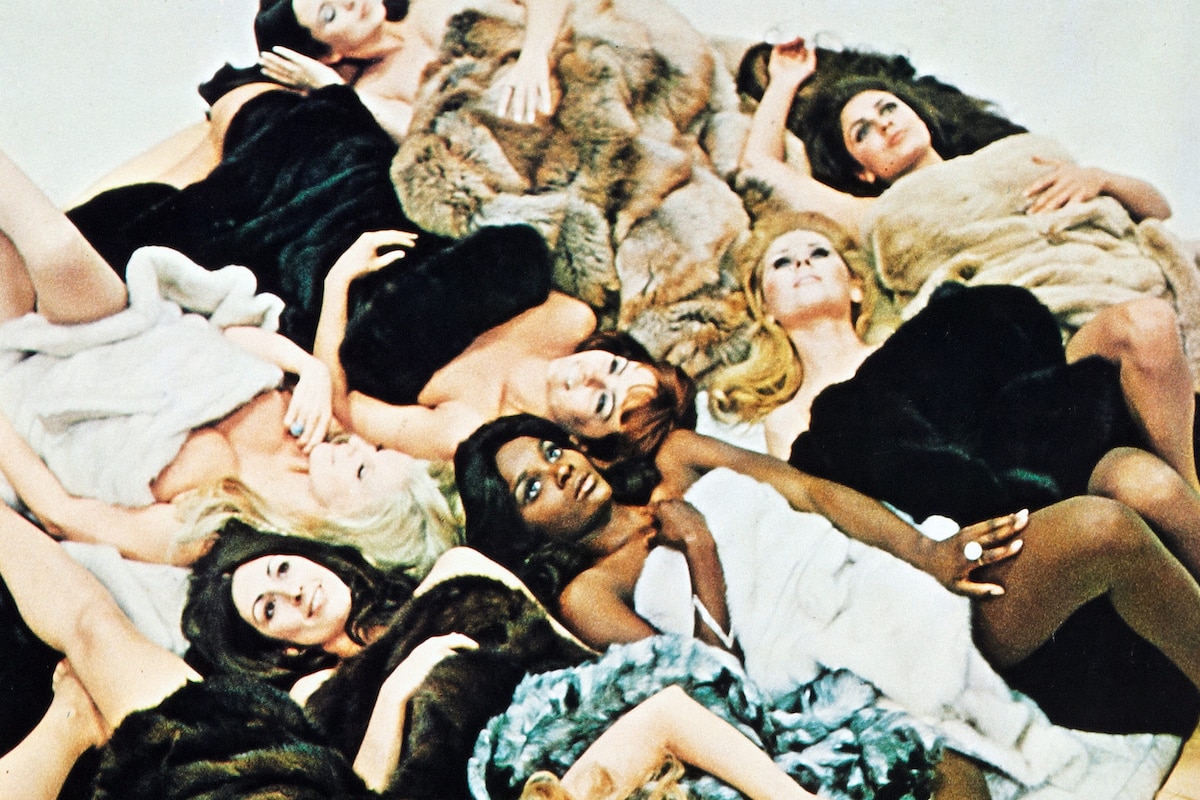
Beyond the Valley of the Dolls is a self-conscious satire of trashy filmmaking, a noisy, outrageous assault on good taste. Ebert's story brings an all-female rock band called The Carrie Nations (Dolly Read, Cynthia Myers & Marcia McBroom) to the bedrooms of Hollywood. The women find new lovers at a series of wild parties thrown by the bizarre rock promoter Ronnie Barzell, who calls himself 'Z-Man' (John LaZar). Pulpy subplots proliferate. One newcomer enters into a lesbian love affair, and the band's manager pairs up with a porn star (Edy Williams, Russ Meyer's wife). The party scenes are jammed with oddly-dressed older people and curious cross dressers. An innocent student, a pretty boy gigolo (Michael Blodgett) and other oversexed characters bring the soap opera intrigues and jealousies to a boil, until drug-induced madness drives Z-Man to commit a series of murders on a Manson-esque level of grotesquery.
The level of sex is R-rated, featuring Meyer's concentration on topless females. His favored actress Haji (real name: Barbara Catton) wanders nude through the party scene, painted solid black. Meyer's editing enforces a brisk pace; nothing is allowed to linger. Ebert and Meyer revel in their exaggerations as the rise of The Carrie Nations is told via fast-cut montages. Also featured is the psychedelic band The Strawberry Alarm Clock.
Everything on view is artificial, a parody of youth culture and hollow movie glamour. The bad taste finds expression in crass sex dialogue, and even a holocaust joke, purposely pursuing a sub-Warhol trash aesthetic. The dance floors are jammed with "beautiful people" seeking instant ecstasy. Characters don't converse but instead shout declarations of love or desire. Critic John Simon credited Roger Ebert with an uncanny ear for bad dialogue. The film's most quoted line belongs to Z-Man: "This is my happening and it freaks me out!"
The film's initial X rating was applied not for nudity or sex scenes, but for graphic violence, including a decapitation by sword. One reviewer stated, "The last sequence - a rampage of murders by a crazed hermaphrodite - goes past trash into obscenity," and asked, "If this is what 20th Century-Fox needs to save itself, why bother?" Despite industry resentment, Meyer's show made money, making back 10 times what it cost.
Although Russ Meyer had a multi-picture deal with Fox, he made only one more studio film, a relatively tame courtroom drama about an obscenity case called The Seven Minutes (1971). He instead returned to independent filmmaking, and after a couple of explicit pictures, reverted to his softer formula combining comedy and topless beauties. His Supervixens (1975) became his biggest independent hit. Beyond the Valley of the Dolls was set aside by the studio but revived on home video. As a cult item, it has been the focus of several cast reunions, some of them accompanied by a proud director.
A screening at the French Lumiere Festival in 2017 was hosted by Quentin Tarantino. He described the picture as Fox's bizarre attempt to take erotic cinema mainstream. "When it actually became a hit," Tarantino said, "They were horribly embarrassed by that."
By Glenn Erickson
Beyond the Valley of the Dolls
by Glenn Erickson | September 23, 2019
SIGN UP FOR OUR NEWSLETTERS

CONNECT WITH TCM