Japan enjoys a rich history of supernatural tales and legends that became subject matter for films as far back as the silent era. Some of those lost titles have been rediscovered, such as director Teinosuke Kinugasa's silent horror film A Page of Madness (Kurutta ippeji, 1926), which was found and restored in 1971. But during WWII, the military government discouraged movies about Japanese mythology, though costume dramas and fantasies returned in the Occupation period, partly because the American censors strictly controlled movies about current controversies. By the 1950s, ghostly horror stories had made a comeback, to be joined by new science fiction-themed fantasies.
The prolific Kaneto Shindo wrote over 200 screenplays. He made his name as a director with 1960's Hadaka no shima aka The Naked Island, a harrowing tale of farmers eking out a living on a barren rock. His international stature grew with the frightening Onibaba (1964), based on a folklore tale about a 'mask of flesh.' Shindo made pictures with other themes, but his next big export to the West was another traditional horror film, a Bakenoko mono ('ghost cat story'), Kuroneko (Yabu no Naka no Kuroneko, 1968), which translates to "A Black Cat in a Bamboo Grove."
In Bakenoko mono folktales, cats take human form to dispense supernatural justice, avenging murders when there are no human witnesses. Shindo stages Kuroneko in the same wartime setting as Onibaba, among poor peasants in the Heian period (794-1185). Shindo said that his sympathies were with the low-born: "My camera is fixed to view the world from the lowest level of society, not the top."
With the man of the house, Hachi (Kichiemon Nakamura), off fighting in a civil war, farm women Yone and Shige (Nobuko Otowa and Kiwako Taichi) are raped and murdered by marauding samurai. But a curious house cat is attracted to the blood of their burned bodies. Three years later, Hachi has been given a new rank by the local lord Raiko Minamoto, as well as new name, Gintoki. He returns to find his mother and wife gone and the house reduced to ashes. Raiko gives Gintoki the responsibility of destroying unknown phantoms said to be killing various samurai in the vicinity (Raiko Minamoto was a real historical personage, who stated openly that peasants are worthless and can be killed without regret). Gintoki eventually discovers that Yone and Shige are now murderous cat-phantoms with unfinished business to complete in the supernatural realm.
Reviewers praised Kaneto Shindo's stylized, genuinely frightening tale of horror. The unsettling film contrasts beautiful images against convincing gore makeup and accompanies its fright scenes with strange sound effects that blend with Hikaru Hayashi's music score. Variety judged Kuroneko less poetic than the ghost stories of Kenji Mizoguchi, yet called it "...one of those glacially beautiful, stylized exercises in supernatural themes that the Japanese excel in." As a protégé of the revered director Kenji Mizoguchi, Shindo adopted his master's sympathy for the plight of women. Gender politics enter into the ghost story, as defenseless women return from the dead to exact a bloody revenge.
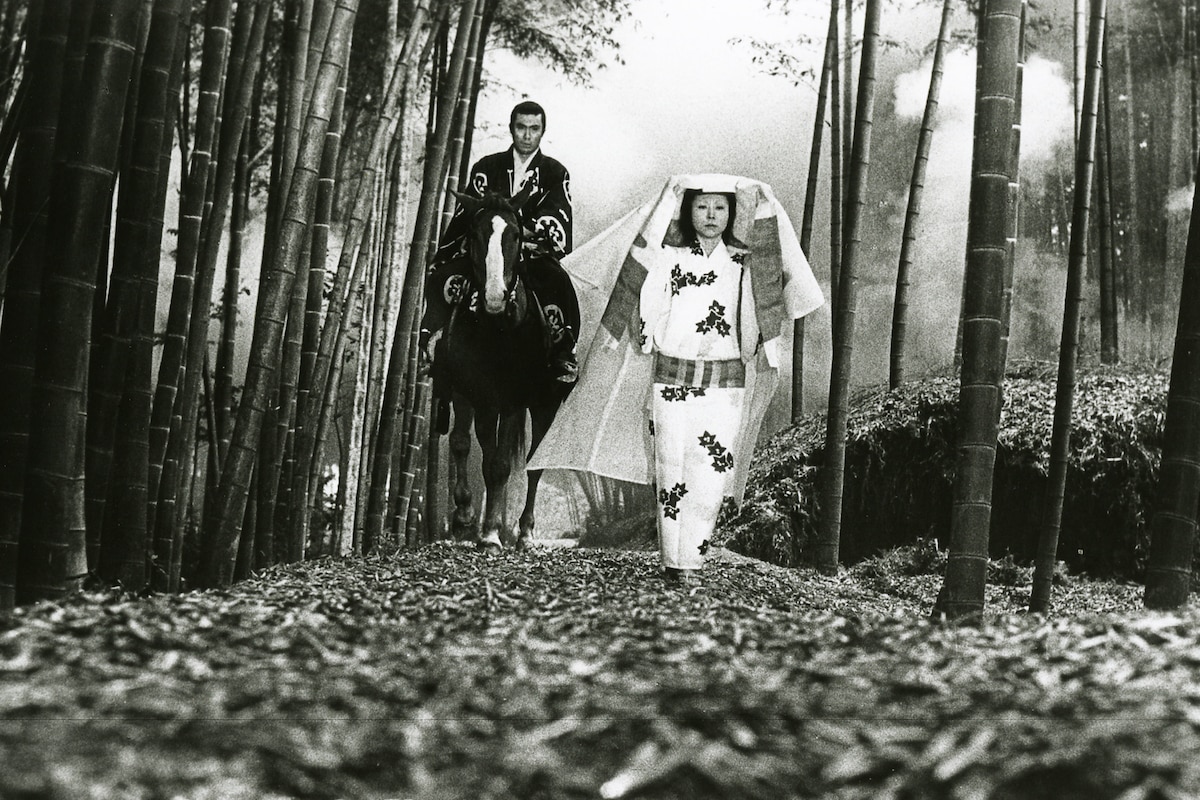
Kuroneko's breathtaking visuals feature images of the beautiful phantoms gliding through spooky bamboo forests. The tone shifts between realism and artificiality, unlike the all-abstract, more theatrical Kwaidan (1964) by Masaki Kobayashi. In 2016, critic Melissa Anderson of the Village Voice reviewed Kuroneko when promoting films featuring powerful women: "Balletic ghost-face killers leap, fly and somersault through the air, luring members of Japan's military nobility to their bamboo lair with promises of sake before they savage their victims's throats like lavishly kimonoed mousers."
Critic Michael Atkinson was charmed by some of Shindo's more arresting details. Yone's ponytail twitches like the tail of a stalking cat. When a woman's arm is chopped off, it becomes a cat's paw, which she carries in her mouth. The women's Ghost House appears to move through the bamboo forest under its own power, prowling the foggy mist. The house looks inviting to new victims, but afterwards reverts to its burned and crumbled state.
Kuroneko was originally scheduled to be screened in competition as Japan's official selection at the ill-fated 1968 Cannes Film Festival. The entire gala was closed down five days early by film directors acting in concert with the May strikers.
By Glenn Erickson
Kuroneko
by Glenn Erickson | September 20, 2019
SIGN UP FOR OUR NEWSLETTERS

CONNECT WITH TCM