This is one of those quickies put out during the war years as short (in this case, just over an hour) diversions for homefront audiences and GIs in training camps and overseas. Since it came fairly early in the war (May 1942 premiere) and follows the story of Army trainees during and after basic training, this also served as an upbeat recruitment tool.
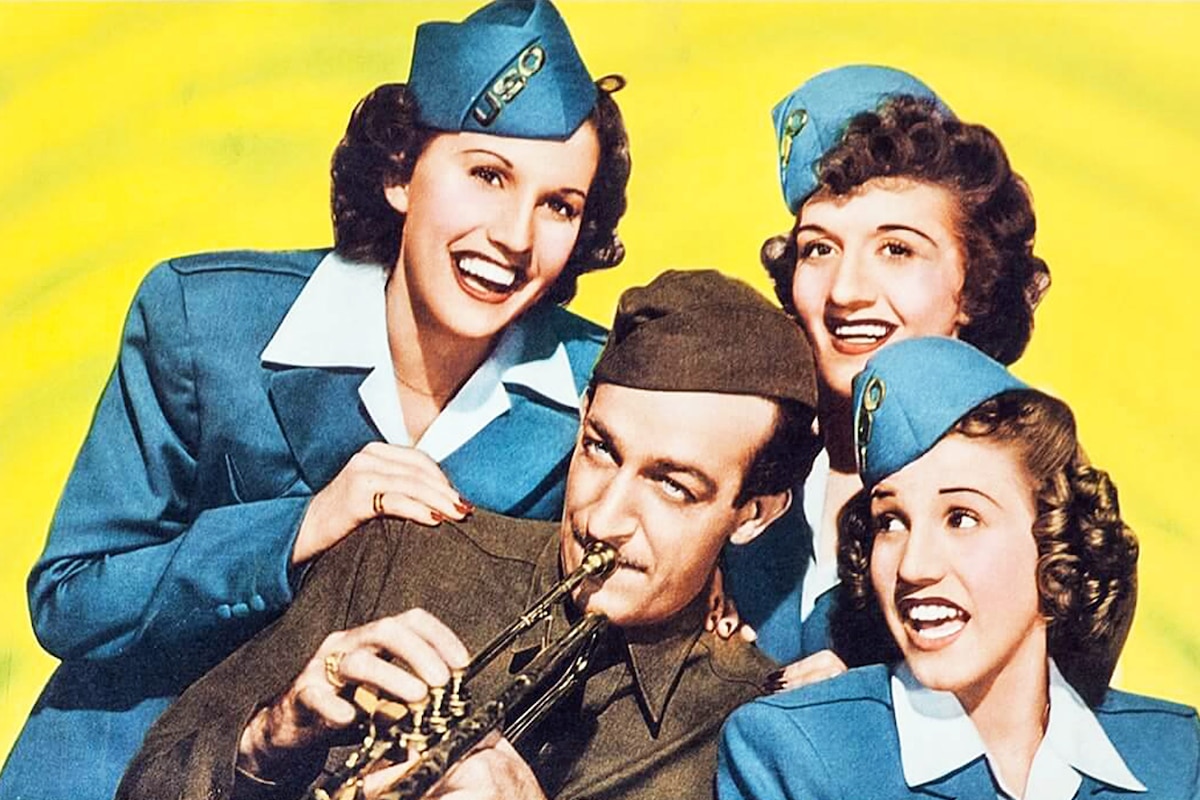
The diversion is provided by some of the best and most popular musical acts of the day. Trumpeter Harry James plays a fictionalized version of himself, drafted into the Army along with his lead singer, Lon Prentice, played by singing cowboy Dick Foran as a vain and arrogant recruit who must be taken down a few pegs and taught to be a team player, a pretty standard trope for war movies but here played mostly for fun.
Also on hand are a teenage Donald O'Connor and his on-screen partner at the time, Peggy Ryan (Universal Pictures' answer to Mickey Rooney and Judy Garland), nightclub comedian Joe E. Lewis and on-and-off Three Stooges actor Shemp Howard, brother of Moe and Curly, whose scenes with the inimitable Mary Wickes are some of the funniest in the picture.
Other than James, the biggest pop stars to appear (also as themselves) are the singing Andrews Sisters, then at the height of their popularity thanks to such huge hits as "Bei Mir Bist Du Schön," "Don't Sit Under the Apple Tree (With Anyone Else but Me)," "Rum and Coca-Cola" and the song most associated with them and their wartime popularity (although released nearly a year before the U.S. entered World War II), "Boogie Woogie Bugle Boy." One would expect them to perform that number in this picture, but it had already debuted in another Universal production, the Abbott and Costello comedy Buck Privates (1941), well over a year earlier. They did, however, get to sing "Don't Sit Under the Apple Tree" in this film.
Unlike his onscreen depiction in Private Buckaroo, a back injury kept the real-life James out of the service. His band - second in popularity only to Glenn Miller's during this time - never included Foran but featured several lead vocalists, including Frank Sinatra, Dick Haymes and Helen Forrest, who gets to perform one of their biggest hits, "You Made Me Love You," in this film.
The director is Edward Cline, best known for co-directing a number of Buster Keaton films in the silent era, including such classic shorts as One Week (1920), The Scarecrow (1920) and The Balloonatic (1923) and the feature Three Ages (1923). Even as Keaton's career tanked, Cline continued to work, directing W.C. Fields in some of his biggest comedies, The Bank Dick (1940), My Little Chickadee (1940) and Never Give a Sucker an Even Break (1941). He and Keaton were reunited for two television series in the early 1950s, The Buster Keaton Show and Life with Buster Keaton.
Private Buckaroo is a public domain film, meaning no individual or company owns the rights to it anymore. A number of films, including such classics as Keaton's The General (1926), Howard Hawks' comedy His Girl Friday (1940) and the cult film noir Detour (1945), failed for various reasons to have their copyrights renewed within the 28-year time frame then allotted. In 1966, Congress passed an extension of the copyright to 75 years, but those that fell into public domain prior to that remained. Although some films fall into this category, some of their aspects, such as the songs in this picture, are still protected.
Director: Edward F. Cline
Producer: Ken Goldsmith
Screenplay: Edmund Kelso, Edward James, from an original story by Paul Gerard Smith
Cinematography: Elwood Bredell
Editing: Milton Carruth
Art Direction: Jack Otterson
Cast: The Andrews Sisters (Themselves), Harry James (Himself), Dick Foran (Lon Prentice), Joe E. Lewis (Lancelot Pringle McBiff), Ernest Truex (Col. Elias Weatherford)
By Rob Nixon
Private Buckaroo
by Rob Nixon | September 20, 2019
SIGN UP FOR OUR NEWSLETTERS

CONNECT WITH TCM