When Godzilla (a.k.a. Gojira) first terrorized Tokyo in Ishirō Honda's original black-and-white 1954 release, he helped usher in the Japanese kaijū genre. (Kaijū being a Japanese term for "strange beast" which was typically a giant monster.) Cinema had seen its fair share of giant monsters before with such amazing behemoths as King Kong (1933) on up through The Beast from 20,000 Fathoms (1953). What set Godzilla apart from his predecessors was that rather than being animated by miniature models or forced perspectives, the special effect that was pioneered was called "suitmation" and featured a stunt performer wearing a suit (these being several hundred pounds heavy) as they interacted, wrestled with and destroyed miniature sets. These suits would go through a lot of wear and tear, requiring new ones be made for ongoing sequels (which explains why Godzilla looks a bit different from one title to the next).
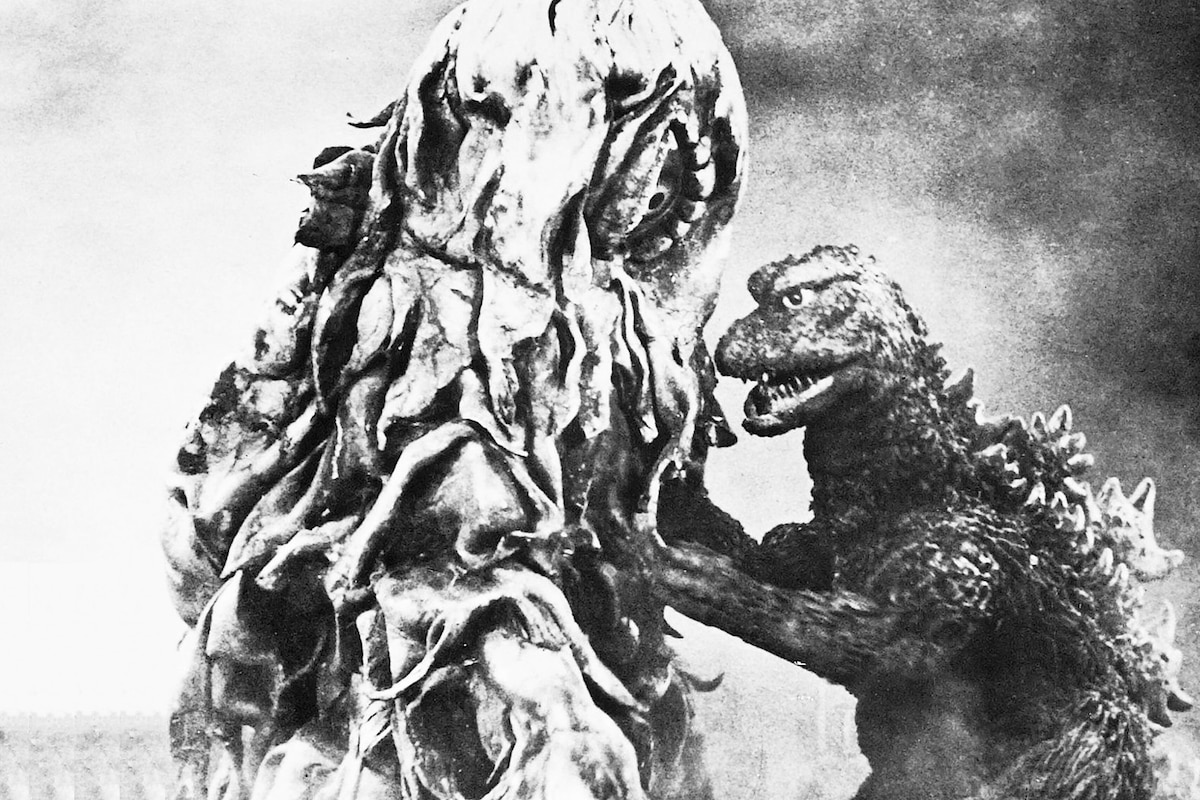
Another feature that sets Godzilla apart are the record-breaking sequels he spawned - currently totaling upwards of 30 (James Bond, by comparison, has about 25 incarnations). There is also something uniquely political about Godzilla since he, at first anyway, clearly embodied a nation's fears as they related to the destructive capacity of atomic bombs. This set a precedent by which kaijū characters often serve to stand in as visual metaphors for something else. Interestingly, by the time of Yoshimitsu Banno's Godzilla vs. Hedorah (1971), the 11th entry into the franchise, Godzilla was so well revered that he had morphed into a de facto symbol of Japanese national identity as well as a child-friendly protector of Japan. Also at this time, Japan was not being destroyed by bombs but rather by decades of pollution-related health problems, which earlier on included the Minemata outbreaks that afflicted almost 3,000 people with a central nervous system disease related to mercury poisoning. Hedorah, which roughly translates into "vomit" or "sludge", is here a kaijū monster that thrives off of breathing in the fumes of factories and absorbing other forms of pollution to get bigger and more dangerous.
The United States was not immune from its own growing pollution-related problems. After World War II, in the 1950s and '60s the U.S., like Japan, experienced a boom in economic growth that was uncurbed by appropriate regulations or legislation. The result was heavily urbanized areas afflicted by poisonous smog banks that killed hundreds of people and inflicted thousands more with respiratory problems. Finally, in 1971, the U.S. created the Environmental Protection Agency. Another thing that happened in 1971 was that the organization Keep America Beautiful launched various ads including one featuring the iconic "Iron Eyes" Cody weeping at the sight of rampant smog and pollution. The U.S. automobile market was still four years away from developing catalytic converters to comply with E.P.A. regulations, and smog was visibly choking the big cities and very much on the collective mind. Small surprise, then, that when Godzilla vs. Hedorah was released in the U.S. the name was changed to Godzilla vs. the Smog Monster. It was also one of the first kaijū movies to be widely syndicated across the U.S. - an important inflection point that might account for it being one of the more oft-cited and written about Godzilla entries amidst both academic writers and film critics. Roger Ebert was a big proponent for Godzilla vs. Hedorah. On the other hand, other fans and critics viewed Godzilla vs. Hedorah derisively because they felt the strong social messaging was over-the top, as was the fact that it's the only Godzilla movie in which he is able to fly through the air by blasting his atomic breath towards the ground as propulsion.
From the first frame showing belching factory smokestacks in the foreground with Mt. Fuji hazy in the background, the metaphoric battle between a beleaguered Japanese nation fighting deadly pollution is made obvious. The air is under assault. The water is under assault. And we see the foreboding head of Hedorah rising from the toxic water. Once a microscopic alien life-form, it is now large enough to sink oil tankers and eventually it can also shamble across the landscape and later fly through the air. As Hedorah secretes acid and stomps through crowds killing thousands, Godzilla comes to the rescue.
Despite all the pollution and toxic sludge, Godzilla vs. Hedorah is a scrappy, colorful and unexpectedly daring affair. As the opening song plays, it intercuts between groovy lava-lamp inspired backgrounds and a jarring scene of a mutilated mannequin floating in a polluted river, with other surprises yet to come, including animation in the form of a children's cartoon to help explain how Hedorah thrives on pollution.
The producer, Tomoyuki Tanaka, and the Toho studio were disappointed with the end results that Banno delivered. And yet, perhaps by necessity, given that it had a lower budget than usual, Godzilla vs. Hedorah is a playfully inventive entry in the pantheon of Godzilla movies. One whose social message is still very much relevant today.
By Pablo Kjoseth
Godzilla vs. Hedorah
by Pablo Kjoseth | September 18, 2019
SIGN UP FOR OUR NEWSLETTERS

CONNECT WITH TCM