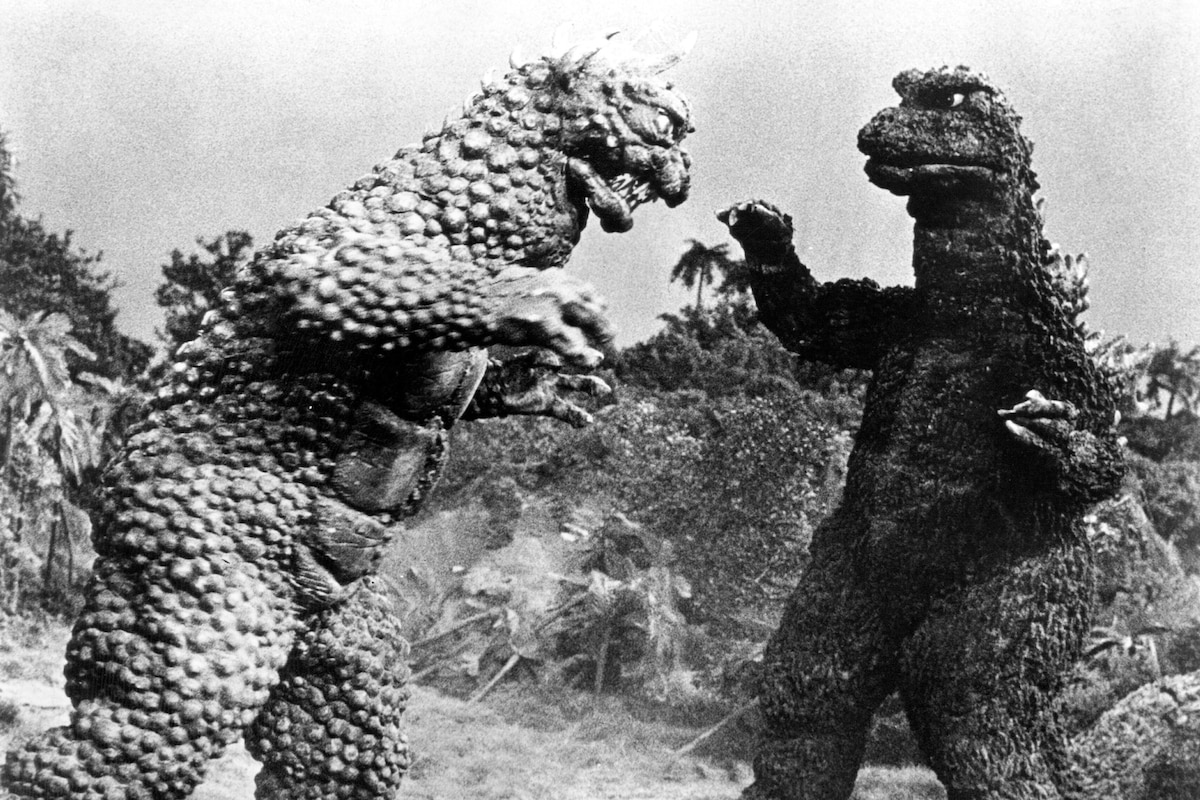
Anyone who dislikes the more whimsical, family-friendly era of Godzilla films that began with Son of Godzilla (1967) will have a particular axe to grind with All Monsters Attack (1969), an all-star kaiju rally that marked the 10th entry in the Godzilla Shōwa era (named for the emperor in power at the time). Also known more informally as Godzilla's Revenge, it's essentially a lesson for children in which bullied Ichirô (Tomonori Yazaki) escapes into his dreams to Monster Island, where Godzilla's son, Minilla, is dealing with similar issues. Other monsters include newcomer Gabara, the giant praying mantis Kamacuras and a carnivorous plant that gets into the action as well, which is padded with preexisting scenes from prior films featuring Ebirah, Gorosaurus, Anguirus and others.
An outlier in the series thanks to its fanciful plot, lack of direct connection to any other entries, chatty monsters and peculiar plot detours including bank robbers, All Monsters Attack is most notable as the inaugural entry in the Monster Island cycle that would continue through the 1970s. Of course, in this case it's never quite established whether Ichirô knows about Monster Island through real-life reports or just made it up as a metaphysical question beyond the scope of this film, which also makes it even trickier to contextualize with its fellow Godzilla features. Attempts to court droves of children into the theater with this one didn't quite pay off as well as expected, even with the budgets slashed compared to the series' heyday. Toho would go back to business as usual with the next title, Godzilla vs. Hedorah (1971), better known to Americans as Godzilla vs. the Smog Monster. Both of these films would have their soundtracks tampered with rather notably when it came to their main themes, in this case with the "Monster March" featuring the Tokyo Children's Choir replaced with more generic stock music.
Like many preceding kaiju films like Godzilla, King of the Monsters (1956), Rodan (1956) and Mothra (1961), this one was directed by longtime Toho helmer Ishirō Honda, who had also excelled at sci-fi and war films for the studio. This would be his penultimate Godzilla feature, followed by Terror of Mechagodzilla (1975). That film would mark the end of the Godzilla Shōwa era, with the big lizard taking time away from the public eye until a much-publicized comeback with The Return of Godzilla (1984), which was reworked into Godzilla 1985 (1985). By the time he passed away in 1993, Honda's name had become synonymous with images of monsters in rubber suits destroying major cities. However, he always openly credited those who were responsible for making his films so iconic--in particular, special effects supervisor and creator Eiji Tsuburaya, whose innovative and still impressive creations are an indelible part of the Godzilla legacy. Tsuburaya even receives a credit for this film despite the fact that his only contribution is seen in the stock footage selections.
As with the previous Godzilla films, this one was dubbed when released in the U.S. The movie played most widely in 1971 as a co-feature with the Terence Fisher sci-film Night of the Big Heat (1967), which was retitled Island of the Burning Damned, for distributor Maron Films. This marked one of the stranger pairings from the short-lived distributor, which also handled such other films as Godzilla vs. Monster Zero (1965) and The War of the Gargantuas (1966) when it wasn't dabbling in Italian gialli, sexploitation and the occasional curveball like the Edie Sedgwick semi-documentary Ciao Manhattan (1972). In retrospect All Monsters Attack marks a peculiar but endearing late period curio from the Shōwa era, one not for all tastes but certainly difficult to forget--or, in the right frame of mind, resist.
By Nathaniel Thompson
All Monsters Attack
by Nathaniel Thompson | September 18, 2019
SIGN UP FOR OUR NEWSLETTERS

CONNECT WITH TCM