AIP executive Larry Gordon gave filmmaker Jack Hill his marching orders: "I want you to open the picture with a scene where this black chick just kills the sh*t out of two people."
OK, thought Hill, no ambiguity there. Other than the fact that, well, that was all Gordon had. Just that one scene. It would be up to Hill to concoct the rest, to live up to Gordon's ambition of beating Cleopatra Jones at its own game. "My heart sank," recalls Hill, "but I needed the job, so I gave it a shot."
Hill approached the task by crafting the story as "racist, from the Black point of view." Hill was unable to get Charles Napier to appear in the film, because the actor resented the anti-white attitude of the script. For Hill, this was key to the movie's success-giving a long-suffering audience an overdue taste of payback.
The film indicts the White Establishment for fostering the drug trade as a way of keeping blacks down. Coffy has to take the law into her own hands, because she learns the hard way that the police are in league with the crooks. We see the white crime lords take over ghetto crime, sexually humiliate black women, lynch a black pimp, and profit from human suffering. But what the movie says in words, it sometimes undermines with onscreen action. The most eloquent statement of the film's apparent politics comes from a duplicitous character who is revealed to be as corrupt as anyone else.
Hill inserted radical politics into several of his thrillers from the 1970s. In Foxy Brown (1974), Pam Grier's character joins up with a sort of Black Panthers militia; the same idea was developed further in Switchblade Sisters (1975). These films were sometimes banned abroad; some countries were deeply unsettled by images of sisters doing it for themselves. What if women watched these movies and actually started to think of themselves as powerful?
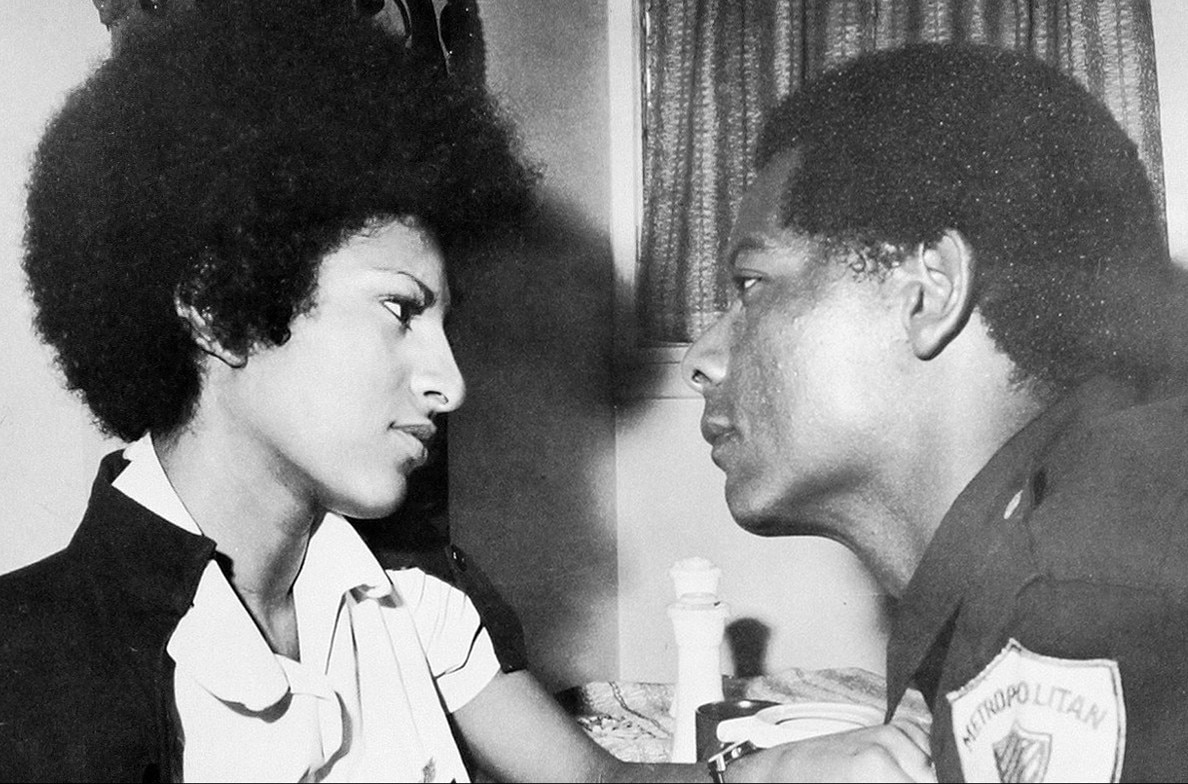
For Pam Grier, Coffy's strength was emblematic of the time. These were the war years, remember, when Vietnam was swallowing hordes of young men and leaving many young women to fend for themselves. Unable to look to men to do for them, these women found their own masculine side.
Grier came to the project with concrete ideas about how to equip her character: the razor blades in the hair, the bobby pins wielded as deadly weapons, these were Grier's contributions. "She had that kind of life experience in those things," says Hill.
That Grier's life experience veered into the world of acting had a lot to do with Jack Hill. He had come up the ranks of low-budget quickies, doing crazy things like shooting Boris Karloff's last four films, back-to-back-cramming all of Karloff's scenes for all four films into a handful of days in Hollywood, then bumbling off to Mexico to shoot the rest of the material without him. Hill got his start with Roger Corman, shooting scenes to fill out Francis Ford Coppola's unfinished Dementia 13 (1963).
It was this kind of ability to squeeze blood from rocks that convinced Corman to send Hill in on a run of women-in-prison flicks in the Philippines. Corman had also spotted Grier at the AIP offices and invited her to take an acting career seriously. It started with Women in Cages (1971), starring Hill's pal Sid Haig and giving Pam Grier her first meaningful screen appearance. Grier had no acting experience, but Hill recognized raw charisma (and Haig spent his nights coaching her). By the time Coffy came along, Hill knew what Grier was capable of.
For the rest of the cast, Hill had definite ideas. Many were friends he wanted to employ-such as Haig (who played an Armenian bodyguard), Carol Lawson (a brutalized whore), and Robert DoQui (flashy pimp King George). As crooked politico Brunswick, Hill tapped Booker Bradshaw, a classically-trained actor from England used to working with the likes of Sir Laurence Olivier. For one climactic scene, Hill simply mentioned to Bradshaw, "I took this scene from Richard III," and the Shakespeare vet knew exactly what to do.
Coffy was shot in just 18 days for a budget of a mere $500,000. Rather than construct sets, AIP sent Hill out to shoot entirely on location, a decision Hill felt was poor economizing. The money you might have saved by not building sets you lost trying to fight the elements and outside factors beyond strict control. It was emblematic of the studio's pervasive contempt for blaxploitation: they were happy to make money off these things, but never once considered them worth taking seriously.
But Hill was just a director-for-hire, and as soon as the footage was in the can, the studio sent him packing. Nowadays, even lowly directors have a contractual right to see their work through the editing phase and test screened-producers can alter it then, but not before. Back in 1973, the rules were different, and Hill played no part in the editing of Coffy.
Coffy opened to excellent business, drawing in better box office than AIP had even hoped. It even found huge success abroad-something AIP never even considered. As the saying goes, it was big in Japan.
Larry Gordon asked Hill back for a sequel, with the wonderfully lurid title Burn, Coffy, Burn. At the eleventh hour, AIP's sales department decreed that sequels made less money than originals, and didn't want to hobble the movie's chances from the outset. Larry Gordon was angry-he'd started to think of Coffy as a franchise character a la James Bond. Jack Hill was more sanguine about the change, but thought the new title Foxy Brown was tawdry and insulting. In the end, Foxy Brown proved its own mettle, and wound up being a more enduring name than Coffy (just ask the hip-hop star who borrowed the name as her own).
Recently, talk has floated around remake-addicted Hollywood of a new version of Coffy to star Halle Berry in the Pam Grier role. Hill chuckles at the idea that this once notorious exploitation quickie could have such legs... and secure in the knowledge that whatever comes from such talk, nothing will ever unseat this powerful little thriller from the memories of its many fans.
Compiled by David Kalat
SOURCES:
Jack Hill, commentary track on the MGM Coffy DVD.
Darius James, That's Blaxploitation, St. Martin's Griffin.
Colin Murphy, "She's Here, She's Grier," The Vital Voice.
Interview with Sid Haig, Psychotronic Video.
Gerald Martinez et al, What It Is...What It was!, Hyperion Books.
Insider Info (Coffy) - BEHIND THE SCENES
by David Kalat | December 21, 2006
SIGN UP FOR OUR NEWSLETTERS

CONNECT WITH TCM