The best reason to pick up Warner Home Video's new Forbidden Hollywood
Collection Vol. 1 DVD box set is Baby Face (1933). One of the
most notorious of all pre-Code films, Baby Face is offered here in
two cuts - the edited general-release version known for the past 73
years, and the newly unearthed, original, uncensored version, which
restores five minutes of material. While the movie was always pretty
shocking and racy anyway, the unedited version brings a fantastic new
level of luridness to the proceedings.
"She used everything SHE had... to get everything MEN had," declared the
posters, and the posters were right. Baby Face gives us Barbara
Stanwyck as Lily, a barmaid in Erie, Penn., who's been pimped out by her
father since she was a teenager. Finally leaving her putrid life, she
lands in New York City, where she methodically and ruthlessly sleeps her
way to the top of a banking empire - floor by floor, department by
department, and man by man. That's the story in a nutshell, which
incidentally was written by Warners' production head Darryl Zanuck (under
the pseudonym Mark Canfield) with input from Stanwyck herself. What
really pushed the limits of acceptability back in '33 was not just the
manner of Lily's corporate ascent but the relish with which she
undertakes it. In an early scene in Erie, she is encouraged by a
Nietzsche-quoting local cobbler to "exploit" herself and "use men!" She
sees this as the smart, right way for a woman to succeed, and we the
audience are sympathetic to her because we can see that she's been raised
by her own father to see men as nothing more than lowlife sex objects.
Her plan for success seems sadly inevitable (not to mention deliciously
entertaining!).
Baby Face was actually given a limited release in its original,
longer form, in early April 1933. One theater's newspaper ad implored
readers, "PARENTS: PLEASE DO NOT BRING YOUR CHILDREN!" The picture was
banned outright by the New York state censorship board, and it proved so
shocking elsewhere that it was quickly withdrawn altogether and ordered
to be altered.
The stars were not available for retakes, however, so Warners carefully
snipped out almost 30 separate bits of business or lines of dialogue,
totaling about five minutes. Most of the changes merely toned down the
explicitness or luridness of the given scenes. The implication of sex
was still there; it had just been a little more obvious in the longer
version. For example, in the uncensored version, Lily gets her first
bank job by seducing a fat office boy, who follows her into a private
room and closes the door. In the censored version, we fade out on the boy
watching her go into the room, though the implication remains. In another
example, an entire wordless sequence of a bank executive arriving at
Lily's apartment one night and leaving the next morning was eliminated
entirely, though the following scenes still make it clear they have been
sleeping together. A scene of Lily's father accepting money from another
man for Lily's services was removed, though it's still plain as day that
the father is pimping her. Lily's dialogue that this has been happening
"ever since I was fourteen" was also deleted.
The biggest problem, however, was the cobbler. His advice to Lily had to
go. Production Code censor Joe Breen suggested changing him from an
agent of encouragement to a "spokesman of morality" as a way of
counterbalancing the otherwise sordid subject matter. Now, instead of
quoting Nietzsche to push Lily towards success, he tells her, "There is a
right way and a wrong way. Remember the price of the wrong way is too
great." That's the version we've heard for the past 73 years, even
though it has always been obvious that the dialogue was dubbed in. In a
later scene, Lily was originally shown receiving a book by Nietzsche as a
Christmas present from the cobbler, with underlined passages reminding
her to press on with her ruthless ways. In the re-cut version, a new
insert changes the book to Stanley's Christian Institutions with a
letter inside, from the cobbler, telling her that she is on the wrong
path and expressing utter disappointment in her sinfulness.
The only major scene to be shot anew for the censored version was the
ending, wherein the bank's board of directors reveal what has become of
Lily and her bank president husband. It's always seemed ridiculously
absurd. The original ending, now restored, is still a bit of a cop-out
but is certainly not as jarring or unbelievable.
Three months after the initial release, Baby Face went to theaters
again. The reaction wasn't much better. "Unsavory," said The New York
Times. "Blue and nothing else," declared Variety. "Anything
hotter than this for public showing would call for an asbestos audience
blanket." The new version was edited down even more by regional
censorship boards and was banned outright in Virginia and Ohio, as well
as in Quebec, Australia and Switzerland. Commenting on the new
re-release in 2006, The New York Times said, "Baby Face
remains one of the most stunningly sordid films ever made. With its five
full minutes of sleaze restored, it has to be seen to be not quite
believed."
That Baby Face survived at all is fortunate. Things could have
been much worse. A film called Convention City (1933), starring
Joan Blondell and Dick Powell, came out the same year and was deemed so
offensive that Jack Warner eventually ordered all known prints and the
negative to be destroyed. That picture is now considered lost. Films
like these led to a much heavier enforcement of the Production Code, and
by mid-1934, the party was basically over.
Aside from the two versions of Baby Face, Forbidden Hollywood
Collection Vol. 1 also includes Red-Headed Woman (1932) and
Waterloo Bridge (1931). There are no major extras - just an
introduction by TCM's Robert Osbourne and a trailer for Baby Face
which, interestingly enough, includes a few lines from the uncensored
version (most noticeably Stanwyck's "ever since I was fourteen").
Technically, the uncensored version looks better, probably because the
negative was in better condition for not having had many prints struck
from it. Both versions suffer from some scratches and blemishes, though
nothing major. The discs are mislabeled, with the two versions of
Baby Face on Disc 1, and the other titles on Disc 2.
In all, this is an excellent, entertaining movie, and comparing the two
versions is tremendously interesting. This DVD is one of the most notable
of 2006 and belongs on every collector's shelf.
For more information about Baby Face, visit Warner Video. To order Baby
Face, go to
TCM Shopping.
by Jeremy Arnold
(Special thanks to film historian Richard Bann for some of the factual
information in this review.)
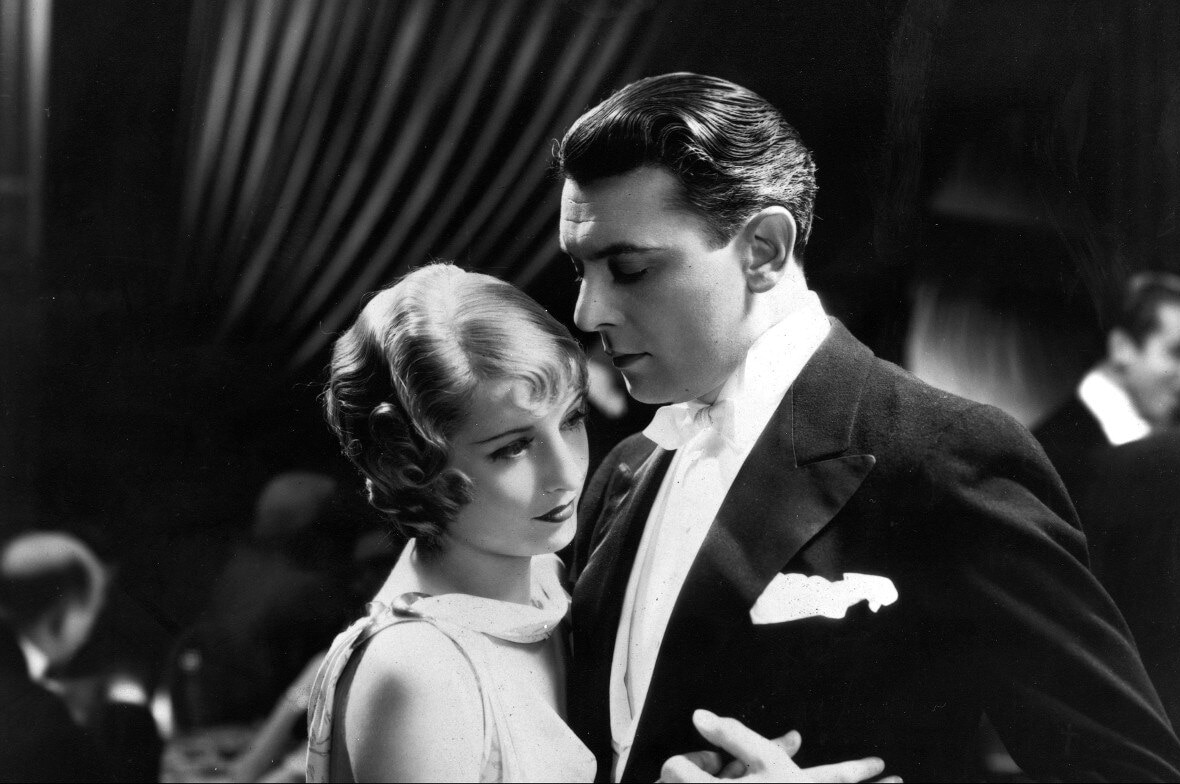
Baby Face - Barbara Stanwyck stars in The-Daring-For-Its-Time BABY FACE - A 1933 Pre-Code Melodrama on DVD
by Jeremy Arnold | December 19, 2006
SIGN UP FOR OUR NEWSLETTERS

CONNECT WITH TCM