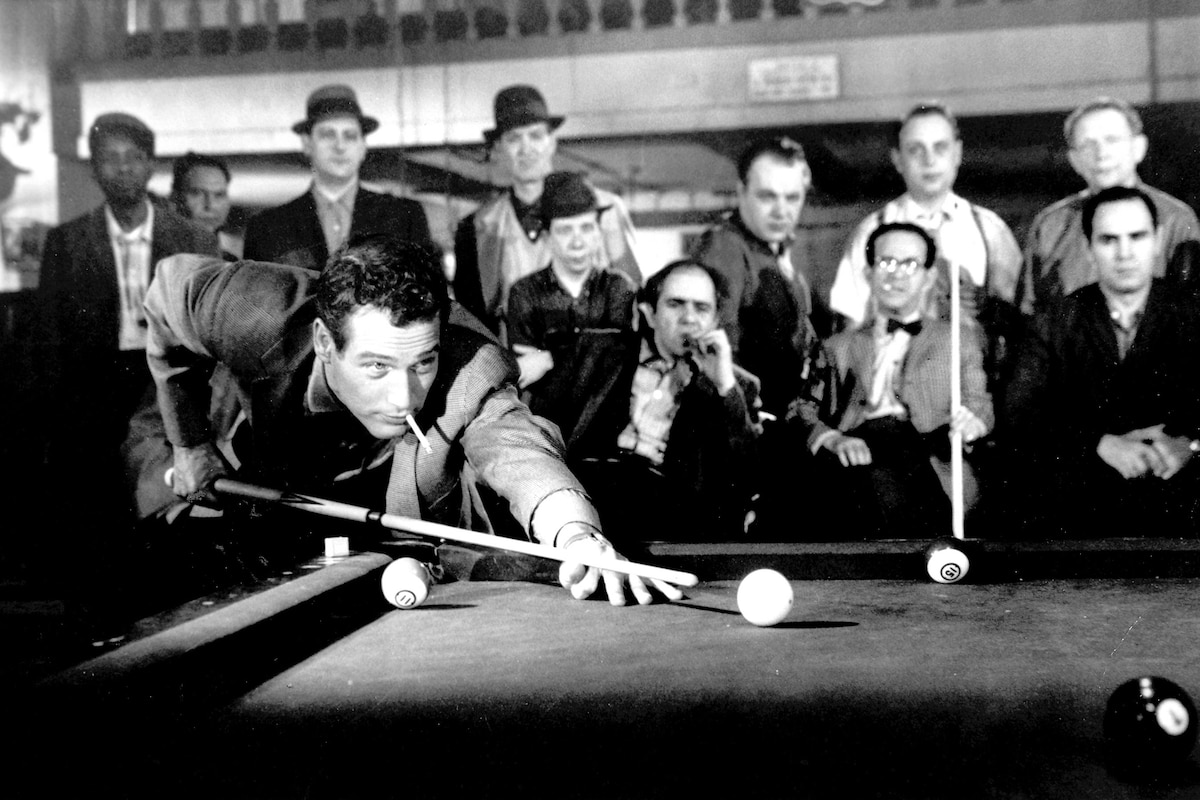
(SYNOPSIS) "Fast" Eddie Felson and his partner-manager Charlie have been
hustling pool around the country for a few years; they set up
a con in which the highly skilled Eddie pretends to be a
mediocre amateur to sucker other players into higher-stakes
games. But Eddie is no mere two-bit hustler; he's an expert
player who longs to take on the best in the business, the
legendary Minnesota Fats. He gets his chance at the famous
Ames Pool Hall in New York, challenging Fats and beating him
game after game. The difference between the two is that Fats
knows how to pace himself, while the headstrong and cocky
Eddie goes beyond his limits and loses every penny of the
$18,000 he initially won from Fats. Abandoning Charlie, who
wants to return to hustling on the road, Eddie falls in with
Sarah, an attractive but depressed alcoholic. The two move in
together and begin to find some semblance of happiness,
although Eddie cannot commit to anything beyond his desire to
defeat Fats and be recognized as the best pool player in the
business. Eventually, he contacts Bert Gordon, a shrewd,
highly skilled gambler-promoter, who agrees to promote his
career and the stage is then set for another match against
Minnesota Fats.
A lot was riding on The Hustler for both the director
and the major cast members, and the picture paid off in a big
way for all of them. Besides the critical accolades and the
film's enduring popularity, it introduced the style and
language of the pool hall to a wide audience and created
characters so indelible that real-life pool players clamored
to be identified as the inspirations for these fictional
creations. The Hustler also received nine Oscar®
nominations including Best Picture, Best Actor (Paul Newman),
Best Supporting Actor (both George C. Scott & Jackie Gleason
were honored), and Best Director. It won Academy Awards for
Best Cinematography (by Eugene Shuftan) and Best Art
Direction-Set Decoration (Harry Horner and Gene
Callahan).
Director Robert Rossen had a promising career, first as a
screenwriter of several notable films of the late 30s and
early 40s, then as director/producer of hard-hitting dramas
such as Body and Soul (1947) and the Oscar®-winning
All the King's Men (1949). But it all went sour in the
1950s. Refusing to testify before the House UnAmerican
Activities Committee (HUAC), Rossen found himself blacklisted.
Tortured by his inability to work at the art and profession
he loved, Rossen relented in 1953 and confessed his former
Communist Party membership, naming other party members to
Congress. Though his career had recovered somewhat, his
projects in the following years didn't quite live up to his
earlier potential. With The Hustler he found at last a
story with which to explore his characteristic themes: power,
corruption, the lure and dangers of fame and success, and the
study of a professional who through talent and ambition rises
to hero status in his field, only to be laid low by flaws in
his character and the exploitative system around him. It was
a project Rossen - as co-writer, producer and director - could
make truly his own, and he found the best collaborators to
make it happen.
The ensemble cast also seized the opportunity to make this a
breakthrough movie for them. Piper Laurie got the chance to
break the mold of pretty ingénue parts she had mostly been
offered for a decade. Jackie Gleason, whose film career had
gone nowhere in the 50s, was able to prove he was a dramatic
actor to be reckoned with and not just a popular TV comedy
star. New York stage actor George C. Scott added another
outstanding performance to his early film career, and garnered
perhaps the best reviews of the picture (today, many people
consider Scott's and Gleason's performances to hold far more
interest than that of the leads).
But the person who gained the most from The Hustler was
Paul Newman. Although he had survived his disastrous debut in
The Silver Chalice (1954) to become a popular leading
man and male sex symbol, Newman's performance in The
Hustler propelled him into the top ranks of actors and
made him the reigning male superstar of the next decade. The
role, and Newman's performance of it, also paved the way for
the rebel anti-heroes of the 60s, the tormented,
less-than-sympathetic characters who would be the central
focus of many films and performances by the likes of such
1970s successors to Fast Eddie as Robert De Niro, Al Pacino,
Jack Nicholson and Warren Beatty.
Producer/Director: Robert Rossen
Screenplay: Sidney Carroll, Robert Rossen, based on the novel
by Walter Tevis
Cinematography: Eugene Shuftan
Editing: Dede Allen
Production Design: Harry Horner
Original Music: Kenyon Hopkins
Cast: Paul Newman (Fast Eddie Felson), Piper Laurie (Sarah
Packard), Jackie Gleason (Minnesota Fats), George C. Scott
(Bert Gordon), Myron McCormick (Charlie Burns).
BW-135m. Letterboxed.
by Rob Nixon
The Hustler
by Rob Nixon | December 18, 2006
SIGN UP FOR OUR NEWSLETTERS

CONNECT WITH TCM