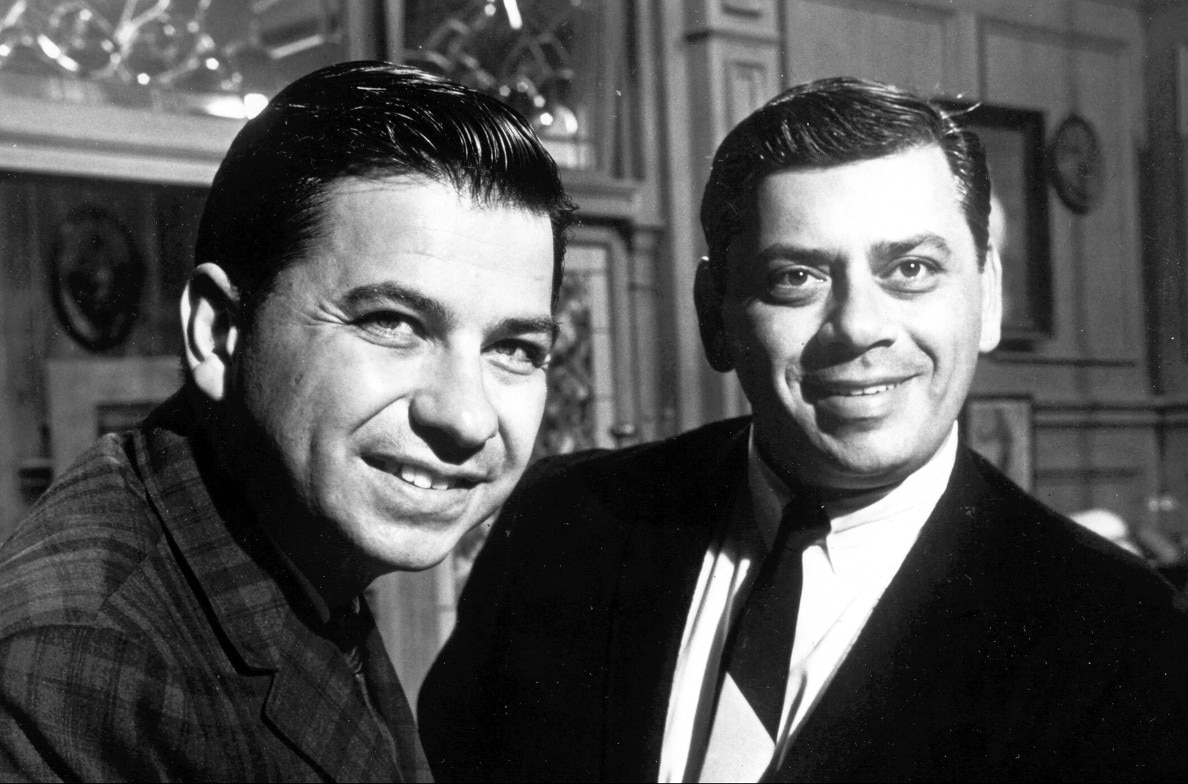
After the success of Mary Poppins (1964), Walt Disney was eager to produce another live-action musical. He already had a film in development based on the hit 1956 Broadway comedy The Happiest Millionaire, and he realized it would be perfect to transform into a musical, so he put Richard M. and Robert B. Sherman, the brothers who had written the songs for Mary Poppins, to work on it right away. They came up with twelve songs to incorporate into A.J. Carothers's screenplay, and to further increase the chances of recapturing the Mary Poppins magic, Disney also brought on the same choreographers, Marc Breaux and Dee Dee Wood.
The property itself had first begun as a book, My Philadelphia Father, by Kyle Crichton and Cordelia Drexel Biddle Robertson. It was about Cordelia's unusual upbringing in 1916 Philadelphia as the daughter of an eccentric millionaire, Anthony J. Drexel Biddle. As shown onscreen, his boisterous household includes live alligators, jujitsu matches in his stables and boxing lessons under cover of bible classes. When Cordelia falls in love with the son of another wealthy family, the Dukes, a family rivalry begins.
The book was the basis for a Broadway comedy written by Crichton and starring Walter Pidgeon. It ran 271 performances starting in November 1956. For the movie, Disney cast Fred MacMurray, in the midst of starring in a series of films for the studio, and Greer Garson, ironically Pigeon's frequent leading lady of the past. He also cast Gladys Cooper in her first feature film since her Oscar-nominated turn in My Fair Lady (1964). Cooper and Geraldine Page portray the two family matriarchs and perform the song "There are Those."
Also in the cast is Lesley Ann Warren as Cordy (Cordelia), in her first credited feature film role, Mary Poppins favorite Hermione Baddeley, and British pop star Tommy Steele in his first Hollywood film as the butler. Disney handed the directing reins to Norman Tokar, who had just directed a string of six other Disney films.
Production started in May 1966. Walt Disney was diagnosed with lung cancer but still oversaw the production, with Bill Anderson handing the day-to-day producing. It would be the last film to be personally overseen by Walt Disney. He saw a rough cut of the picture in the fall, and he died on December 15, 1966.
Post-production was completed in the spring, and the studio held a lavish $100,000 premiere at the Pantages Theatre in Hollywood on June 23, 1967--"the granddaddy of Hollywood premieres," declared Variety. It doubled as a tribute to Walt Disney as well, and began with a parade, dinner at the Brown Derby, a party and stage show, a champagne intermission and a two-block walk to the Hollywood Palladium after the screening, on a closed-off street teeming with Disneyland entertainers. At the Palladium, which was essentially converted into the 1916 Biddle mansion in Philadelphia, guests enjoyed another extravagant party, a second dinner, stage show and dancing until 2:00 am. The stars arrived in old-time cars matching the period of the film, and author Cordelia Drexel Biddle Robertson arrived with California's then-first lady, Nancy Reagan. After the parade, according to a news article, "thousands and thousands of balloons [were sent] soaring into the sky."
The film's critical reception was by contrast quite mild. Newsweek declared "it suffers from cirrhosis of the script." The New York Times deemed it "a laboriously low-brow, high-hat film... The whole picture is vulgar. It is an over-decorated, over-fluffed, over-sentimentalized endeavor." But Variety found it "an outstanding family comedy, with pertinent dramatic overtones, which blends all creative and technical elements to near-perfection... Tommy Steele projects warmth, sincerity, and the right amount of deviltry. A big film career lies ahead."
Film historian and Disney expert Leonard Maltin, in his book The Disney Films, later wrote that the movie hangs uneasily between reality and fantasy. "That it is a lightly enjoyable film is not much to say about such an ambitious production, but that is about the best one can do."
The film premiered in a roadshow version running 164 minutes. It was cut by 46 minutes for general release, so that theaters could squeeze in more screenings per day. The excised footage was restored in 1984.
According to Variety, the film cost $5 million and grossed nearly $13 million, though other sources indicate a much lower gross. The Happiest Millionaire received one Academy Award nomination for Best Costume Design. Bill Thomas created 3000 costumes in all for the film, including 250 for the principal characters. Composer Richard M. Sherman can be seen in a cameo as a flautist at a garden party toward the end of the movie.
By Jeremy Arnold
The Happiest Millionaire
by Jeremy Arnold | August 28, 2019
SIGN UP FOR OUR NEWSLETTERS

CONNECT WITH TCM