Fun and Fancy Free (1947) was the ninth full-length musical cartoon from Walt Disney Productions. It was created from two stories, Bongo and Mickey and the Beanstalk, that had each been intended as stand-alone features and were in production in 1941 but neither were completed until 1947.
Bongo was based on the 1930 Sinclair Lewis short story Little Bear Bongo, which had first appeared in Cosmopolitan. Bongo is a unicycle-riding bear cub who is forced to work in a circus while dreaming of freedom. When the opportunity to escape comes, Bongo flees to the forest where he falls in love with a female bear called Lulubelle and must fight another bear, Lumpjaw, to win her affections. Popular vocalist Dinah Shore sings "Lazy Countryside," "Too Good to Be True" and "Say It with a Slap" and acted as narrator. When the film went into production, Cliff Edwards reprised his role of Jiminy Cricket, allowing Disney to capitalize on the character's popularity thanks to his appearance in Disney's Pinocchio (1940), which had just been released.
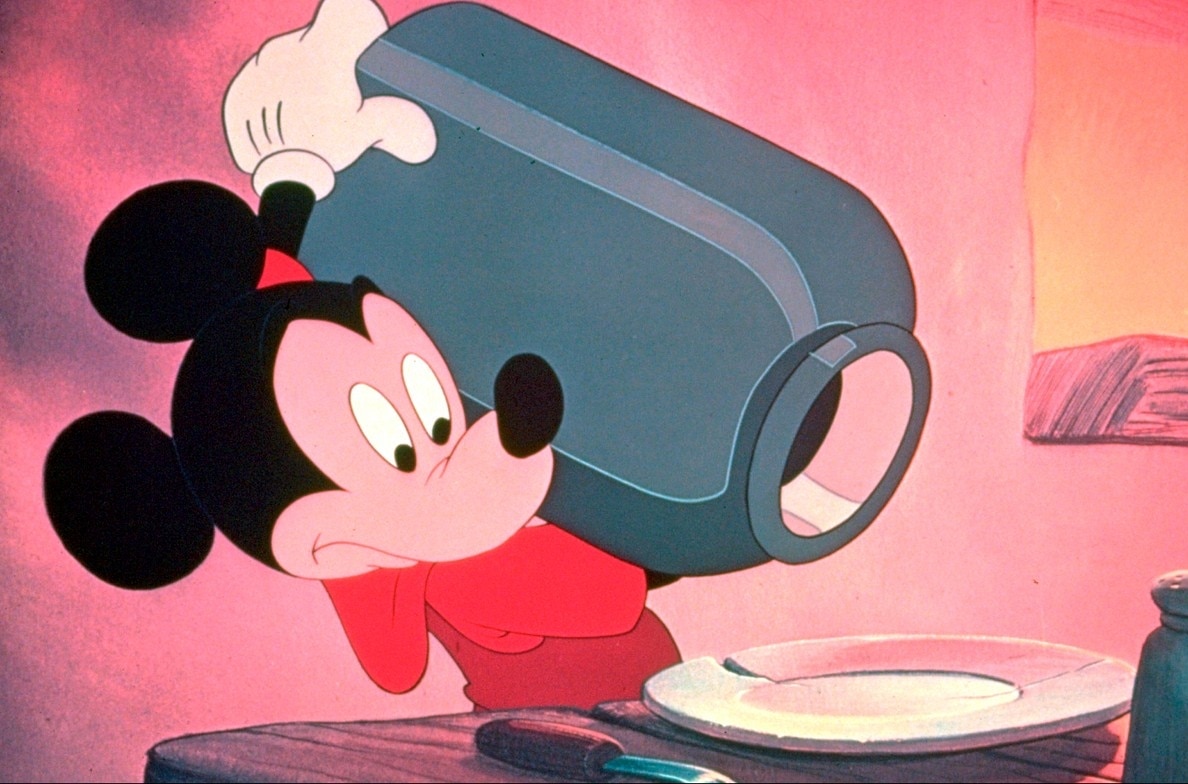
The second part of the film is Mickey and the Beanstalk based on the old Jack and the Beanstalk tale, with Mickey Mouse, Goofy and Donald Duck instead of the "Jack" character. As in the traditional story, the three use magic beans to grow a beanstalk that leads them away from their "Happy Valley" home to a castle in the sky owned by a giant named Willie. There they find a singing gold harp who has been kidnapped by the giant. The giant is eventually defeated and later reappears at the famous Brown Derby restaurant in Hollywood, where he places the hat-shaped restaurant on his head and goes in search of Mickey Mouse. Providing voices were Billy Gilbert, Anita Gordon and Disney staples Clarence Nash and Pinto Colvig. This would be the last time that Walt Disney himself would provide the voice of Mickey Mouse for a feature, since the demands of running an ever-expanding studio were too much to allow him the time necessary to do voiceovers. James MacDonald, who voiced Lumpjaw in Fun and Fancy Free would take over the role from Walt Disney after this film and continue to play the part for the next 30 years.
This was not the first time that Disney had produced a version of the Jack and the Beanstalk story; his Laugh-O-gram production company had animated it in 1922, and in 1933 he returned to the subject in Giantland. Mickey and the Beanstalk had been floated around the studio as a feature-length film since early in 1940 when animators T. Hee and Bill Cottrell pitched the idea to Disney, who laughed at the idea but was concerned about the potential for altering his established characters. In the end, he was convinced and production began with animation directors Ward Kimball, Les Clark, John Lounsbery, Fred Moore and Wolfgang Reitherman for about six months until the United States was attacked on December 7, 1941 by Japan. Once war was declared, the Disney studio was commandeered by the military to produce propaganda and training films, which sometimes cost the studio more to produce than the government reimbursed. Because so much manpower was being diverted to the war effort, few production materials were available due to wartime restrictions, and only a small amount of money could be diverted to entertainment. Fun and Fancy Free was put onto the back burner until late 1945 when production resumed.
When Fun and Fancy Free was released in September 1947, The New York Times film critic Bosley Crowther wrote that it was "a gay and colorful show--nothing brave and inspired but just plain happy. [...] Apparently Mr. Disney thought he had something cute in the use of Edgar Bergen to narrate his second episode. But the live-action cut-ins of Mr. Bergen relating the Beanstalk tale to Charlie McCarthy and Mortimer Snerd, his two famed dummies and a little girl named Luana Patten are not inspired. The humans, as usual, look incongruous. [...]But there is one passage in it which the sophisticates should find much to their taste. That is the passage wherein the beanstalk sprouts and reaches toward the sky, writhing and gliding in the moonlight to the rhythms of a flutey symphony. There is madness and menace in this sequence, a sort of evil fascination for eye and ear, restrained by climactic comic touches. It is such stuff as this in Disney pictures that nourishes faith."
SOURCES:
100 Greatest American and British Animated Films. (n.d.).
AFI|Catalog. (n.d.). Retrieved from https://catalog.afi.com/Search?searchField=MovieName&searchText=FUN+AND+FANCY+FREE&sortType=sortByRelevance
Fun & Fancy Free (1947). (n.d.). Retrieved from https://www.imdb.com/title/tt0039404/fullcredits?ref_=tt_ov_wr#writers/
Fun and Fancy Free | TV Guide. (n.d.). Retrieved from https://www.tvguide.com/movies/fun-fancy-free/review/124027/
'Fun and Fancy Free,' a Disney Cartoon, With Bongo,Escaped Circus Bear, Provides Gay and Colorful Show at Globe. (1947, September 29). Retrieved from https://www.nytimes.com/1947/09/29/archives/fun-and-fancy-free-a-disney-cartoon-with-bongoescaped-circus-bear.html
Fun and Fancy Free. (2019, April 22). Retrieved from https://www.skywaytowonderland.com/fun-and-fancy-free/
Fun and Fancy Free. (n.d.). Retrieved from https://movies.disney.com/fun-fancy-free
RKO Radio Pictures Horror, Science Fiction and Fantasy Films, 1929-1956. (n.d.).
By Lorraine LoBianco
Fun and Fancy Free
by Lorraine LoBianco | August 28, 2019
SIGN UP FOR OUR NEWSLETTERS

CONNECT WITH TCM