In the early sound era, a spate of movies revolving around college football attracted audiences to the theaters. Throughout the 1920s, college football had grown increasingly popular as renowned players and coaches made headlines, including Notre Dame coach Knute Rockne and his Four Horsemen, innovative coach Pop Warner and legendary player Red Grange. In 1931, the latter starred in his own 12-chapter serial, The Galloping Ghost, in which he played a fictionalized version of himself. Hollywood reflected and likely furthered the popularity of football in a number of films--from the musical Maybe It's Love (1930) and the drama Maker of Men (1931) to the Marx Brothers' Horse Feathers (1932).
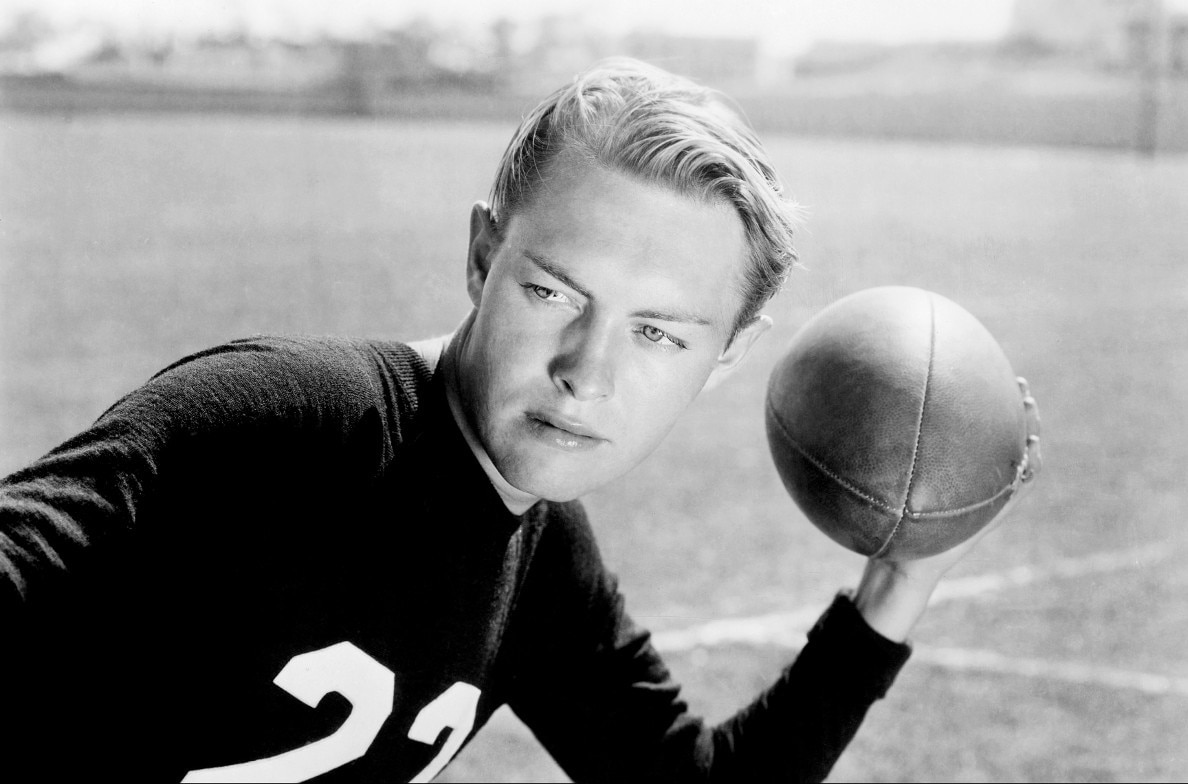
The football-themed movie peaked in 1932 with the release of at least eight Hollywood features, including That's My Boy. Unlike most football films, which tended to focus on the athlete's struggles to win the big game, That's My Boy depicted the dark side of college football. Richard Cromwell stars as Thomas Jefferson Scott who enrolls at Thorpe University to become a doctor. His plans are changed by the school's coach who persuades Tommy to join the football team with the promise of free tuition. Tommy trades in his goal of becoming a doctor for the glory and recognition of being the star player for the college. When he meets a former football hero reduced to working as a clerk, Tommy realizes that such a future likely awaits him. He demands $50,000 to stay on the team. The team's manager obtains the money, which is placed in a holding company, but the stock market crash wreaks havoc on Tommy's financial security as well as his integrity.
The film benefitted from the participation of director Roy William Neill and scriptwriter Norman Krasna. Neill had learned his craft in the silent era, directing around 40 films. That's My Boy was assigned to him while he was under contract to Columbia, where Neill made several films in a variety of genres, including the atmospheric chiller The Black Room (1935) with Boris Karloff. Often unfairly dismissed as a B-movie director, Neill knew how to get the most out of any material assigned to him, with his meticulously lit scenes and deliberate use of shadows. Neill left Columbia in 1935 to work in England. Upon his return to Hollywood, he directed several films in the Sherlock Holmes series starring Basil Rathbone.
That's My Boy launched the career of scriptwriter Norman Krasna, who had been a newspaper columnist in New York City before moving to Hollywood to work in the publicity department of Warner Bros. His play Louder, Please was produced by George Abbott on Broadway; shortly thereafter, he was hired by Columbia Pictures as a junior staff writer. After writing the dialogue for a review titled Hollywood Speaks (1932), Krasna penned his first script, which was for That's My Boy. The writer learned his craft quickly. Two years after That's My Boy, he scripted The Richest Girl in the World (1934), which earned him an Academy Award nomination. Eventually, he wrote for most of the major studios, and his scripts were directed by the biggest names of the Golden Age--Fritz Lang, Alfred Hitchcock and Garson Kanin, among others. Known for his romantic comedies, Krasna wrote and directed Princess O'Rourke, winning an Oscar for Best Original Screenplay.
The cast of That's My Boy included two stars who were at the peak of their brief careers, though they did not realize it at the time. Richard Cromwell was working as an extra when he landed the title role in Tol'able David (1930) after auditioning on a whim. The jolt into the spotlight resulted in a string of roles as the fair-haired young man. In That's My Boy, his star image as the fresh-faced innocent full of youthful energy and ambition fits the story of a good student tainted by the politics of college football. As the decade progressed, Cromwell eased into secondary roles, such as Henry Fonda's brother in Jezebel (1938). Cromwell served in the Coast Guard during World War II, and, upon returning to Hollywood, he chose to pursue his former career as a fine artist.
Dorothy Jordan made a solid effort to pursue stardom in the pre-Code era. In 1932, she appeared in more films than in any other year of her career. However, poor reviews and routine leads in lackluster films hampered her progress. She more or less retired in the mid-1930s after settling down in her marriage to Merian C. Cooper.
Movie lovers should enjoy seeing silent star Mae Marsh in the role of Tommy's mother. Marsh had been one of D.W. Griffith's favorite actresses because she embodied the opposing characteristics he preferred in his heroines. Though youthful, she evoked a maturity beyond her years; though delicate-looking, she was spiritually strong. She left the silent screen in the mid-1920s but reinvented herself as a mature character actress in the sound era. Reviews from as far away as Australia included her name with Cromwell's and Jordan's as key attractions for the film, while others noted her "heart-appealing" presence in the role of the mother.
Any discussion of the cast must include mention of John Wayne, who appeared as a player on the field during the game scenes. He did not receive an individual credit, but the background players were collectively billed as the "University of Southern California football team, 1931 National Champions," though Wayne was not part of the 1931 team. Real-life USC players Russell Saunders and Oscar 'Dutch' Hendrian received bit roles as Pinkie and Hap.
Producer: Roy William Neill for Columbia Pictures
Director: Roy William Neill
Screenplay: Norman Krasna from the novel by Francis Wallace
Cinematography: Joseph H. August
Editor: Jack Dennis
Costumes: Robert Kalloch
Music: Charles Kisco
Cast: Tommy Jefferson Scott (Richard Cromwell), Dorothy Whitney (Dorothy Jordan), Mom Scott (Mae Marsh), Pop Scott (Arthur Stone), Coach 'Daisy' Adams (Douglass Dumbrille), Uncle Louie (Lucien Littlefield), Al Williams (Leon Waycoff), Pinkie (Russell Saunders ), Carl (Sumner Getchell), Mayor (Otis Harlan), Hap (Oscar 'Dutch' Hendrian), First Student (Elbridge Anderson), Second Student (Crilly Butler), Tommy as a Boy (Douglas Haig), University of Southern California Football Team
1932 B&W 71 mins.
By Susan Doll
That's My Boy (1932)
by Susan Doll | August 23, 2019
SIGN UP FOR OUR NEWSLETTERS

CONNECT WITH TCM