Pierce Brosnan took his second assignment as the most famous secret agent in the world in Tomorrow Never Dies (1997), the 18th official James Bond feature. It was the first 007 film produced after the death of Albert "Cubby" Broccoli, the producer who shepherded the series since its 1962 debut Dr. No and founded Eon Productions. Broccoli's daughter, Barbara Broccoli, and stepson Michael G. Wilson officially took the reins of Eon to produce the biggest film in the franchise to date.
This globetrotting thriller pits Bond against megalomaniac media baron Elliot Carver, a thinly veiled Rupert Murdoch parody played with gusto by Jonathan Pryce. Ruthless and amoral, Carver's motto is "There's no news like bad news" and plots to push the world to the brink of war and take over a destabilized China, grabbing the eyeballs of the world along the way as he turns every step into a breaking news story. Bond is particularly suited to this mission because Carver's beautiful wife Paris (an elegant Teri Hatcher) is also Bond's former lover, but her role is secondary to that of Chinese agent Wai Lin, played by Hong Kong action star Michelle Yeoh. The former Miss Malaysia earned international acclaim performing opposite Jackie Chan in the stunt spectacle Police Story 3: Supercop (1992) and made her English language debut playing the first Bond heroine to not just hold her own but match the suave super-agent blow for blow.
Brosnan made his debut as 007 in GoldenEye (1995) with Judi Dench and Samantha Bond as the new M and Miss Moneypenny, respectively. They return for Tomorrow Never Dies along with Joe Don Baker, reprising his role as CIA agent Jack Wade, and the reliable Desmond Llewelyn, back for his 16th appearance as gadget man Q (he appeared one more time before his death in 1999).
GoldenEye revitalized the franchise with a return to exotic locations and big action set pieces after the box-office disappointment of the grittier Licence to Kill (1989), and a follow-up was quickly planned for a December 1997 release date. The production had to overcome some major obstacles to make the deadline. Eon had numerous script treatments in pocket but wasn't satisfied with any of them and GoldenEye helmer Martin Campbell was unavailable ("Martin just didn't want to do two Bond films in a row," according to his agent). Anthony Hopkins had been in talks to play the villain but dropped out when he committed to The Mask of Zorro (1998), directed by Campbell, ironically enough.
Meanwhile the Leavesden studio, which was built out of an abandoned Rolls-Royce factory to film GoldenEye, was unavailable and Pinewood Studios was unable to accommodate the scope of the productions. So the Eon team built another studio from scratch, this time out of a former grocery warehouse in Hertfordshire, 30 miles from Pinewood. Then, two months before the commencement of production, plans to shoot in Ho Chi Minh City in Vietnam were halted when their visa was rescinded.
Roger Spottiswoode (who had a big hit with the action comedy Turner and Hooch, 1989) had approached Broccoli about directing a Bond film during the Timothy Dalton tenure in the 1980s. He was signed as director and given a new screenplay by GoldenEye co-writer Bruce Feirstein that tossed Bond into the new world of global media and manipulation. With a script polish by Nicholas Meyer and Daniel Petrie Jr. (among others) under Spottiswoode's direction, the film was rushed into production, with Feirstein continuing to rewrite right up to the start date. Finally, on April 1, 1997--eight months before its scheduled release date--principal photography commenced in London, followed by location shoots in Bangkok (substituting for Vietnam), the Pyrenees in France (doubling for the Khyber Pass), Hamburg, Germany and at the Baja Studios in Mexico to use the giant water tank built for Titanic (1997). The production was able to secure the massive 007 Stage at Pinewood, where the full-size bridge of Carver's Stealth ship was built. The sprawling set was built over a water tank, which played a central role in the climactic battle.
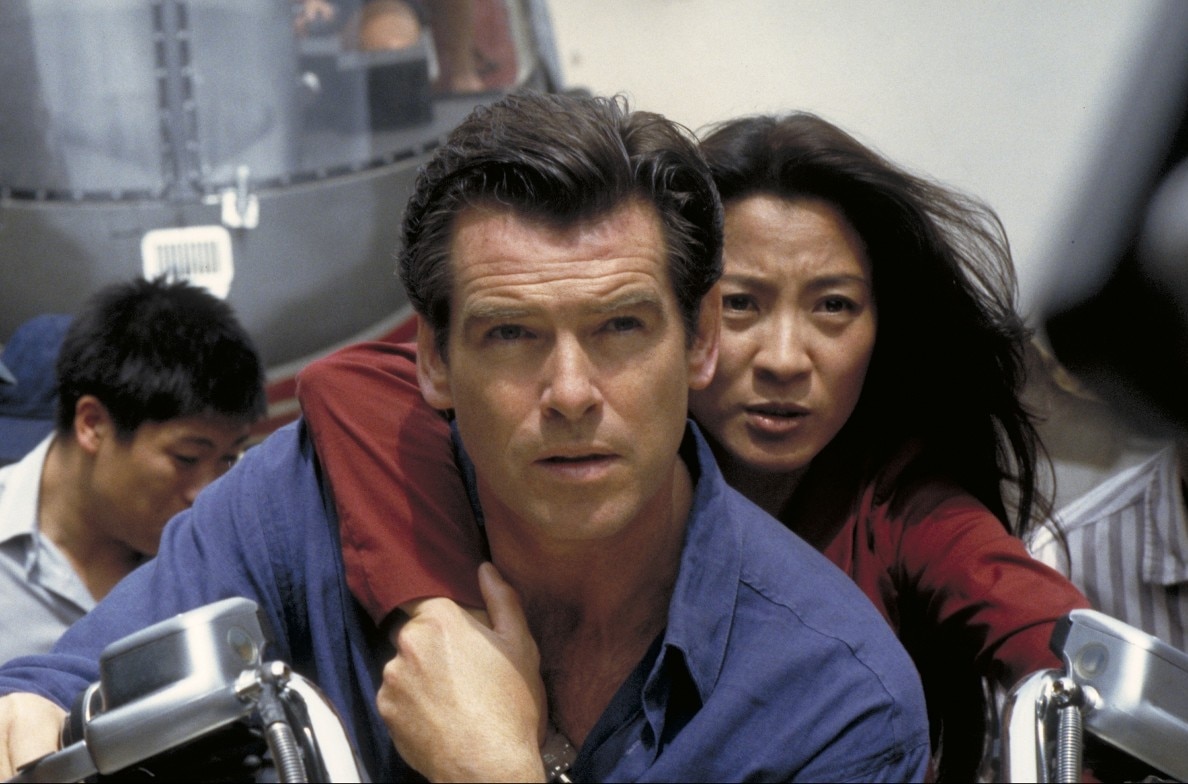
According to Spottiswoode, it was his idea to cast Michelle Yeoh as a different kind of Bond girl. The director put his spin on the action spectacle with Bond guiding a gadget-stocked BMW 750iL through a car park via remote control and a dazzling motorcycle chase with Bond and Wai Lin snaking through the streets of Saigon (recreated at the new Hertfordshire studio) while pursued by cars and a helicopter. And Bond upgrades his reliable Walther PPK with a new Walther P99, a gift from Wai Lin.
According to Spottiswoode, the title of the film was a happy accident. "[W]e had a list of 5 to 10 potential titles, amongst them 'Tomorrow Never Lies'," recalled the director in a 2004 interview. The list was faxed to MGM in the U.S. and the title was misread in the transition. "[T]he next day we had a phone call from MGM, telling us 'We love your title 'Tomorrow Never Dies'! That's going to be it.' Nobody dared to tell them the truth!" With the title in place, the producers invited popular singers and pop groups to submit potential theme songs. Sheryl Crow's song was chosen as the film's signature tune (it earned Golden Globe and Grammy nominations) while a second song written by David Arnold (who composed the score) and sung by k.d. lang played over the end credits.
Tomorrow Never Dies hit its Christmas 1997 window, with a gala premiere on December 9, 1997 followed by a general UK release on December 12 and a U.S. release a week later on December 19. Its American debut coincided with the opening of James Cameron's Titanic, a juggernaut that threatened to sink all competition. Titanic went on to become the biggest moneymaker of all time, a record it held for two decades, but Bond held his own. Tomorrow Never Dies was a worldwide hit and the biggest Bond film yet in the U.S. Brosnan's tenure as Bond was cemented. He returned in 1999 in The World Is Not Enough.
Sources:
Tomorrow Never Dies: Commentary, Vic Armstrong and Michael G. Wilson. MGM Home Entertainment, 2006.
Highly Classified: The World of 007, documentary directed by David L.G. Hughes. MGM Home Entertainment, 1998.
Bond By Design, Meg Simmonds. DK, 2015.
The Essential James Bond, Lee Pfeiffer and Dave Worrall. Boxtree, 1998.
"MGM'S Completion Bond," Rex Weiner and Adam Dawtrey. Variety, December 30, 1996.
"Yesterday's Tomorrow: An Interview with Roger Spottiswoode," Kevin Collette. Mr. KissKiss BangBang website, April 10, 2004.
IMDb
By Sean Axmaker
Tomorrow Never Dies
by Sean Axmaker | August 22, 2019
SIGN UP FOR OUR NEWSLETTERS

CONNECT WITH TCM