By 1983, the James Bond franchise was in the midst of a bizarre year, as it featured two different versions of the iconic character. There was Roger Moore in Octopussy, the 13th official entry in the film series (Moore's sixth), and then Sean Connery's return in Never Say Never Again, an offshoot made possible after a lengthy legal battle over the rights to Thunderball (1965). Thus, the stage was set for competing and rapidly aging Bonds. At its year of release, Moore was 56 and Connery was 53, proving that it was past time to hand down the role to a younger generation. Octopussy was the winner at the box office, and though it will never top any Bond rankings, it has plenty of compensatory pleasures, from its production design to its ambitious action sequences.
Octopussy took its name from Ian Fleming's short story collection Octopussy and the Living Daylights (1966), though the screenplay by George MacDonald Fraser, Michael G. Wilson and Richard Maibaum is largely original. Fraser, who had gained success with the Flashman adventure novels, wrote the first pass. According to his memoir The Light's On at Signpost, he asked producer Albert "Cubby" Broccoli to list all the locations Bond had already visited. They agreed upon India as the main locale he had yet to explore, joining a group of British productions dealing with colonial subjects, such as Gandhi (1982), Heat and Dust (1983), A Passage to India (1984) and TV productions like HBO's The Far Pavilions (1984) and ITV's The Jewel in the Crown (1984). Unlike those however, Octopussy has no interest in reckoning with Britain's colonial legacy; instead it's an opportunity for some Bondian tourism - lush hotels, beautiful women, exotic exteriors. As James Chapman writes in Licence to Thrill, Octopussy is set in a present where Anglo-Indian relations are uncomplicated by racial or political problems.
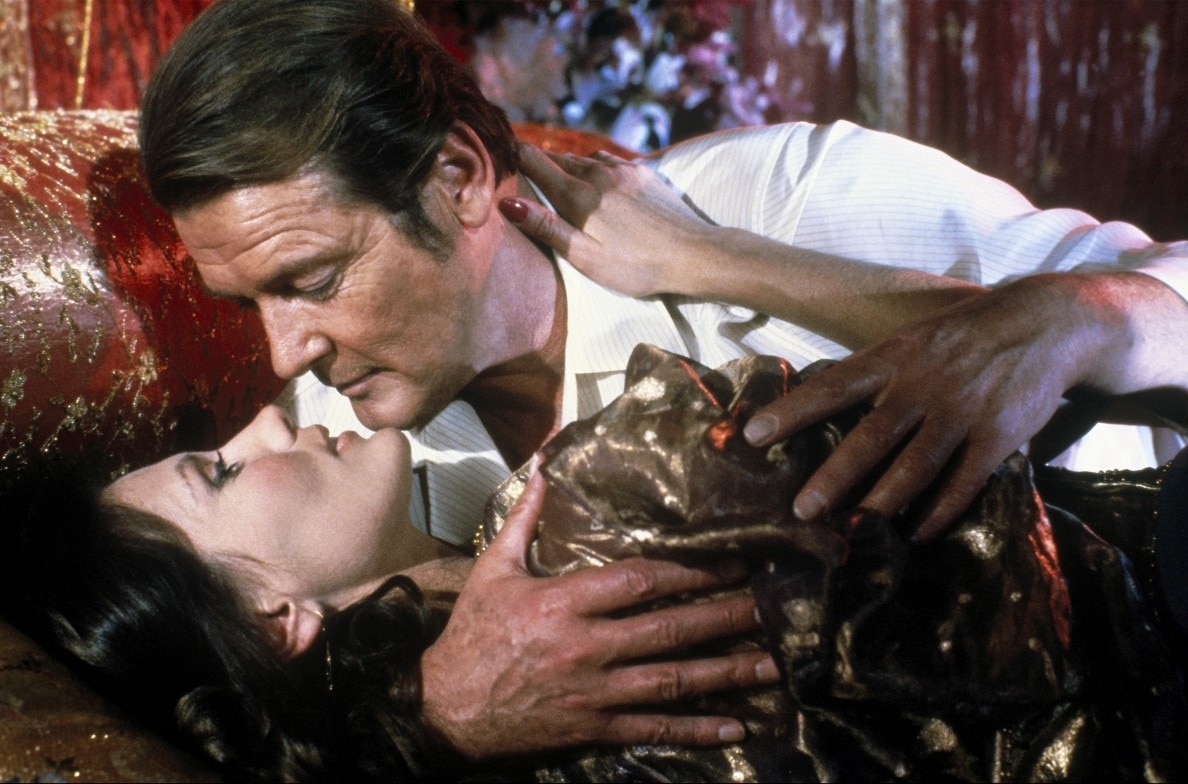
Bond ends up in India because he is tracking the movements of an exiled Afghan prince named Kamal Khan (Louis Jourdan) and his henchwoman Magda (Kristina Wayborn). It's a complicated business involving a Faberge egg, a dead agent in a clown costume and the re-nuclearization of Russia via a mad general named Orlov (Steven Berkoff). All of these lines connect back to the titular Octopussy (Maud Adams), a circus owner and jewel smuggler who lives on an island solely populated by beautiful women, which Bond oh so reluctantly sneaks onto. Production designer Peter Lamont took the already-stunning Taj Lake Palace and embroidered a matriarchal society out of it that incorporates octopus details into every room, including Octopussy's brass cephalopod bed.
He gets in via a crocodile submarine, with Roger Moore's head popping out of the back of the fake croc's throat with all the subtlety of a stripper popping out of a cake. It's a preposterously silly bit of tech that could only make sense in the Bond universe. It's representative of the clashing tones of the film, which veers from Bond wearing clown and gorilla suits to somberly debating the merits of denuclearization. It seems to be aiming for the more serious tone of the most recent bond, For Your Eyes Only (1981), but can't fully shake the goofiness of Moonraker (1979).
Moore had settled into the role by now, a savvy underplayer who never dominates a scene. But it's clear and understandable that the physical demands of the job are beyond him at this stage of his life. Even the punches look like a struggle. Director John Glen and his production team do a fine job of cutting around him though, pulling off some invigorating action setpieces, including the pre-credit opener in which Moore pilots a microjet through an airplane hangar to evade a missile bearing down on him. In DGA Quarterly Jeffrey Ressner interviewed Glen about this sequence - "We shot Roger in the Bede jet at Pine-wood with a sky backing and smoke blowing through a wind machine, with the camera on tracks zooming in and out to make it more realistic. We didn't have computer effects, so everything was smoke and mirrors. We frequently used these moving backings, which were very much lo-tech." Add in some fireworks, exploding miniatures and precise stunt driving, and a spectacular sequence came into being. Glen's experience as an editor surely helped him in conceiving and storyboarding these sequences, which are the main reason Octopussy is still worth seeing today.
By R. Emmet Sweeney
Octopussy
by R. Emmet Sweeney | August 22, 2019
SIGN UP FOR OUR NEWSLETTERS

CONNECT WITH TCM