James Bond conquered space in the 11th Bond film from producer Albert R. Broccoli. Before taking off, he also fought his way through the Venetian canals and the Brazilian rain forest. The 1979 secret agent thriller Moonraker is the fourth in the series to star Roger Moore, the third and last directed by Lewis Gilbert, who had revitalized the series two years earlier with The Spy Who Loved Me (1977), and the final Bond film to feature Bernard Lee as M. He passed away during pre-production for the next film, For Your Eyes Only (1981).
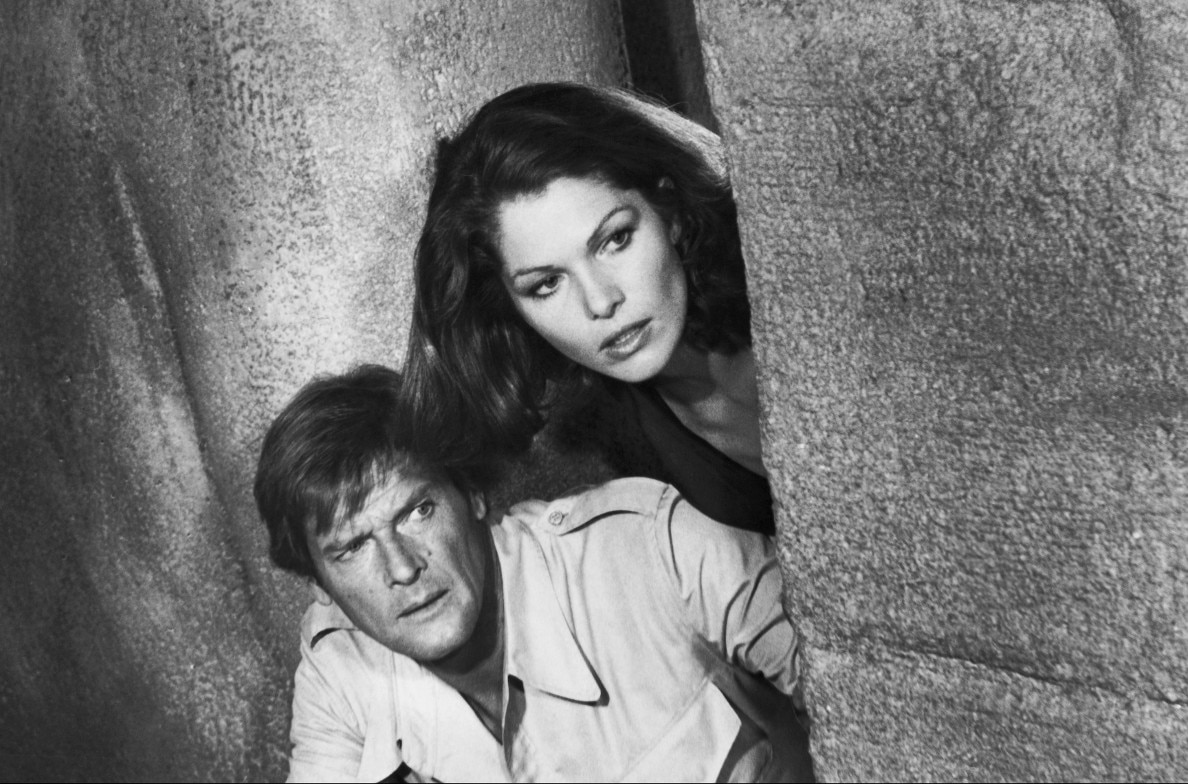
Bond's nemesis this time out is millionaire industrialist Hugo Drax (Michael Lonsdale), who designed and built the Moonraker, a space shuttle. When the first Moonraker disappears, Bond is sent to investigate, quickly discovering the shuttle was stolen by Drax as part of his scheme to destroy the Earth's population and replace them with a handpicked master race. Along the way, Bond battles Drax's two henchmen, the martial-arts expert Chang (Toshiro Suga) and the hulking Jaws (Richard Kiel), whom he had fought previously in The Spy Who Loved Me. He is helped by Holly Goodhead (Lois Chiles), a beautiful astronaut working for the CIA.
Ian Fleming based his 1954 novel on a screenplay he had written earlier. Although Bond's nemesis is Drax, as in the film, the rest of the plot is significantly different, with Drax building a super missile with which to drop a nuclear bomb on London. John Payne first optioned the novel for the screen, paying $1,000 a month to hold onto the rights until he learned Fleming would not sell him the other books in the Bond series. At that point, he dropped the project. Then J. Arthur Rank optioned the novel, but did nothing with it, selling the rights back to Fleming in 1959. Finally, Harry Saltzman bought the film rights to the entire series and joined Albert R. Broccoli in a partnership to make the James Bond series.
Originally Albert Broccoli had planned to film For Your Eyes Only after The Spy Who Loved Me and even had announced that at the end of the previous film. With the success of Star Wars (1977), however, he decided to go with a story with stronger science fiction elements. For Your Eyes Only would follow Moonraker in 1981. In amping up the science-fiction elements, screenwriter Christopher Wood departed significantly from the original. This was par for the course with the Bond films, which had stopped crediting Fleming's novels with You Only Live Twice (1967). The production company even issued its own novelization by Wood, titled James Bond and the Moonraker. Eventually, elements of the original's plot were used in GoldenEye (1995) and Die Another Day (2002).
Because of recent changes in British tax law, this is one of the few Bond films not shot largely at Great Britain's Pinewood Studios. They were only used for special effects work, while the rest of the film was shot on French sound stages, with location work in Italy, Brazil, Guatemala and the U.S. To qualify as an Anglo-French co-production, they cast French actors Lonsdale and Corinne Clery, the latter as Drax's pilot. Clery's character was originally supposed to be an American Valley girl type, but she was changed to a Frenchwoman to accommodate the casting.
The other major roles were filled by Chiles and Kiel. After her appearance in The Great Gatsby (1974),Chiles had taken a break from acting to care for her brother, who suffered from Non-Hodgkin's Lymphoma. As a result, she turned down the chance to star in The Spy Who Loved Me, with the role going to Barbara Bach instead. Her brother passed in 1978, and she returned to acting with supporting roles in Coma and Death on the Nile (both 1978). She happened to be seated next to Gilbert on a plane ride, and that led to her being cast as Dr. Holly Goodhead in Moonraker. Jaws had been so popular in The Spy Who Loved Me that Broccoli decided to bring him back for the next film. Originally, he was to have been the main villain, but the actor received so much fan mail from children that he was given a more sympathetic story line, including a love interest. This is the only Bond film in which the character speaks.
Shooting in France posed unique problems. They could only shoot an eight-hour day, which Moore found relaxing. French crews were not allowed to work overtime. When the French production crew saw set designer Ken Adam's sketches, however, they were so impressed, they agreed to work extra hours to complete it. On Sundays, they even brought their families to the studio to visit with them while they worked. For the space station's interior, the crew built the largest set ever constructed for a French film.
Moonraker contains some of the most spectacular action scenes in the Bond series. For Bond's fight with an enemy pilot while in free fall, the crew could only shoot for a few seconds at a time before they had to open their parachutes. It took 88 jumps to complete the sequence. Bond's battle with Drax's bodyguard Chang in the St. Mark's bell tower in Venice used more breakaway glass than any previous film. For the chase through the Venetian canals, Moore went through five silk suits, because he kept getting dumped in the water. He dubbed his combination gondola and hovercraft the "Bondola."
With its extensive special effects, Moonraker cost a then high $34 million. to make, almost as much as the first eight films combined. The title sequence alone cost more than Dr. No (1962). As the first film to feature a modern space shuttle, Moonraker was supposed to be released at the time of the shuttle's first launch and premiere in Houston. Unfortunately, delays in the space program pushed the launch back two years, so the premiere was moved to London. The film won an Oscar nomination for Derek Meddings' special effects.
Moonraker opened to mixed reviews. Although Vincent Canby of the New York Times called it "one of the most buoyant Bond films of all," and Time critic Frank Rich called it "irresistibly entertaining as only truly mindless spectacle can be," Roger Ebert, writing for the Chicago Sun-Times, considered it over-stuffed, "so jammed with faraway places and science fiction special effects that Bond has to move at a trot just to make it into the next scene." Despite the naysayers, Moonraker would become the highest-grossing Bond film at that time, with more than $210 million in international grosses. That record would not be broken until the release of GoldenEye, the first of Pierce Brosnan's Bond films in 1995.
Director: Lewis Gilbert
Producer: Albert R. Broccoli
Screenplay: Christopher Wood
Cinematography: Jean Tournier
Score: John Barry
Roger Moore (James Bond), Lois Chiles (Holly Goodhead), Michael Lonsdale (Hugo Drax), Richard Kiel (Jaws), Corinne Clery (Corinne Dufour), Bernard Lee (M), Geoffrey Keen (Sir Frederick Gray), Desmond Llewelyn (Q), Lois Maxwell (Miss Moneypenny), Alfie Bass (Consumptive Italian), Ken Adam (Man at St. Mark's Square), Arthur R. Broccoli (Man at St. Mark's Square), Dana Broccoli (Woman at St. Mark's Square), Lewis Gilbert (Man at St. Mark's Square)
By Frank Miller
Moonraker
by Frank Miller | August 22, 2019
SIGN UP FOR OUR NEWSLETTERS

CONNECT WITH TCM