The ninth James Bond film and the third to star Roger Moore was the most expensive to produce up to that point, costing as much as the prior two releases combined. But, it was the best received yet, more than doubling the domestic box office of the previous entry, The Man with the Golden Gun (1974), and garnering some of the best reviews of the Moore series.
The success can be attributed to a number of factors, not least the urbane lightness and self-aware sense of humor Moore brings to the 007 character. Replacing the original Bond, Sean Connery, was always going to be tricky business - just ask George Lazenby, the Australian actor plucked from near obscurity for the first non-Connery release, On Her Majesty's Secret Service (1969), and just as quickly returned to big screen oblivion when fans and critics rejected his approach (an assessment that has since been reevaluated in many quarters). Moore had the advantage of not only being already well-known but having established a suave roguishness with his longtime TV role in The Saint, allowing him to put his own stamp on Bond while staying within audiences' expectations of the master spy.
From the start, the Bond movies had been preposterous in many ways, particularly in some of the "high-tech" weapons and over-the-top action sequences. The Moore pictures often took the improbability even farther while amping up the winking self-mockery. The Spy Who Loved Me, however, downplayed the silliness to a degree and offered one of the most celebrated stunt-driven set pieces in the series' history, a pre-title sequence in which Bond, pursued by Russian agents in the Alps, skis backwards, unleashes a lethal weapon built into his ski pole and flies off the edge of a sheer cliff, freefalling in silence for several seconds before opening a parachute printed with the British Union Jack to the strains of the familiar Bond theme. Despite some tacky rear projection for Moore's close-ups on the slopes, audiences found the sequence thrilling. According to a production company executive, even Prince Charles stood and applauded during a screening he attended.
The story features one of the least ridiculous "Bond Girls," who usually sported cutesy-salacious names like Kissy Suzuki, Pussy Galore, Holly Goodhead and the outrageously monikered Octopussy. As Russian agent Anya Amasova/Agent XXX, Barbara Bach (in a role reportedly sought by Catherine Deneuve) goes from capable nemesis to reluctant colleague to ardent lover as she and Bond team up to thwart the plans of a mad shipping tycoon who wants to start a nuclear war between the two superpowers (shades of the earlier You Only Live Twice, 1967) in order to drive Earth's population to live in the underwater city he has developed.
The picture also boasts one of the most memorable and improbable of 007's would-be assassins, the seven-foot Jaws, an apparently indestructible villain so popular that he was brought back for this movie's follow-up, Moonraker (1979). The connection to Steven Spielberg's 1975 blockbuster is no accident. Sporting a mouth full of lethal metal teeth, the character (based on the Ian Fleming source novel's "Horror" Horowitz and renamed for obvious reasons) was supposed to be killed by a shark near the end of the movie, but test audiences liked him so much the situation was reversed and Jaws ends up chomping the animal to death.
Moore's series continued the tradition of popular title tunes begun with From Russia with Love (1963), but "Nobody Does It Better," penned by Marvin Hamlisch and Carole Bayer Sager and performed by Carly Simon, was the first not to be titled the same as the film, although it does contain "the spy who loved me" as a line of lyrics. The song was the second Bond theme to be Oscar-nominated (after Paul McCartney's "Live and Let Die" from 1973), and like that earlier hit, it reached #2 on the Billboard Hot 100 charts second only to Duran Duran's #1 song from A View to a Kill (1985).
The opening sequence features The Bond Who Never Was, an actor who was considered for the role numerous times but only managed to be cast as a Russian agent (and Bach's lover) killed by Bond before the credits even roll. British actor Michael Billington (1941-2005) was first spotted as a Connery replacement by United Artists executive Bud Ornstein, but the part went to Lazenby. Harry Saltzman, then producer of the series, looked at footage of Billington's work on the ITV sci-fi series UFO when a new Connery substitute was needed after Lazenby was deemed unsuitable, but nothing came of it. He finally tested for Live and Let Die (1973) but was rejected in favor of the better-known Moore. Whenever the new star balked in salary negotiations with the Bond producers, Billington was tested again, but his role as 007's would-be-killer-turned-victim would be the closest he ever came.
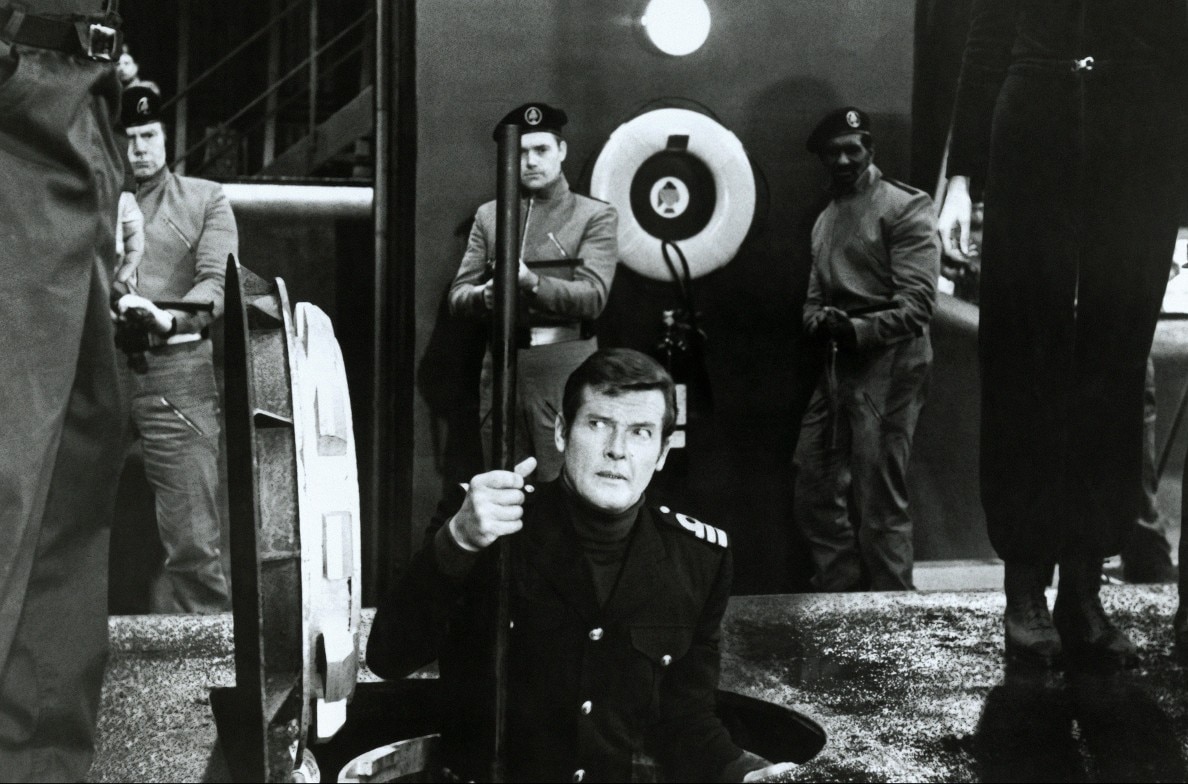
The movie was shot by venerable French cinematographer Claude Renoir, nephew of the great film director Jean Renoir. In the audio commentary for the DVD release, director Lewis Gilbert and others repeated the long-rumored story that because Renoir's failing eyesight made it difficult for him to light the massive supertanker set built for the production, Stanley Kubrick was brought in to supervise the lighting.
The end of the film bears a title announcing 007's expected return in For Your Eyes Only (1981), but due to the popularity of Star Wars (1977) the studio decided to proceed with the space-themed Moonraker instead. That follow-up was an even more massive hit, but The Spy Who Loved Me remained Moore's favorite of all his turns as James Bond.
Director: Lewis Gilbert
Producer: Albert R. Broccoli
Screenplay: Christopher Wood and Richard Maibaum, based on characters by Ian Fleming
Cinematography: Claude Renoir
Editing: John Glen
Art Direction: Peter Lamont
Music: Marvin Hamlisch
Cast: Roger Moore (James Bond), Barbara Bach (Anya Amasova/XXX), Curt Jurgens (Stromberg), Richard Kiel (Jaws), Caroline Munro (Naomi)
By Rob Nixon
The Spy Who Loved Me
by Rob Nixon | August 22, 2019
SIGN UP FOR OUR NEWSLETTERS

CONNECT WITH TCM