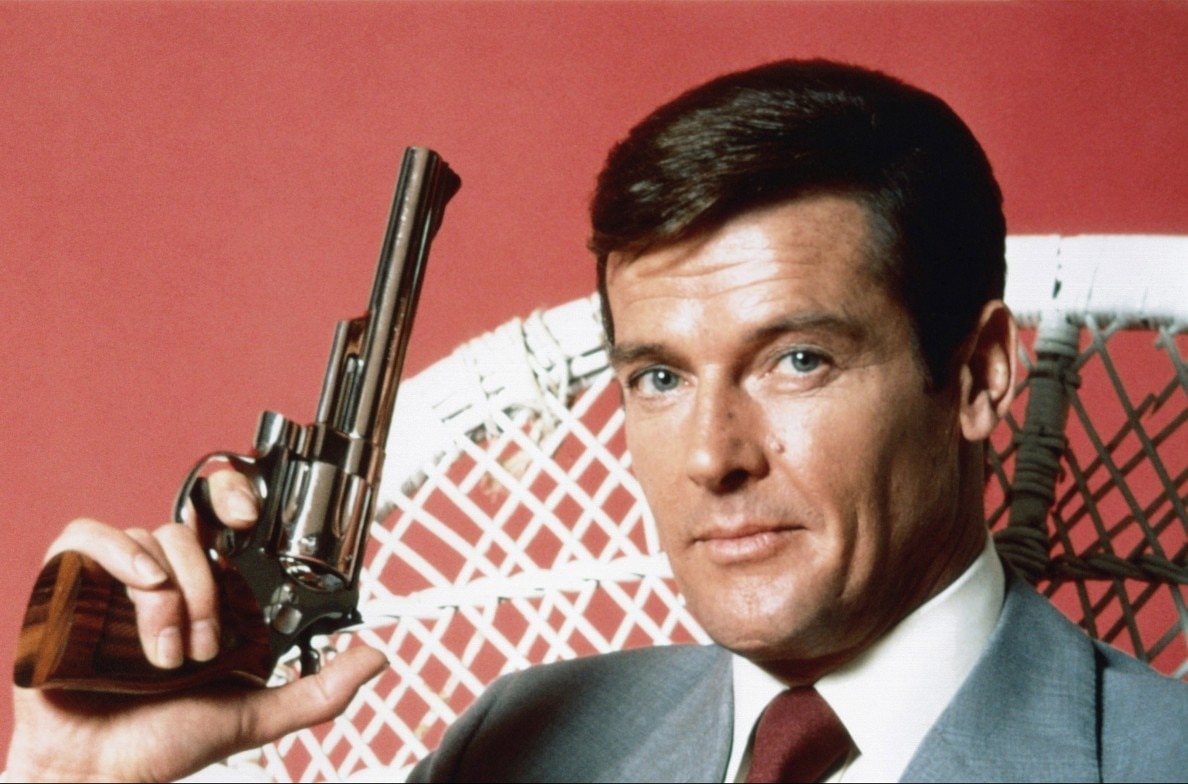
When Sean Connery finally quit the James Bond series, producers Harry Saltzman and Albert R. Broccoli didn't want to repeat their difficult experience with George Lazenby, the one-shot 007 of On Her Majesty's Secret Service (1969). Instead of another unknown, they tapped the dependable veteran Roger Moore, a consummate professional who had been considered for the role twice before and had just spent seven years playing a somewhat 007-like character on TV's The Saint. Writer Tom Mankiewicz would need to re-invent Bond to fit Moore's lighter, more genteel personality.
Mankiewicz had already updated Diamonds are Forever (1971) by adding gay and lesbian assassins, upping the comedy quotient and adding more action set-pieces. He lobbied for Ian Fleming's second 007 book, Live and Let Die, next because he liked the idea of dropping Moore's polite interpretation of Bond into a trendy Blaxploitation context. When Moore tries to introduce himself, as had Sean Connery, Yaphet Kotto's main villain Mr. Big shuts him down cold: "Names are for tombstones, baby! Take this honkey out and waste him!" Roger Moore's Bond differs from Connery in that he's less of a brutal thug and more of a gentleman. He plays 007 almost as a comic character, often responding to challenges with smart repartee instead of violence.
Mankiewicz populates the story with characters worthy of a comic strip. Common heroin dealer Mr. Big wears a rubber mask to carry off his disguise as Dr. Kananga, the corrupt leader of a Caribbean island. His main bodyguard Tee Hee (Julius Harris) has a deadly metal claw in place of a hand. Dancer-choreographer Geoffrey Holder is the Voodoo figure Baron Samedi, who presides over murder rituals by poisonous snake. Samedi's ability to return from the dead seems at first to be clever stage magic, but by the finale he's established as immortal.
Also given a supernatural twist is Solitaire, Mr. Big's Tarot-reading spiritualist advisor. Her power to divine the future will last only as long as she is a virgin, which gives Bond's seduction a secondary purpose. Mankiewicz wanted Diana Ross to play Solitaire but the producers insisted on a white heroine as in the book and hired actress Jane Seymour. As per formula, the show features two more 'Bond girls.' Actress Madeline Smith is a cute but disposable bedmate for the opening scene. Actress Gloria Hendry is the 'bad' Bond girl for this outing, a double agent who leads 007 into a trap. She holds the dubious distinction as James Bond's first black bed partner.
The producers filmed in Harlem, New Orleans and Jamaica, following the old Hitchcock rule to allow locations to suggest action set-pieces. New Orleans is exploited for a jazz funeral and an alligator farm. In an elaborate, hair-raising scene, 007 escapes from certain death by using a row of crocodiles as stepping stones to safety.
Most of Live and Let Die's (1973) action returns to the format of a Republic serial. Chase scenes employ ordinary cars in Manhattan, a double-decker bus on San Monique, a Piper Cub airplane in New Orleans and finally a score of high-powered speedboats on a Louisiana Bayou. Making the boats vault high in the air over roadways resulted in numerous crashes and minor injuries. A gag in which the boats zip across a bayou lawn laid out for a wedding is worthy of a Buster Keaton film.
Mankiewicz uses humor to defuse what might be taken as racist stereotyping. Storefronts in Harlem are named 'Fillet of Soul' and 'Oh Cult Voodoo Shop'. In any serious context, the finale would be offensive: a grinning witch doctor prepares the white heroine Solitaire for human sacrifice during a 'savage' Voodoo dance. Helping to rebalance the white hero/black villain equation on the bayou is Sheriff Pepper, played as a redneck clown by New York actor Clifton James. The wildly exaggerated Pepper gives audiences a white fool to laugh at, cleverly converting race insensitivity into more broad comedy.
In keeping with the effort to make a fresh start, Live and Let Die breaks with the music formula previously set by composer John Barry. Paul McCartney's excellent title theme became the most popular Bond tune ever. It fronts a dynamic, different soundtrack by the Beatles' producer-composer George Martin. The result gives Roger Moore's 007 debut its own identity.
Despite the producers' worries about resentful Sean Connery fans, the 007 franchise reboot was well received. The New York Times recognized it as well-made matinee thriller fun, "a superb collection of grotesque ways of killing." Roger Ebert found it lacking in style and wit but acknowledged that the Bond formula indeed appeared to be indestructible. Live and Let Die would be the first of seven Bonds for Roger Moore. When he finished his final outing, A View to a Kill (1985), he had just celebrated his 57th birthday.
By Glenn Erickson
Live and Let Die
by Glenn Erickson | August 22, 2019
SIGN UP FOR OUR NEWSLETTERS

CONNECT WITH TCM