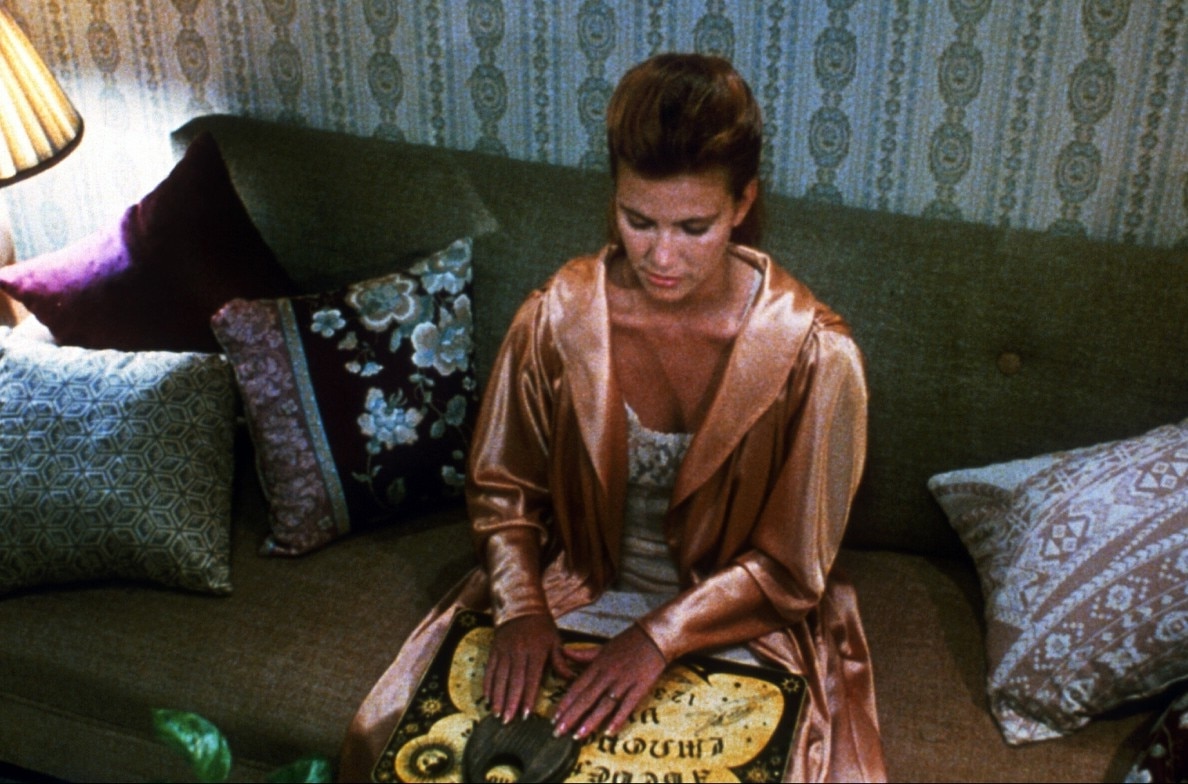
Long after the Ouija board first intersected with the horror film in popular culture in The Exorcist (1973), the popular and very controversial toy took center stage for a vehicle of its own in Witchboard (1986), a cult favorite begun as an assigned college script by USC student Kevin Tenney. Originally written and shot as Ouija, a term that was owned by Parker Brothers at the time, the production shot in various parts of Northern California and enjoyed one of the widest theatrical releases from the independent distributor Cinema Group, who had recently rolled out one of its larger national releases with Deadtime Stories (1986). This film was given an even more (relatively) lavish rollout on approximately 1,100 screens after a positive test run, though it didn't fully take off until it hit home video and became a consistent VHS rental favorite. Advised that using a genuine Ouija board might cause legal trouble, the filmmakers used the production design team to come up with the variation seen in the film which was not only safe to use but played a major part in the promotional artwork.
A creative type since making amateur movies in his garage as a teenager, Tenney first got the idea for the script based on the concept of progressive entrapment, the process of gradually infiltrating a person as part of the process of demonic possession. However, he also approached it as a kind of tense romantic triangle as a married woman becomes gradually manipulated by an evil spirit posing as a young boy's spirit following an impromptu séance. Many viewers immediately picked up on the unorthodox nature of the central relationship, with an unexpected charge also existing between the two male leads with enough subtext to make this part of the similar wave of horror films around that time including Fright Night (1985) and The Lost Boys (1987). Tenney and the film's producers weren't exactly advertising the fact that this was the director's first film, and Tenney openly admitted that the main role of Jim played by Todd Allen was based on his own sarcastic personality. Later seen in Tenney's Pinocchio's Revenge (1996) and Django Unchained (2012), Allen was entranced by the choice of leading lady in Tawny Kitaen.
Best known in pop culture for her iconic appearances in Whitesnake music videos (whose lead singer, David Coverdale, was her one-time husband), Kitaen had two leading roles under her belt thanks to Bachelor Party (1984) and the outrageous erotic fantasy The Perils of Gwendoline in the Land of the Yik Yak (1984). With her striking auburn hair and winning personality, she was cast because, as Tenney and the producers have recounted on the film's numerous special features, she was both attractive to men and appealing to women. She would later reenter pop culture as a high-profile cast member of the VH1 reality series, The Surreal Life, in 2006. At the time of filming, Kitaen was actually dating O.J. Simpson, whose set visits prompted their fair share of practical jokes from the crew including rocking Kitaen's trailer while he was present. Days of Our Lives actor Stephen Nichols completed the trio of leads as arrogant vineyard heir Brandon; a regular on other soaps as well, he was the most recognizable name of the three and, according to Allen, carried around headshots to autograph for soap fans who would approach him during the shoot.
Of course, two names will immediately stand out to TV fans among the colorful cast: Rose Marie, the legendary vaudeville performer who created the beloved Sally on The Dick Van Dyke Show, and an early role for Kathleen Wilhoite, a colorful character actress who would become a regular on ER and Gilmore Girls. Easily stealing all of her scenes as a self-described "punk rock psychic," Wilhoite is not only a highlight of the film but the centerpiece of its most memorable violent shock moment.
Off to a strong start in the horror genre, Tenney immediately launched into another cult favorite and long-running home video staple, Night of the Demons (1988), and even directed a belated sequel, Witchboard 2 (1993), starring Ami Dolenz (with Allen providing a cameo). However, none of the original talent played a role in the third film, Witchboard III: The Possession (1995). Apparently feeling that "witch" was his lucky charm, Tenney swerved into haunted house territory with Witchtrap (1989) and recruited this film's comic relief, James W. Quinn (who plays Lloyd), to play the hero - another smart aleck clearly in the mold of Jim and, again, Tenney himself.
By Nathaniel Thompson
Witchboard
by Nathaniel Thompson | August 16, 2019
SIGN UP FOR OUR NEWSLETTERS

CONNECT WITH TCM