The house lights dim. A hush falls over the audience. On the screen, a
darkened room-in its center sits a small table, on the table a crystal ball.
And in the crystal ball... well, a human head. Distorted and alive, the thing is
mocking you: "This is the Inner Sanctum," it sneers, "A strange, fantastic world
controlled by a mass of living, pulsating flesh-the mind. It destroys,
distorts, creates monsters, commits murder. Yes, even you, without knowing, can
commit murder." The head stops just shy of bleating "nah-nah-nah-boo-boo."
And so the movie begins.
In the age of television, any number of fantasy-inflected anthology
series would open their shows with similarly portentous narration, establishing
a sort of vaguely unifying principle to the variegated thrills that would
actually follow. The Inner Sanctum franchise came a wee too early to
make it to the boob tube--instead it played out as a cycle of a low-budget
quickie thrillers cranked out in the early 1940s.
Originally, the Inner Sanctum brand name identified a set of pulp
mysteries published by Simon and Schuster. The popularity of the line led to a
radio incarnation launched by NBC in 1941. The Inner Sanctum broadcasts
tweaked traditional mystery conceits by adding supernatural overtones. The
radio plays featured the voices of Boris Karloff, Peter Lorre, Claude Rains, and
other genre luminaries on loan from Hollywood. The icing on the cake was host
Raymond Edward Johnson. With arch menace and tongue-in-cheek wit, Raymond
introduced each production. His droll charisma seeded a generation of
followers, from Famous Monsters' Forry Ackerman to Elvira and the many
regional "horror hosts" who kept Gothic horror alive with TV reruns of Universal
Studios' classics.
We get ahead of ourselves. In the 1940s, TV was more a novelty yet than
a fact of ordinary life, and Universal Studios was still producing Gothic
classics for first-run distribution. Having established their dominance in the
genre a decade earlier with the likes of Karloff and Lugosi, Universal was now
busily grooming a new horror star in Lon Chaney Jr.
Junior's papa, Lon Chaney Sr., was one of the silent era's most
distinguished performers. Junior opted more for soft-spoken All-American charm
over his father's showboating approach; he came into his own with a
much-applauded turn in 1939's Of Mice and Men. Universal's brightest
minds responded by plunking Chaney's understated subtlety into heavy rotation in
its various genre slophouses, where subtlety was all but useless. For the first
half of the decade, Chaney played the mute mummy Kharis (3 times), the Wolf Man
(4 times), Frankenstein's monster (again, mute), and Dracula-shuffled in with
various cowpokes and gunslingers in sundry Westerns. The Inner Sanctum
cycle provided a rare respite for Chaney, a chance to play at something
approaching straightforward drama.
Although the six Inner Sanctum pictures invoke the trappings of
Gothic horror-hypnotists, psychics, ghosts, voodoo curses, wax museums, severed
heads-these are but filigrees in the margins of what are, basically,
conventional films noir.
The formula was simple: Lon Chaney Jr. plays a respected member of the
community (usually some kind of doctor) caught in a torrid love triangle. A
mysterious death brings suspicion on Chaney. Wildly outsize characters and
seemingly paranormal events take up a few reels, before the extraordinary
goings-on are revealed to be hoaxes. Wrap it all up with a last minute twist,
and try not to use up more than 60 minutes on the way (these were B-pictures,
after all, distributed on the lower half of double bills, paired with more
ambitious fare).
The six films worked minor variations on this formulaic understructure,
but did so with ample atmospherics and style. Compared to some of the dreary
stuff the studio was doing over on the monster lot (Mummy's Curse, I'm
looking at you!) these are spry little nuggets of entertainment, better than
they should be.
Reginald LeBorg inaugurated the cycle with 1943's Calling Dr. Death
, the first of three consecutive Inner Sanctum entries; LeBorg also
worked with Chaney on The Mummy's Ghost the following year. All three of
LeBorg's contributions are narrated by Chaney in a whisper (!), signifying his
innermost thoughts. Between the incessant narration and the gloopy organ score,
Calling Dr. Death constantly hints at its radio roots, but a fun
expressionistic dream sequence and a scene-stealing performance by J. Carrol
Naish as a detective enliven the proceedings.
The weakest of LeBorg's trilogy, Calling Dr. Death casts Chaney
as Dr. Mark Steel, an unhappily married hypnotherapist carrying an obvious torch
for his assistant Stella (Patricia Morison). Given his barely-controlled desire
to murder his shrewish wife and bed Stella, he's the prime suspect when wifey
indeed gets killed. Even Steel suspects himself, since an inconvenient mental
blackout has deprived him of any memory of the night in question. Of course, he
could always hypnotize himself to find the truth...
The amnesiac plot, oddly enough, was a popular trend in film noir-"Did I
Do Its" being a curious subset of "Whodunnits" (see also Street of
Chance, Detour, The Blue Gardenia, Blackout...). The
setup plays to Chaney's strengths, allowing him to portray much the same tragic,
unwilling/unwitting killer as his Wolf Man role. In the end, though, it's a
story rendered nonsensical by liberal divorce laws, a relic of its time.
Weird Woman (1944) picks up the pace and is one of the strongest
of the set. This time out, Chaney is sociology professor Norman Reed.
Lovestruck college chicks are throwing themselves at this unlikely sex symbol
while a catfight brews between his new bride Paula (Anne Gwynne) and his jilted
ex (the fabulous Evelyn Ankers, Chaney's co-star from Son of Dracula).
Nothing good can come of this, especially since Paula's a "witch wife" from a
superstition-addled island. Cue the voodoo, and off we go!
Mixing I Walked With a Zombie with soap-opera shenanigans and an
academic intrigue (a plagiarized textbook figures prominently), Weird
Woman is a heady brew. For a black and white movie, it is packed with
colorful characters.
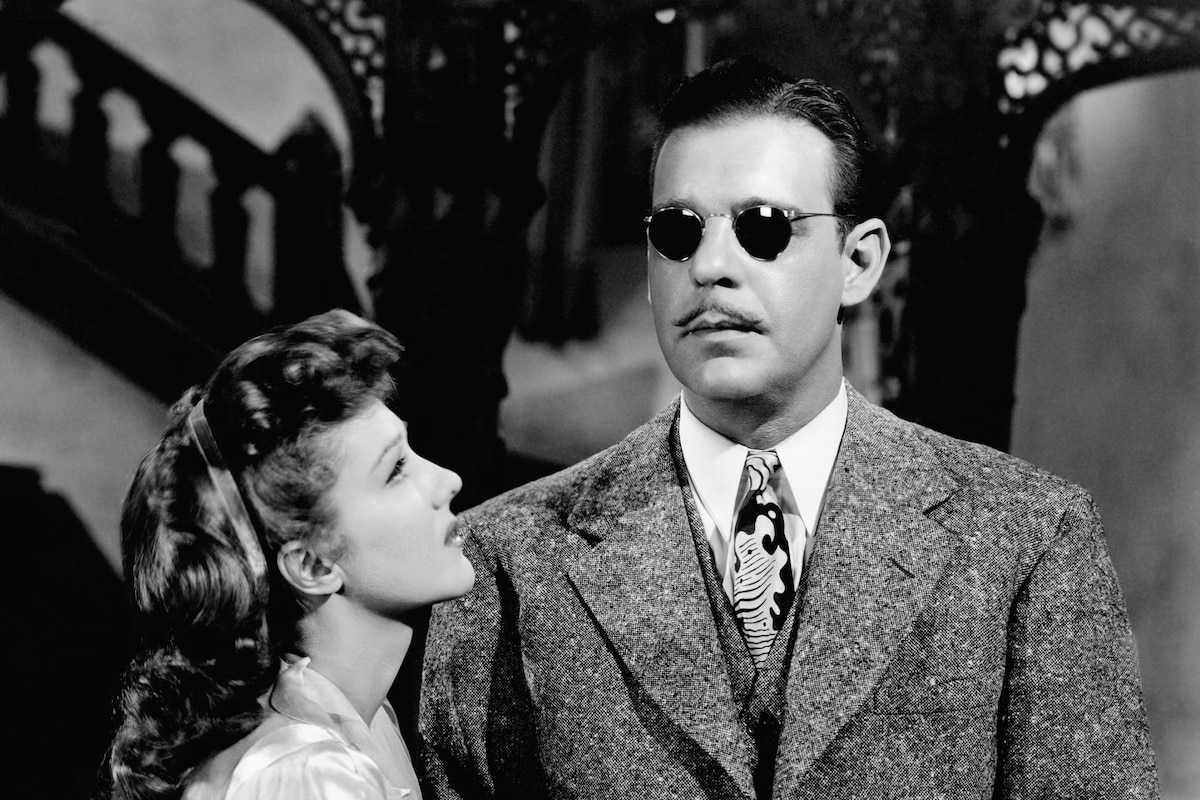
Things go off the rails a bit with #3: Dead Man's Eyes (1944).
This is the kind of looney flick that asks us to suspend disbelief on an artist
(Chaney) whose bathroom vanity houses some eye wash and some acid, side by side
in nearly identical bottles. You can see where this is headed, even if the poor
schmuck himself can't-he blinds himself by accident, gets framed for murder, and
receives the transplanted eyes of his "victim" to replace his own busted
peepers.
In more ambitious hands this has the makings of a psychotronic cult
classic-what if the transplanted eyes still retained vestigial images of their
murderer? Wish on, the material is lazily squandered here. Even costar Jean
Parker, so distinctive in Edgar Ulmer's Bluebeard the same year, is
largely wasted.
Perhaps producers Ben Pivar and Will Cowan sensed LeBorg was losing his
edge, for he was summarily replaced. With LeBorg gone, the 1945 Inner
Sanctums dispense with Lon Chaney's stultifying whisper and go for broke on
sheer pulp energy. The Frozen Ghost comes courtesy of Harold Young
(who directed Chaney in The Mummy's Tomb). The inestimable Evelyn Ankers
returns to the fold to join Chaney in an enjoyably haphazard
everything-but-the-kitchen-sink romp. Chaney plays Gregor the Great, AKA Alex
Gregor, a hypnotist whose act depends on the mind-reading prowess of the
Fascinating Maura (Ankers). Needled by a heckler during a show, Gregor
seemingly "wills" the man to death. Haunted by guilt and fearful of his
apparent power, Gregor retreats into a shadow world of a wax museum run by a
disgraced plastic surgeon (nothing suspicious there!). Character actor Martin
Kosleck ably chews the scenery as the sinister Rudy, topped only by Douglass
Dumbrille as a Shakespeare-quoting detective! The Frozen Ghost is one
exceedingly trippy hour's worth of entertainment.
John Hoffman's Strange Confession opens strong-with Chaney
fleeing the cops with a severed head in a duffel bag under his arm. An extended
flashback explains how it came to pass that the noble chemist Jeff Carter
(Chaney) beheaded his ruthless boss Mr. Graham (J. Carroll Naish again).
Suffice to say Carter had his reasons: Graham stole his formula, his wife, and
killed his baby son. Few B movies have tried to dramatize the problems of
pharmaceutical companies rushing untested drugs to market-fewer still have
dialogue like, "He had my brain in his head and I had to get my brain back."
The final Inner Sanctum is barely one at all-Wallace Fox's
Pillow of Death skips the familiar "This is the Inner Sanctum" talking
head introduction, doesn't get Lon Chaney Jr. onscreen until 20 of its 67
minutes have elapsed, plays more for laughs than previous installments, and is
the only one of the series to conclude with a genuinely unexpected twist.
For this last round, Chaney plays attorney Wayne Fletcher, whose affair
with Donna Kincaid (Brenda Joyce) becomes scandalous when Mrs. Fletcher is found
suffocated (see that idiotic title). Enter "psychic investigator" Julian Julian
(J. Edward Bromberg) with the promise to unmask the killer via séance. A pair
of bitterly resentful old Victorian cows (Rosalind Ivan and Clara Blandick), a
ghost in the attic, and some secret passageways more than make up for Chaney's
delayed entrance. Despite the inexcusably lame title, this is a fine send-off
for the cycle and a satisfying coda.
One word of advice: don't try to watch them all at once in a single
six-hour sitting. The similarities between the different films blend together
for an effect much like listening to a maxi-single EP with six different remixes
of the same song.
Universal's two-disc "Franchise Collection" is handsomely packaged, but
lacking in context. These films were too noir-ish to be fully embraced by the
monster fans, too supernatural to be remembered as film noir, and essentially
fell between two stools. Since little has been written about them, it is likely
many people will be discovering them for the first time on these DVDs-it would
have been good form for Universal to explain a little something about just what
they are for newbies, if not in a booklet than at least a blurb on the box.
Setting aside that quibble, the films themselves have never looked finer than
they do here.
For more information about Inner Sanctum: The Complete Movie Collection,
visit Universal Home
Entertainment. To order Inner Sanctum: The Complete Movie Collection,
go to
TCM Shopping.
by David Kalat
Inner Sanctum: The Complete Movie Collection on DVD
by David Kalat | December 14, 2006
SIGN UP FOR OUR NEWSLETTERS

CONNECT WITH TCM