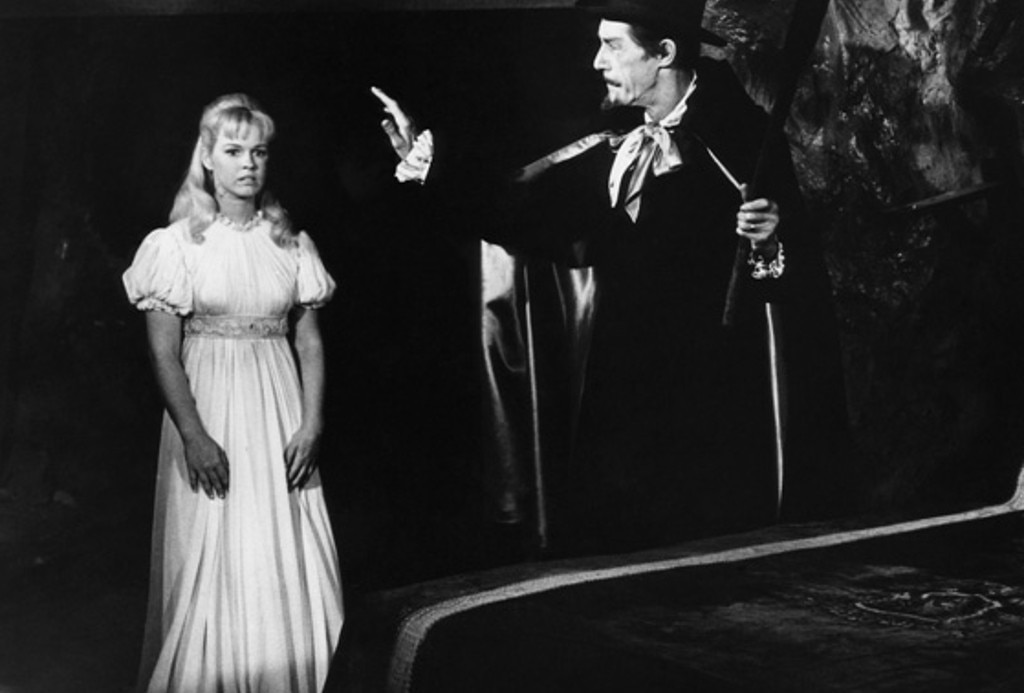
A 38-year-old John Carradine wore graystick in his hair as Bram Stoker's undying Count Dracula, a supporting player in the Universal Studios monster rally House of Frankenstein (1944). Hewing closer to Stoker's description of the character than had Bela Lugosi's Slavic branding of the role in 1931, Jack P. Pierce's makeup afforded Carradine a distinguished, aristocratic aspect that helped to distance the actor from his Bohemian turn as French serial killer Bluebeard (1944) a year earlier. Twenty-one years after Carradine hung up the beaver hat of his bogus "Baron Lajos" in the sequel House of Dracula (1945), he again stepped into the storied bloodsucker's opera cloak for Billy the Kid versus Dracula (1966). This time around, Carradine's hair was a suspicious squid ink black, no doubt to give the then 59-year-old actor a more youthful and vital look. Or at least that was the plan.
Plagued by arthritis through the last act of his fifty year career in films, Carradine looks frail here, and stooped under the weight of a satin-lined cape (a shortcoming aggravated by having the actor wear ruffled cuffs and a plush red necktie that recall his turn as the elegant cardsharp of John Ford's Stagecoach in 1939). This is not to say the actor doesn't give his all in the part, and what joys there are to be taken from the threadbare Billy the Kid versus Dracula are credited to his ripe and ready (but mostly ripe) performance. Carradine growls and scowls like a terrier, barking orders ("I demand privacy!") and dealing rebukes ("You clumsy idiot!") to the hayseed locals of the philistine hamlet he has invaded. (The use of red key lighting when Dracula is in attack mode makes Carradine look like he's mesmerizing a rotisserie chicken.) Pretending to be the uncle of silver mine heiress Melinda Plowman, Carradine's "Uncle Joseph" brings to mind Joseph Cotten's "Merry Widow Killer" in Hitchcock's Shadow of a Doubt (1943) and the scenes in which Dracula pledges his undying love at the bedside of his "niece" carry a discomfiting incestuous charge.
Support players Virginia Christine (as a fearful but resourceful immigrant) and Olive Carey (as a "backwater female pill-slinger") bring levity to the lethargic proceedings with both intentional and unintentional laughs but Chuck Courtney's Billy the Kid is a dull nonstarter. As conceived by Carl K. Hittleman, the former boy outlaw has reformed himself to the extreme of being a bland nonentity, seeming more inconsequentially white-bread than Audie Murphy in The Kid from Texas (1950). Courtney is such an unpersuasive (and perpetually self-deprecating) hero that viewers would be forgiven for hoping that Dracula (oddly never so named in the script) get away with it. Sadly, the Undying Count is defeated yet again in the final frames, impervious to Billy's non-silver bullets but kayoed by being hit in the face with the empty revolver. It's an ignominious end for the Undying Count and this film's biggest laugh.
Producer: Carroll Case
Director: William Beaudine
Screenplay: Carl K. Hittleman
Cinematography: Lothrop B. Worth
Film Editing: Roy V. Livingston
Art Direction: Paul Sylos
Music: Raoul Kraushaar
Cast: John Carradine (Count Dracula), Chuck Courtney (William 'Billy the Kid' Bonney), Melinda Plowman (Elizabeth Bentley), Virginia Christine (Eva Oster), Walter Janovitz (Franz Oster), Bing Russell (Dan 'Red' Thorpe).
C-73m.
by Richard Harland Smith
The Gist (Billy the Kid vs. Dracula) - THE GIST
by Richard Harland Smith | December 11, 2006
SIGN UP FOR OUR NEWSLETTERS

CONNECT WITH TCM