SYNOPSIS:
Meet Coffy (Pam Grier), a woman with a grudge. The scourge of heroin addiction has claimed her entire family-such breaks are tough enough already, no doubt, but unbearable when her little 11-year-old sister joins the junkie ranks. Driven by righteous anger, Coffy descends on the world of drug kingpins and pimps like an avenging angel.
She masquerades as a prostitute, hides razor blades in her Afro, shoots bad guys in the crotch, and unleashes holy mayhem wherever she goes. Her antics pull the veil on a hidden corruption that shakes her faith, but drives her fury ever farther...
Coffy (1973) is a drive-in fever dream full of graphic violence and nudity. This is a film that takes the term "crotch shots" literally. It is full of prostitutes-and not just any prostitutes, mind you, but lesbian prostitutes. And these lesbian prostitutes get into catfights in which ripping off someone's top is somehow equivalent to a knock-out. Add to the mix some deliriously quotable dialogue, and of course Pam Grier herself.
Grier was an Air Force brat who grew up at a military base in England. Returning to the states as a teenager, she had her sights set on a medical career. To help pay college tuition bills, she enrolled in the Miss Colorado Universe pageant-in 1967, she was the only dark-skinned contestant. She placed second, and caught the eye of Hollywood talent scouts.
The girl went West, and took a job at American International Pictures as a receptionist. Answering phones was the day job, but AIP's top director Roger Corman had a keen eye for talent and saw to it that Ms. Grier got a walk-on role in Russ Meyer's Beyond the Valley of the Dolls (1970) --and an acting career was, at last, belatedly launched.
Meanwhile, another burgeoning talent was working his way up the ladder. Jack Hill was a low-budget auteurist filmmaker schooled in the Roger Corman-style of quickie production. His first writer/director credit was on Spider Baby (1968), a notorious horror comedy starring a washed-up Lon Chaney, Jr. and the old-school black comedian Mantan Moreland in a film so determinedly bizarre it was all-but minted as a cult property.
Hill was now stuck in the Philippines, cranking out women-in-prison flicks with, you guessed it, Pam Grier. Sleazy stuff it may have been, but it paid the bills.
Along came Max Julien with an idea for a movie: a sexy black woman vs. the drug trade; he called it Cleopatra Jones (1973). AIP liked the idea, and was eager to set to work-when Warner Brothers scooped the project out by offering Julien more money. Burned, AIP producer Larry Gordon decided to crank out his own "black woman revenge picture" and called in Jack Hill to handle it.
Hill's only experiences with black culture were occasional forays into the jazz scene of his youth. This put him a league ahead of a lot of other white filmmakers now scurrying to cash in on the blaxploitation craze, but Hill knew that there was a gulf between the world of 1940s era jazz musicians and the ghettos of the 1970s. So he turned to Pam Grier.
AIP was not sure Pam Grier had it in her to be a top-lining star, and it took some hard lobbying from Hill to convince them to give her the chance. Hill specifically wrote Coffy for Grier. She in turn added her own ideas-especially concerning Coffy's more unusual weaponry and tactics. Between them they fashioned a bona fide black superhero. Nominally a nurse (blink and you'll miss her one scene in scrubs), Coffy is tough-as-steel, no-nonsense, sexier than a dozen women put together. She takes names and kicks ass-or vice-versa when the moment demands.
And audiences ate it up. Coffy was a huge hit, beyond the limited expectations and lowball ambitions of its studio. It even outperformed the slicker, more ambitious Cleopatra Jones--AIP had their revenge at last.
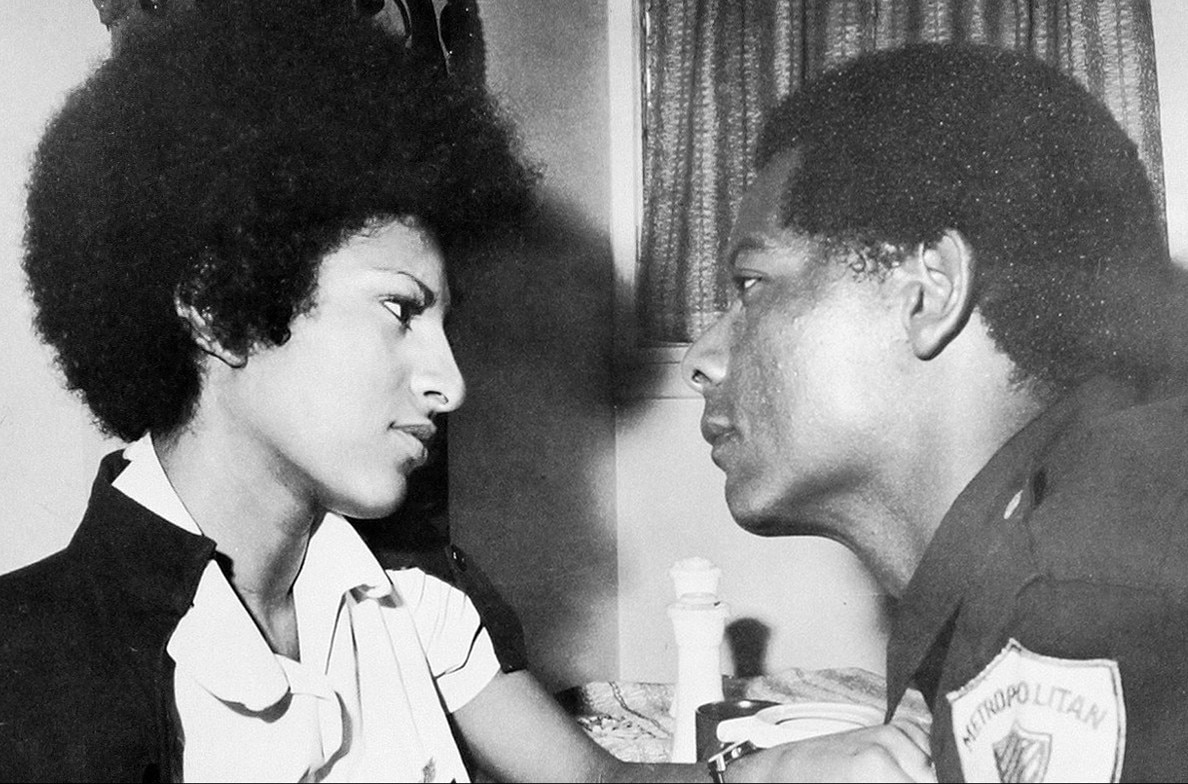
There is a moment in the film which is but a throwaway, a momentary piece of business unconnected to the larger action: Pam Grier's titular heroine is waiting in her car outside the hospital where she works. A white man approaches, asks her business, starts to hassle her. What's next? Rape, perhaps? A cop arrives, a black cop. He immediately suspects the worst of the man, makes him "assume the position," frisks him, humiliates him.
A small moment, perhaps, but powerful nonetheless.
This is the stuff of blaxploitation-the giddy feeling of turnabout, if not in real life at least on the screen. For audiences all-too accustomed to the usual police routine, white cops assuming the worst of blacks, it was thrilling and satisfying to see the game played in reverse. For a handful of years in the early-to-mid 1970s, grindhouse theaters thrived on such wish-fulfillment fantasies.
For some activist organizations, the whole thing was painful: pop culture trafficking in the worst images of black life. For black filmmakers, both on and off camera, the trend was the first genuine opportunity, long overdue, to be anything other than marginalized. For audiences, white and black, the films were wild, trashy fun, escapism of the highest order. Since blaxploitation meant so many different things, small wonder the term itself continues to provoke controversy.
Conventional wisdom held that the establishment (read: white) press cooked up "blaxploitation" as a catch-all; others insist that the NAACP coined the term as a pejorative for a breed of movie they found demeaning to African-Americans; Pam Grier herself says some black marketing execs at AIP thought it up in a fit of genius.
If anyone should know, Grier would. Not only was she the reigning Queen of Blaxploitation, but she was at the AIP reception desk answering phones when (and if) that brainwave hit.
Rarely have pulp movies been tasked with so much-escapism can't rewrite history or undo generations of prejudice. For decades, black actors were shoved to the margins or unemployed altogether. Once in a while a Sidney Poitier would come along to prove the exception to the rule, most often the talents of dark-skinned filmmakers were simply squandered. Blaxploitation spun history on its head, and changed the dynamic altogether. Doors opened in Hollywood for the first time-demand even exceeded supply. Yet the groundbreaking opportunities were linked to a very narrow genre.
"Black exploitation" was a simplistic formula, tailor-made for low-budget houses like AIP: film noir crime thrillers revamped with lots of graphic violence and sex. Take a classic noir thriller or gangster pic, set it in Harlem or Watts or South Central, make most of the characters black (except the vilest villains, natch), play that funky music, serve hot.
Hill saw through it like glass: these were just amped up versions of the B&W thrillers of the 40s. As a diehard fan of film noir, Hill easily adapted memories of things like White Heat (1949) into the new context-and being an erudite intellectual, he was equally comfortable pilfering ideas out of Shakespeare while he was at it.
The result is one of the most carefully constructed exploitation films of all time-almost obsessively detailed. It wasn't enough for Hill to simply present Coffy as a chick with a 'tude, she had to have a good reason to go on her killing spree: Hill has her whole family blighted by the scourge of heroin, with the addiction of her 11-year old sister the final proverbial straw. But even that wasn't enough motivation, thought Hill-so Coffy has to watch her childhood friend get beaten into a brain-damaged pulp by drug-dealing thugs, too. And did I mention that the victim was a black cop, the only truly "good" character in the film?
Coffy's vengeance may be justified and cathartic (Hill has stories of audiences hooting in bloodthirsty accord as Grier blows away bad guys on screen), but as she wages her one-woman war on drugs she is all the while wondering aloud about the morality of her mission. Racist reviewers, unwilling or unable to seek nuance in a "black" film, missed such complexity, and saw only an unremittingly violent picture. Blaxploitation fans knew better-like its cousin Super Fly (1972), this film uses its soundtrack to contradict and comment on the story. While Grier struts her stuff, the soundtrack music blares its refrain, "Coffy, baby, you can't see right from wrong." Hill knew from film noir, a genre that had no time for absolutist right and wrong, but reveled in shades of gray.
Most reviewers, even when they panned the flick, recognized Pam Grier's fabulous star power. Roger Ebert had crossed paths with Grier before-he was the screenwriter for Russ Meyer's 1970 Beyond the Valley of the Dolls which gave Grier her screen debut; as a critic he had a better appreciation for pulp than most. He noted that Grier's talents had until now been relegated to "the kinds of movies frequented only by demented creeps and movie critics." Some of those critics were still mired in the plantation mentality that blaxploitation was fighting: Variety's reviewer summed Coffy up as "the story of a black tart." Jack Hill still fumes over that article even to this day.
When Robert Altman saw Coffy, he immediately poached one of its actors (Robert DoQui) and its cinematographer (Paul Lohmann) for his next opus, Nashville (1975). Pam Grier became a major movie star-joining the select ranks of Barbra Streisand and Liza Minnelli as the only actresses in Hollywood capable of "opening" a film on their own marquee power. A generation later, Quentin Tarantino would strip mine the entire film, cutting and pasting references to it in all of his films.
The final scene of the film promises, "It's not the end, it's the beginning." In fact, it was neither-but Coffy sits comfortably at the top of the heap, as one of the high water marks of a singular moment in pop culture when black cinema finally got some of its own back.
Producer: Robert A. Papazian
Screenwriter and Director: Jack Hill
Art Direction: Perry Ferguson
Cinematography: Paul Lohmann
Film Editing: Chuck McClelland
Original Music: Roy Ayers
Cast: Pam Grier (Coffy), Booker Bradshaw (Brunswick), Robert DoQui (King George), William Elliott (Carter Brown), Allan Arbus (Vitroni), Sid Haig (Omar), Barry Cahill (McHenry).
C-91m.
by David Kalat
The Gist (Coffy) - THE GIST
by David Kalat | December 11, 2006
SIGN UP FOR OUR NEWSLETTERS

CONNECT WITH TCM