A
New York Times film critic Vincent Canby wrote in 1985, "A
Passage to India is the kind of movie that people think they are
talking about when they insist that 'they'-meaning Hollywood in the
generic sense-don't make movies the way they used to." Indeed, it is
an epic echo to the way movies used to be made, as demonstrated by
director David Lean's own previous epics, such as Doctor Zhivago
(1965) and Lawrence of Arabia (1962). Based on the novel by E.
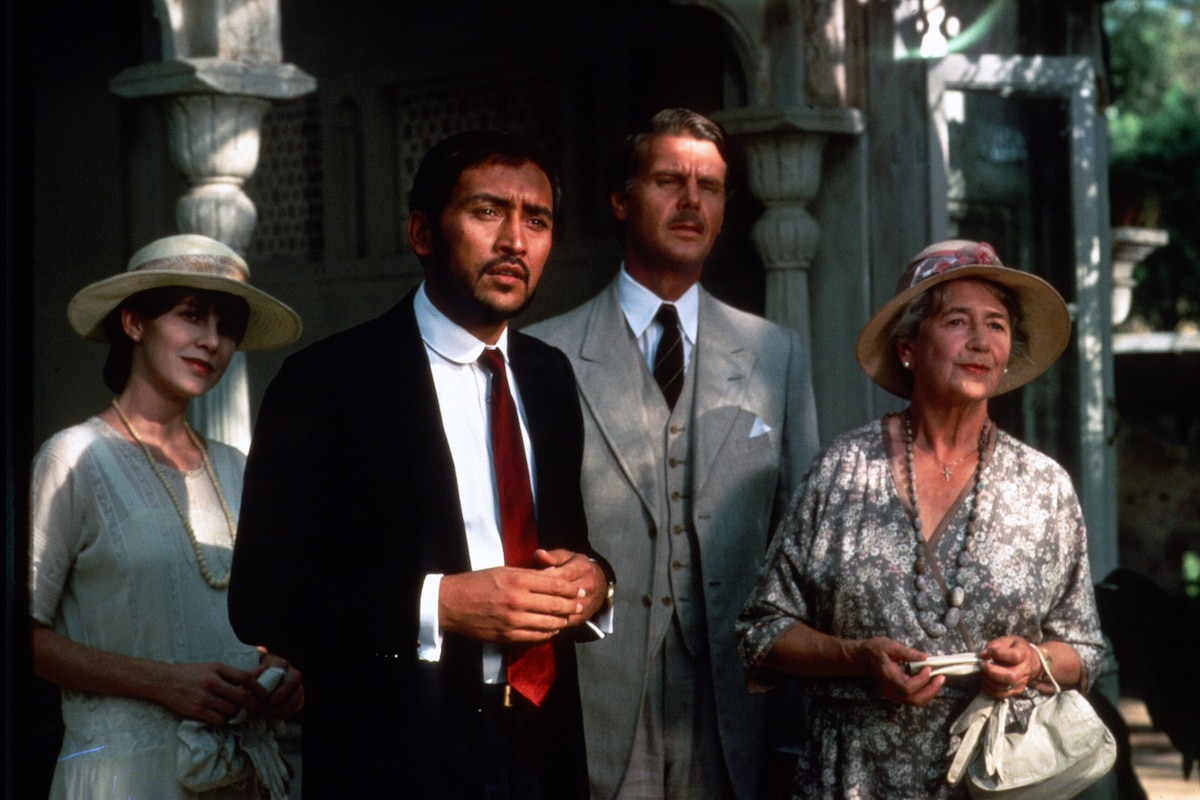
M. Forster, the film is set in colonial India in 1924. Adela Quested
(Judy Davis), a sheltered, well-bred British woman, travels to the
subcontinent to visit her fiancé, a British magistrate posted in a
small town; her traveling companion is his mother Mrs. Moore (Peggy
Ashcroft). They arrive in the fictional town of Chandrapore, and soon
wish to escape the trappings of colonial Britain and hope to experience
the sensual sights and the sounds of "the real India". Soon, Adela and
Mrs. Moore meet and befriend Dr. Aziz (Victor Banerjee), who, despite
longstanding racial and social taboos, moves with relative ease and
freedom amongst highborn British circles. Feeling comfortable with
Adela, Aziz invites her and Mrs. Moore to accompany him on a visit to
the Marabar caves. Leaving an overcome Mrs. Moore behind, Aziz and
Adela climb a mountain to reach a more forbidden part of the caves.
What happens in the mystical caves touches off a mystery that
implicates Aziz in a shameful crime, and brings to light the shameful
hypocrisy and racism prevalent in the ruling British class.
Forster's complicated novel had long been targeted by filmmakers as
excellent source material. In 1958, producer John Brabourne wrote E.M.
Forster to inquire about securing the screen rights. Forster flatly
refused, underscoring what some historians have considered to be
Forster's deep dislike and distrust of the cinema. Brabourne wrote,
"He had a strong suspicion that even if he found someone worthy of
trust to make the adaptation, control would be wrested away from that
person by others of lesser integrity." Furthermore, Forster was afraid
that a film version of his story would come across as either
pro-British or pro-Indian. Finally, in 1969, Forster relented, but he
passed away before the deal could be signed. The executor of Forster's
literary property, Donald A. Parry, the master of King's College,
Cambridge, also shared an intense disregard of the movies. This
intellectual thumbing of the nose deep-sixed several attempts to bring
Forster's novel to the screen, including attempts by Joseph Losey,
Ismail Merchant and James Ivory. But then in 1980, Professor Bernard
Williams-a film buff-became provost of King's College in 1980, and
channels were finally cleared for a proper cinematic adaptation. (A
theatrical version of A Passage to India, written by Santha Rama
Rau, was previously adapted for television by the BBC in the
mid-1970s.)
Enter David Lean. The Academy Award-winning director had wanted to
bring Forster's novel to the screen himself, but he too could not get
the rights. Fortunately for Lean, Brabourne had the legendary director
in mind when the producer secured the rights himself. Lean promptly
began the task of pulling together a working shooting script. With
Lean's longtime screenwriting collaborator, Robert Bolt, too ill to
write, Lean took it upon himself to write the script. Santha Rama Rau,
the playwright who wrote the play A Passage to India, had the
backing of the Forster estate and a completed draft in hand when Lean
took the job. But Rau's draft was unacceptable to Lean. It was too
stagy and wordy, the work of an "amateur," Lean said. Moreover, much
of Rau's draft took place indoors and Lean obviously wanted to take
advantage of the sumptuous Indian landscape. So once Lean began taking
liberties with Forster's novel (there are a few key scenes that Lean
invented for the story, such as Adela's bicycle ride), Rau was eager to
have her name removed as the screenwriter. Still, A Passage to
India is credited as having been based on Forster's novel and Rau's
play. Lean spent six months writing the script at the Maurya Sheraton
Hotel in New Delhi, then another three months in Zurich. Lean typed
out the entire screenplay himself with two fingers, using a
hunt-and-peck method that he said allowed him considerable time to
truly contemplate the direction of the story as he went along.
Meanwhile, producers John Brabourne and Richard Goodwin made a passage
to Hollywood to raise financing for Lean's adaptation. They were met
with a chorus of yawns. The bosses at the major studios were genuinely
wary of handing millions of dollars to an aging director whose last
film, Ryan's Daughter (1970), was an infamous financial and
critical disaster. Moreover, the studio bosses were of the mindset
that the big budget costume drama was no longer in vogue. As Lean
recalled, "Everybody said, 'This is a good art house film,'" meaning
that it had limited commercial potential. One studio executive said
he'd do it if Lean put an explicit rape scene in the screenplay, an
inclusion that would ruin the central mystery of the story. Another
studio boss sent Lean a memo saying, "Our audiences are young people;
young people are bored by old people. Cut the old dame," meaning Mrs.
Moore, Peggy Ashcroft's character. Fortunately, the producers were
able to find funding for $17.5 million by three principal investors.
Columbia Pictures bought the American distribution rights, with
Columbia's new partner Home Box Office (HBO) ponying up the cash for
the television rights. Thorn-EMI, an English conglomerate, bought the
British distribution rights.
With the script and financing in place, Lean turned to casting. For
Mrs. Moore, Lean wanted Peggy Ashcroft, a veteran actress of British
cinema. E.M. Forster himself once told Ashcroft, "I hope one day you
will play Mrs. Moore." But Ashcroft was not eager to spend a lengthy
shoot in India. She was worn out from having just returned from India,
where she had spent several months filming The Jewel in the
Crown, a fifteen-hour miniseries for British television. But after
Alec Guinness leaned on Ashcroft to accept, and Lean refused to take no
for an answer, Ashcroft gave in. One actor who did not give in was
Peter O'Toole; David Lean had him in mind for the supporting role of
Richard Fielding, the headmaster of the local school. Unable to forget
the grueling months he spent with Lean in the desert heat for the
unforgettable Lawrence of Arabia, O'Toole took a pass at
spending several months sweating during an Indian summer. Esteemed
British actor James Fox was eventually cast as Fielding (a character
based on E.M. Forster). Victor Banerjee, a popular fixture in Indian
films like The Chess Players (1977), was cast in the pivotal
role of Dr. Aziz, a local physician and surgeon who is both impressed
and repulsed by British colonial rule.
Two cast members shared something in common: both were painful thorns
in David Lean's side. Judy Davis, the Australian actress chosen to
play Adela, clashed often with Lean while on location. Davis found the
experience of taking direction from Lean deeply unsatisfactory. "He
made me feel inadequate initially and, I thought, unfairly...He was very
nervous about making that film; he hadn't made one for so long." Also,
Davis doubted that Lean could direct women. Lean suggested that she
see Celia Johnson's performance in Brief Encounter (1945) for
his assured feminine hand. Davis was right on the point that Lean was
a bit rusty, but he had always been tough on his actors, dating back
even to The Bridge on the River Kwai (1957). Just ask Alec
Guinness. He and Lean had made several pictures together, and on just
about every one of those productions, director and star fought
bitterly. A Passage to India was no exception. Cast as the
Indian mystic Professor Godbhole, Guinness complained that his Indian
makeup made him look like "an old turkey for sale." Guinness also no
longer had the patience to put up with Lean's typical perfectionism,
and was apt to say so, which only served to irritate and undermine the
director. Another bone of contention was an intricate Hindu temple
dance that Guinness carefully and dutifully rehearsed and filmed. It
was to be placed during the closing credits of the film, but Lean ended
up putting it on the cutting room floor.
A Passage to India went on to become an enormous commercial and
critical success in America and in Europe. The picture received eleven
Academy Award nominations. Lean himself was nominated in three
categories, Best Screenplay, Best Editing and Best Director. Other
nominations were for Judy Davis (Best Actress), Ernest Day (Best
Cinematography), John Box (Best Production Design), John Mitchell (Best
Sound), and Judy Moorcroft (Best Costume). The film garnered two wins:
for Best Supporting Actress (Peggy Ashcroft) and Best Score (Maurice
Jarre). "I was terribly pleased," said Lean of the film's multiple
Oscar® nominations. "It was terribly encouraging. That gave me a
new lease on life." Lean began to mount a new film, based on Joseph
Conrad's classic British novel Nostromo, but the director died
in 1991. A Passage to India became his fitting epitaph.
Producer: John Brabourne, Richard B. Goodwin, John Heyman, Edward
Sands
Director: David Lean
Screenplay: David Lean, E.M. Forster (novel), Santha Rama Rau
(play)
Cinematography: Ernest Day
Film Editing: David Lean
Art Direction: Clifford Robinson
Music: John Dalby, Maurice Jarre
Cast: Judy Davis (Adela Quested), Victor Banerjee (Dr. Aziz H. Ahmed),
Peggy Ashcroft (Mrs. Moore), James Fox (Richard Fielding), Alec
Guinness (Professor Godbhole), Nigel Havers (Ronny).
C-163m. Letterboxed.
by Scott McGee
A Passage to India
by Scott McGee | December 11, 2006
SIGN UP FOR OUR NEWSLETTERS

CONNECT WITH TCM