West of Zanzibar was based on the controversial play Kongo (by Chester De Vonde and Kilbourn Gordon), which had starred Walter Huston as Dead-Legs in its New York run (opening March 30, 1926). The New York Sun reported it was "apt to disgust anybody who has no liking for profanity, immorality, unvarnished sex talk and other forms of smut on the stage."
When the original play was submitted to the MGM story department in 1926, the anonymous reader filed this report, "If there is one clean line or situation in it I don't know where it is... I won't say it wouldn't be successful on Broadway, because it seems the more smut there is cloaked under the name of 'drama,' the more New York likes it, but as a picture there isn't a line of it could be done. If the censors didn't stop it, the public would. It is one play that to my mind should be tabooed... I am unalterably opposed to this play as a picture."
The story was inspired by a trip through the Congo taken by De Vonde (a noted repertory stage actor). According to a newspaper report, De Vonde contracted an "incurable tropical disease" during his jungle excursion, and the quest to bring the play to film became an intense desire in his final days. On January 10, 1928, De Vonde died, without realizing his goal. Two hours after his death, MGM purchased the motion picture rights for $35,000.
Kongo was on a list of literary properties that censorship czar Will Hays "recommended" never be adapted to film. MGM changed the name of the film to appease the Hays Office. For a time, it was known as The Dark Continent, and then South of the Equator. In addition, several characters' names were changed to prevent further associations with the notorious play. Hays wrote to MGM, "We should first consider the elements which caused Kongo to be rejected, and then see that those elements are entirely removed... In proceeding you will easily remove all references to dope... to social diseases, miscegenation, seduction, etc."
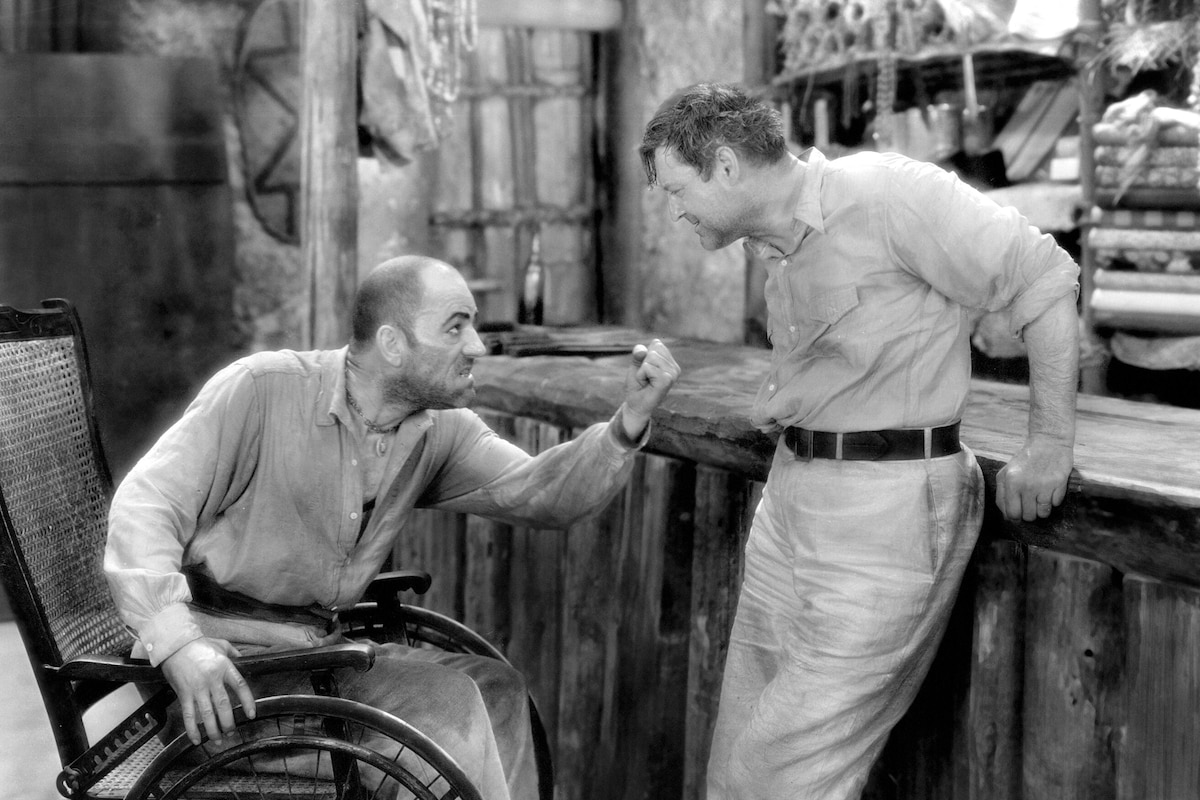
Warner Baxter plays "Doc," a drink-addicted man whom Dead-Legs keeps at his jungle compound to administer to his paralyzed spine. In the original play, Doc was exiled from America because a patient had died as a result of an illegal abortion he performed.
The jungles were recreated on the MGM backlots, and the tropical foliage was kept alive via underground steam pipes that saturated the soil and provided the surrounding air with humidity.
To create the mud floor of Dead-Legs's hut, set-builders laid down a burlap base, then covered it with a mixture of paint and putty to create the desired consistency and appearance.
Shooting of West of Zanzibar (production #378) began July 2 and concluded July 31, 1928, only one day behind schedule. The crew encountered no major setbacks, although on five days they worked from nine a.m. until after midnight -- one night shooting until 4:50 am (no doubt shooting the night exteriors).
During the shooting of some scenes, Browning had musicians pound jungle drums off-screen to enhance the tropical mood. In the more dramatic interiors, Browning relied upon the talents of Sam and Jack Feinberg (on violin and portable organ), who often provided mood music to silent performers during filming. When it came time for the ceremonial tribal dances, the local extras had difficulty dancing to the jungle drums. To remedy the situation, a radio was brought to the set and played jazz tunes broadcast by a local station.
Sources:
The MGM Story
The Barrymores: The Royal Family in Hollywood by James Kotsilibas-Davis
The House of Barrymore by Margot Peters
Classics of the Silent Screen: A Pictorial Treasury by Joe Franklin
The Horror People by John Brosnan
Dark Carnival: The Secret World of Tod Browning by David J. Skal & Elias Savada
Research compiled by Bret Wood
Insider Info (West of Zanzibar) - BEHIND THE SCENES
by Bret Wood | December 08, 2006
SIGN UP FOR OUR NEWSLETTERS

CONNECT WITH TCM