Kalla Pasha, a former professional wrestler, appears as Dead-Legs's cockney thug "Babe." Pasha had previously appeared in Browning's 1919 film The Wicked Darling.
A former Ziegfeld Follies girl, Mary Nolan (aka Imogene Wilson) was cast for her large pleading eyes, "the most tragic eyes on the screen," Browning said. Nolan was the victim of several abusive relationships and was unofficially blacklisted when she filed complains against blackface comedian Frank Tinney for "kicking and beating her once too often and too hard."
The stage play occurs entirely within the jungle hut of Dead-Legs (who, in the play, is known as Morgan). Browning devised Flint's vaudeville background, and the entire music-hall prologue. The idea of Flint's magic tricks was retained in the 1932 remake, Kongo.
By mid-1928, when West of Zanzibar was shot, many big-budget films in Hollywood were being shot in sound. Chaney was resistant to the sound revolution, so the film was shot silent. For its initial release, however, a Movietone score was commissioned, comprised of original music and sound effects. This soundtrack exists today and accompanies TCM's showing of West of Zanzibar.
West of Zanzibar was first screened in Los Angeles in November 1928. Its official opening was December 28, 1928 at New York's Capitol Theatre (the palace where MGM premiered its major productions). The response was overwhelming. It earned an unbelievable $88,869 in its first week at the Capitol. Motion Picture News wrote, "If you do not have a S.R.O. (Standing Room Only) sign in your theatre... you had better order one immediately before playing this picture."
DELETED SCENES
In one scene missing from release prints of West of Zanzibar, Dead-Legs devises his own "detox" method. To help sober up the alcohol- and drug-addicted Doc, Dead-Legs took a small knife and made "little jabs at his legs and arms," explaining, "Just making a few marks for the leeches to work on!" The patient was then thrown into a swamp so the leeches could "suck the poison out."
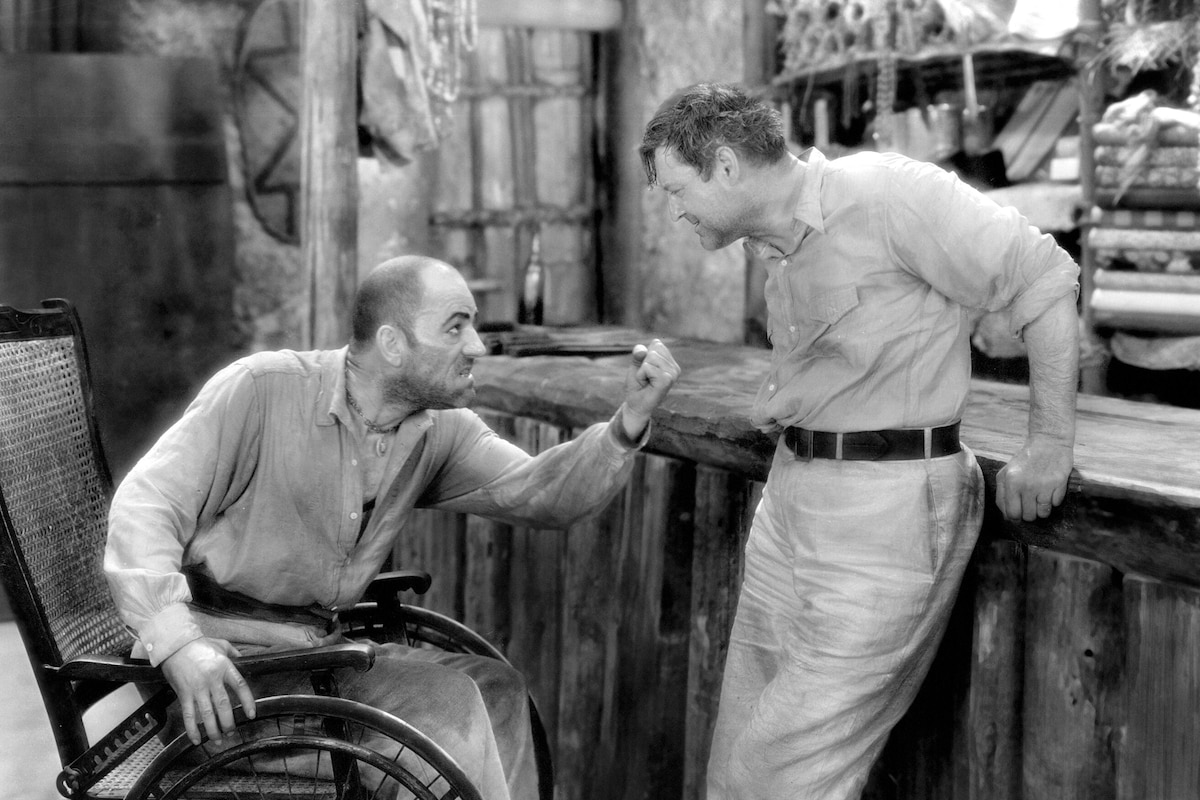
In one of the most notorious "lost scenes" in film history, Browning had shown Dead-Legs' rebirth after his crippling accident. First he is a beggar, wheeling himself into a barbaric cantina on the East Coast of Africa. (see photo) Two men taunt him and throw him through a plate glass window. The tormentors experience drunken remorse, and take up a collection for the abused man. Browning reveals it was all a ploy, and the tormentors are actually Tiny (Roscoe Ward) and Babe (Kalla Pasha), his new accomplices in crime. Next, we see a carnival tent in Zanzibar, a "pit show" advertising "The Human Duck." (see photo) Doc is the spieler outside, Babe is the ticket-taker and Tiny is the musician, strumming a guitar himself. Dead-Legs is the Human Duck, wallowing in the sawdust in a monstrous half-man/half-duck costume. This costume was put in mothballs after the shoot, but was revived four years later when Browning employed it in the final shocking scene of Freaks (1932).
Although never shot, the film's original ending has Maizie stabbing Dead-Legs to death while he sleeps in his hut.
Sources:
The MGM Story
The Barrymores: The Royal Family in Hollywood by James Kotsilibas-Davis
The House of Barrymore by Margot Peters
Classics of the Silent Screen: A Pictorial Treasury by Joe Franklin
The Horror People by John Brosnan
Dark Carnival: The Secret World of Tod Browning by David J. Skal & Elias Savada
Research compiled by Bret Wood
In the Know (West of Zanzibar) - TRIVIA
by Bret Wood | December 08, 2006
SIGN UP FOR OUR NEWSLETTERS

CONNECT WITH TCM