With the growing popularity of post-Freudian psychoanalysis
and atomic-age science breakthroughs in the 1950s, the
popularity of disembodied heads and super-powered brains
wreaking havoc perfectly encapsulated social anxieties of the
decade. Pulp novels got plenty of mileage from the concept,
and filmmakers grappled with severed heads and floating brains
terrorizing the populace in projects that turned out classy
(1953's Donovan's Brain), creepy (1957's The
Brain from Planet Arous), grisly (1958's Fiend without
a Face), and, ahem, Teutonic (1959's The Head).
However, for sheer absurdity, the prize easily goes to The
Brain that Wouldn't Die (1962), an independent, low-budget
mish-mash of a mad scientist, a deformed monster in a closet,
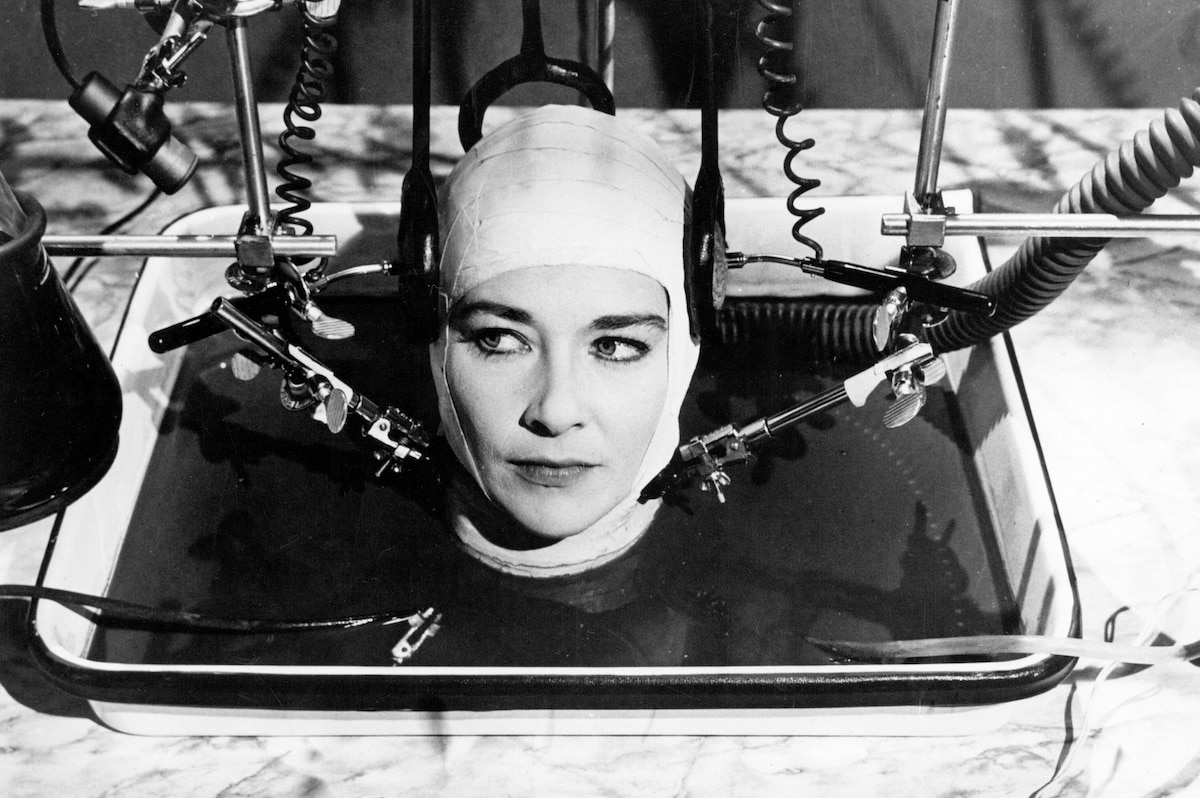
sleazy women, and a constantly complaining female cranium with
diabolical powers.
Comprised mostly of television bit players, the film follows
the misadventures of struggling young scientist Dr. Bill
Cortner (Jason "Herb" Evers), whose experiments involving the
transplantation of body parts have resulted in some unsavory
secrets in his basement at a secret country house. When he
wrecks his car and accidentally dismembers his fiancée, fellow
scientist Jan (Virginia Leith), he decides to abscond with her
severed head and find it a new, super-stacked body to revive
his love life. While the doc spends his spare time cruising
strip joints and cheap beauty pageants for the perfect female
vessel, the reanimated head of Jan sits in a medical pan and
develops a peculiar telepathic connection with Bill's most
monstrous creation, which lurks unseen behind a nearby locked
door...
Though filmed in 1959, the film (originally filmed as The
Head that Wouldn't Die) didn't see the light of drive-in
projectors until 1962 (barely beating out the
almost-as-ridiculous The Madmen from Mandoras (1963), later
re-edited into the tacky They Saved Hitler's Brain),
where it delighted horror fans with its eccentricities and secured its cult reputation for all time. Though its quality obviously can't compare, the
film also ties with Georges Franju's Eyes without a
Face (1960) as the first modern graphic gore film thanks to its
imagery of chunks of torn shoulder flesh and amputated,
wall-spraying arm stumps (often edited out of TV prints and
several video editions). In an odd shortcut around the demands
of creating an imposing monster, the film instead utilizes
7.6-foot-tall Israeli-born, Bronx-bred Eddie Carmel (born
Edward Carmeli), a stand-up comedian, singer and circus
performer most famous for his Diane Arbus portrait, "Jewish
Giant at Home with His Parents." His only other credited film
appearance came in 1963 with a caveman nudie, 50,000 B.C.
(Before Clothing), which makes The Brain that Wouldn't
Die look opulent in comparison.
Financed by Rex Carlton Productions (whose only other
contribution to American cinema was the rather more sedate
The Devil's Hand the same year), The Brain that
Wouldn't Die was theatrically released by
American-International Pictures, whose failure to add
copyright information to the new title card resulted in the
film quickly falling into the public domain. This proved to be
a blessing as numerous video companies issued their own
versions from the early 1980s, though its most notorious
incarnation is easily its adaptation into one of the most
popular episodes of Mystery Science Theater 3000.
However, in this case, the experience is just as entertaining
and outrageous if not even more so without the presence of
wisecracking robots. Watch it with someone you love... or at
least what's left of them.
Producer: Rex Carlton, Mort Landberg
Director: Joseph Green
Screenplay: Rex Carlton (story), Joseph Green
Cinematography: Stephen Hajnal
Film Editing: Leonard Anderson, Marc Anderson
Art Direction: Paul Fanning
Music: Abe Baker, Tony Restaino
Cast: Jason Evers (Dr. Bill Cortner), Virginia Leith (Jan Compton), Leslie Daniels (Kurt), Adele Lamont (Doris Powell), Marilyn Hanold (Peggy Howard), Bruce Brighton (Dr. Cortner).
BW-82m.
by Nathaniel Thompson
The Brain That Wouldn't Die
by Nathaniel Thompson | December 04, 2006
SIGN UP FOR OUR NEWSLETTERS

CONNECT WITH TCM