When producer Arthur Freed suggested a musical remake of Ah, Wilderness! (1935) to director Rouben Mamoulian one day in December 1945, Mamoulian wasn't terribly interested. But the more he thought about it, the more he came to like the idea. He saw it as an appealing and quite serious challenge to maintain the integrity of the original in a musical form, and he attacked it from every artistic angle he knew: color, costumes, production design, editing and the like. He also intellectualized this project (ultimately entitled Summer Holiday, 1948), seeing it as a chance to make not a mere musical, but rather a musical play. He explained the difference in a didactic memo to Freed, writing that a musical would have to contain "overblown" song and dance numbers at the expense of pieces of the play itself, thereby spoiling the essence of the original work and "emaciating its characters."
A musical play, on the other hand, was "a story which will be told through the medium of integrated dialogue, songs, dance and music, with each of those elements taking an organic and vital part in the telling of that story. What happens in this case is that the dialogue scenes, which have been cut out of a good play, are not thrown overboard, but are actually translated into their musical equivalent of song and dance. As a result the story has not suffered, nor has it changed, but the manner of telling it has changed, and it has been enriched by added emotional values which the right kind of music brings."
Perhaps Mamoulian saw this as a good property to heavily stylize because it was already so widely known by the public. After all, the play, Ah, Wilderness!, Eugene O'Neill's famous piece of Americana about a family in 1906 Connecticut, first opened on Broadway in 1933 starring George M. Cohan, Gene Lockhart and Elisha Cook, Jr., and ran nearly 300 performances. The 1935 movie, directed by Clarence Brown, remains a classic. O'Neill himself said of his play, "My purpose was to write a play true to the spirit of the American large small-town at the turn of the century. Its quality depended upon atmosphere, sentiment, an exact evocation of the mood of a dead past." Qualities like "atmosphere," "sentiment" and "mood" are what Mamoulian was most interested in enhancing - in musical and visual terms. (Mamoulian got the chance to explain his approach to O'Neill while on a trip to New York, and the playwright, who was suffering from Parkinson's Disease, gave the film his blessing.)
Mamoulian had just taken four years away from Hollywood to work on Broadway, directing the original productions of Oklahoma! and Carousel so theatrical stylization was undoubtedly on his brain. For example, he had strong and specific ideas for the color scheme of the film: "I didn't want any contrasting colors," he said, "just tints within a very narrow chromatic range - various degrees of yellow, beige and green. This I considered to be the colors of 'Americana' - like Thomas Benton, John Curry and Grant Wood." When hearing of this plan, MGM art director Cedric Gibbons replied, "You can't do this here. Believe me, Rouben, you're wasting your time. [Louis B.] Mayer wants to see bright colors." Not accepting this response, Mamoulian called producer Arthur Freed to complain, then handed the phone to Gibbons. Gibbons listened to Freed, then hung up and said to Mamoulian, "You know, Rouben, I LOVE the idea."
The color idea extended to the costumes as well. Costume designer Walter Plunkett said, "For the opening scene he wanted a period feeling like Currier and Ives prints. So I eliminated colors from the dresses and suits of the characters to give them a washed and faded look."
Meanwhile, Mamoulian was working very closely with his songwriters, Harry Warren and Ralph Blane, telling them in one memo: "May I once more remind you to keep in mind the importance of phraseology and vocabulary in any dialogue or lyrics added to O'Neill's writing...They should sound as if they were O'Neill's - lyrics O'Neill could write if he would, or perhaps if he could." Warren himself said that setting O'Neill to music was easy since O'Neill wrote in eight-bar phrases which came out "in cadence, like poetry."
Warren and Blane were known teasingly as the "transportation fellas" because Warren had written "Chattanooga Choo-choo" and "Atchison, Topeka and the Santa Fe," and Blane had written "The Trolley Song." For Summer Holiday they came up with yet another transport-themed title: "Stanley Steamer." Other songs include "Afraid to Fall in Love," "Our Home Town" and "The Sweetest Kid I Ever Met."
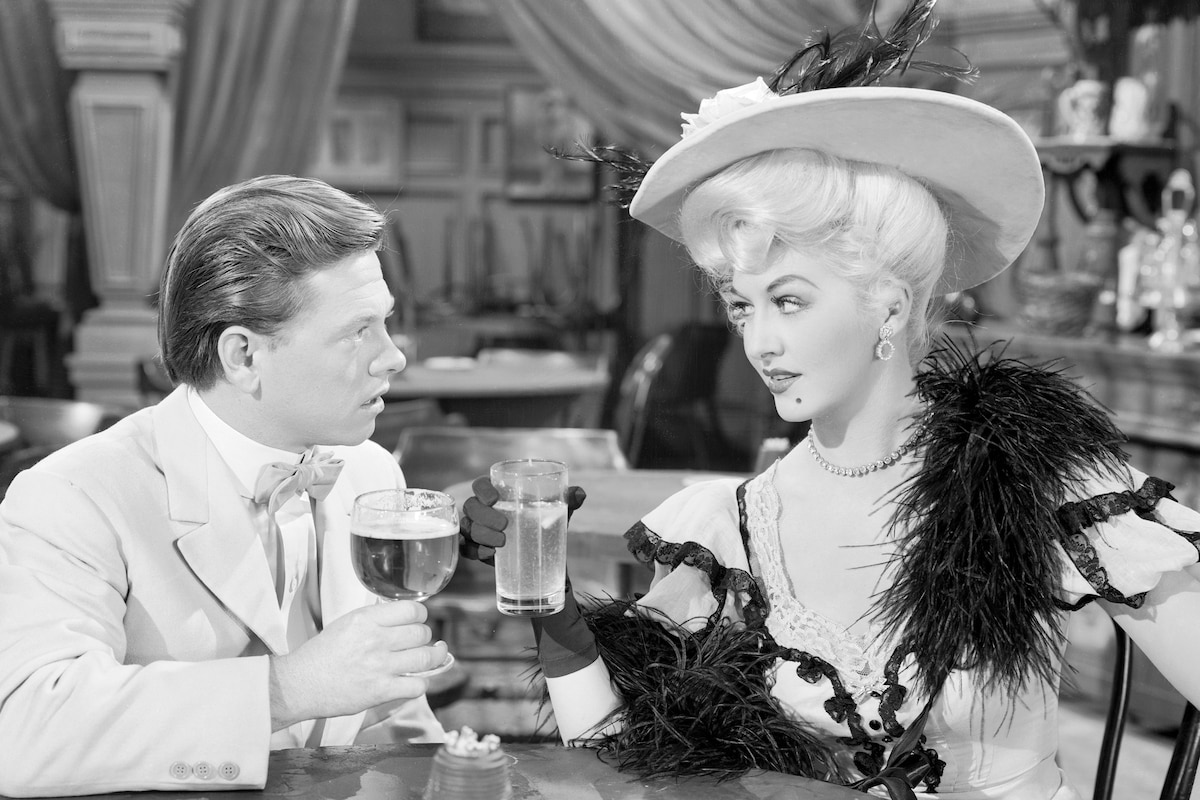
Summer Holiday was given an 'A' production by MGM, with a cast of Mickey Rooney, Gloria DeHaven, Frank Morgan and Walter Huston, and ultimately a 113-day shooting schedule and $2.2 million budget. Rooney had appeared in the movie Ah, Wilderness!, in the role of the youngest brother; here, he plays the oldest. (Ironically, the family's house in Summer Holiday is the same one that was used as the Hardys' home in all of the Andy Hardy films starring Rooney.)
Four songs written and/or filmed for Summer Holiday were ultimately left out. One of these, "Never Again," was prerecorded by a petrified Frank Morgan with Agnes Moorehead. After the first take, Roger Edens (Freed's right-hand man) said, "That's the worst singing I ever heard." Out the song went. The biggest deletion was an elaborate Persian fantasy sequence called "Omar and the Princess" which takes place in Mickey Rooney's imagination and reveals his love for Gloria DeHaven.
During pre-production, Mamoulian received a visit from a Breen Office censor regarding a scene where the father talks to his teenage son about sex. Mamoulian was adamant about keeping the scene, but the censor insisted that many individual words (such as "prostitute") had to go. The result was such a massacre of dialogue that Mamoulian came up with a clever, creative solution, cutting the ends of all sentences which contained "bad" phrases. "I had a new version written," he recalled, "in which the father finds himself embarrassed with the subject of sex to such an extent that he is never able to finish a sentence. And with that the matter would be made perfectly clear to the audience without the use of one single censorable word."
Filmed in mid-1946, Summer Holiday was not released until the spring of 1948 because the studio feared it would not perform well. Sure enough, critics dismissed it and so did the public: it lost $1.5 million at the box office. It's now regarded as a minor classic, however, largely because of Mamoulian's innovative approach. As author Tom Milne has written, "Summer Holiday equals [Mamoulian's earlier film] Love Me Tonight [1932] in the mastery with which rhymed dialogue, songs and leisurely action are swept up by Mamoulian's cutting into one dynamic overall rhythm....Mamoulian needs neither dances nor dancers to create choreography."
After Summer Holiday, Mamoulian took an even longer break from filmmaking; his next picture would be Silk Stockings in 1957 - coincidentally another musical remake of another classic film, Ninotchka (1939).
Producer: Arthur Freed
Director: Rouben Mamoulian
Screenplay: Frances Goodrich, Albert Hackett, Irving Brecher (adaptation), Jean Holloway (adaptation), Eugene O'Neill (play)
Cinematography: Charles Schoenbaum
Film Editing: Albert Akst
Art Direction: Cedric Gibbons, Jack Martin Smith
Cast: Mickey Rooney (Richard Miller), Gloria DeHaven (Muriel McComber), Walter Huston (Nat Miller), Frank Morgan (Uncle Sid), Jackie 'Butch' Jenkins (Tommy Miller), Marilyn Maxwell (Belle).
C-93m. Closed captioning.
By Jeremy Arnold
Sources:
Hugh Fordin, The World of Entertainment: Hollywood's Greatest Musicals
Tom Milne, Mamoulian
Summer Holiday (1948)
by Jeremy Arnold | December 01, 2006
SIGN UP FOR OUR NEWSLETTERS

CONNECT WITH TCM