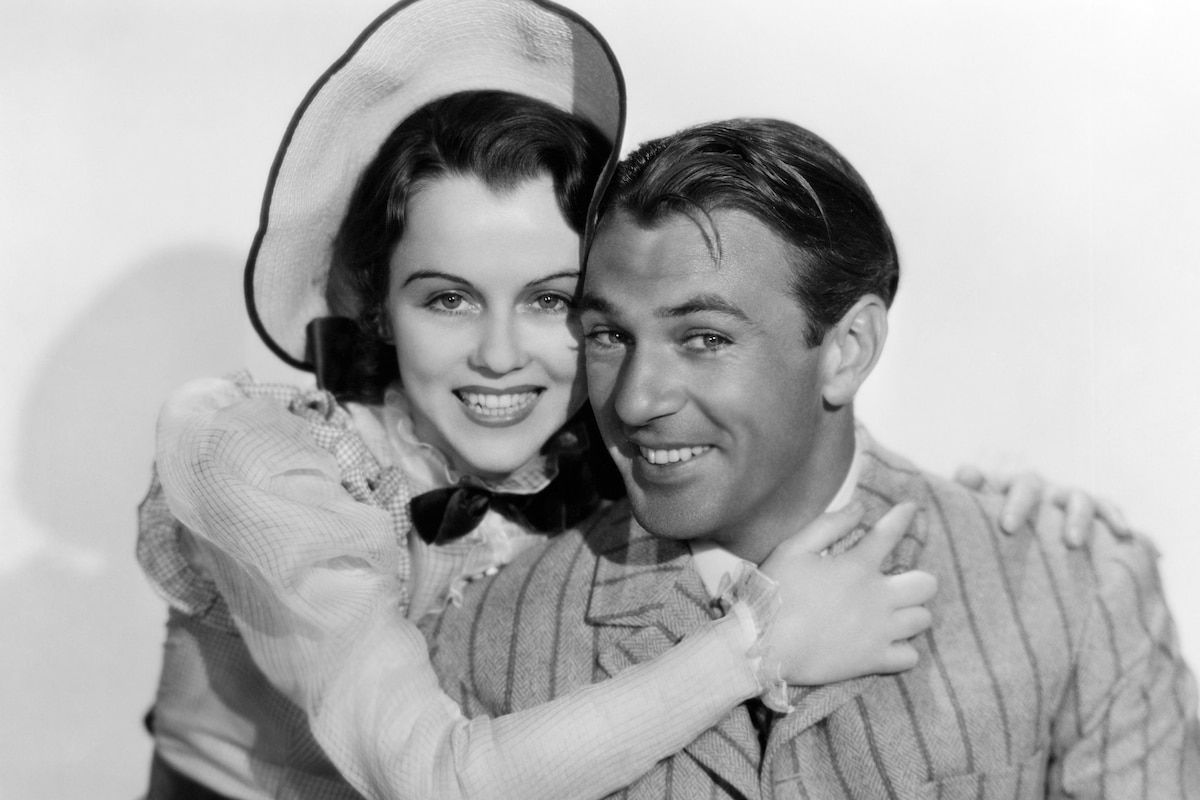
Years ago, Hollywood was so enamored of the Broadway stage producers often didn't know when to stop bringing certain properties to the screen. One Sunday Afternoon, which boasts Gary Cooper in one of his earlier starring roles, is a case in point. A semi-popular Broadway play of the same name served as the basis for One Sunday Afternoon, then inspired a James Cagney vehicle called The Strawberry Blonde (1941), as well as a 1948 musical starring Dennis Morgan and Dorothy Malone that was also called One Sunday Afternoon. And we won't even get into the three TV adaptations that followed!
The original cinematic incarnation of One Sunday Afternoon stars Cooper as Biff Grimes, a dentist who grows convinced that a lothario named Hugo Barnstead (Neil Hamilton) ruined his life years ago when he stole Biff's girlfriend, a sexpot named Virginia (Fay Wray). Biff, who is now married to a perfectly lovely woman (Frances Fuller), but is still convinced that he should have married Virginia, is intent on getting revenge on Hugo. Biff imagines that the best way to do this is to give Hugo a little too much gas while working on one of his molars. But things don't work out quite that way.
Several critics at the time complained that Cooper wasn't intimidating enough to play a larcenous type like Biff, that the role should have rightfully gone to Lloyd Nolan who originated it on Broadway (Cooper adopted a bulldog shortly after the film opened, and named it Biff, since it seemed more properly suited to the role.).
During filming, Cooper, who had already earned a reputation as a playboy, was happily dating Countess Dorothy DiFrasso, whose wealth brought the young actor into social circles that were utterly new to him. However, Fay Wray mentions in her autobiography, On the Other Hand, that she was surprised when actress Dolores Del Rio told her that Coop had dropped the Countess in favor of Veronica Balfe, the niece of MGM's brilliant art director, Cedric Gibbons. In fact, Cooper actually asked Gibbons for permission to marry Balfe, which was a formal enough move to stun Wray even further. Wray describes Balfe as follows: "She was stunning, sleek eyes, the same gray of Gary's eyes. She had won a bit role in King Kong [1933]. She leans out a hotel window in New York, sees Kong, and screams."
Cooper survived One Sunday Afternoon, of course, since his screen presence could withstand pretty much any critical onslaught. Within two years, he'd be starring in The Lives of a Bengal Lancer (1935), after which there would be no looking back for this American screen icon.
Producer: Louis D. Lighten
Director: Stephen Roberts
Screenplay: William Slavens McNutt (based on the play by James Hagan)
Cinematography: Victor Milner
Editor: Ellsworth Hoagland
Art Design: Hans Dreier, Wiard Ihnen
Costume Design: Travis Banton
Cast: Gary Cooper (Biff Grimes), Fay Wray (Virginia Brush), Neil Hamilton (Hugo Barnstead), Frances Fuller (Amy Lind), Roscoe Karns (Snappy Downer), Jane Darwell (Mrs. Lind), Clara Blandick (Mrs. Brush), Sam Hardy (Dr. Startzman), Harry Schultz (Schneider), James Burtis (Dink Hoops).
BW-85m. Closed captioning.
by Paul Tatara
One Sunday Afternoon (1933)
by Paul Tatara | November 22, 2006
SIGN UP FOR OUR NEWSLETTERS

CONNECT WITH TCM