Motion Picture Masterpieces, a five-disc DVD set from Warner Home Video, has a misleading title. Although
its five MGM productions are based on great novels, none of the movies are equally great, and only a couple come
anywhere near masterpiece quality. The set is fun to watch, and fans of MGM's lavish 1930s style will have a ball.
(This could have been called a Cedric Gibbons Festival, since he did the art direction for every film.) But it's
also a reminder that the best screen adaptations usually come from second-rate books-and even tenth-rate ones-that
filmmakers aren't afraid to tamper with for cinematic purposes.
Hollywood's first movie version of Pride and Prejudice, directed by Robert Z. Leonard and released in
1940, has never been topped. One reason is superb production work by art director Cedric Gibbons, costume designers
Adrian and Gile Steele, and cinematographer Karl Freund, who forgoes his German Expressionist roots to capture
exquisite images of England in the early 19th century. The film's other big triumph is its cast, topped by Greer
Garson as lively, lovely Elizabeth Bennet and Laurence Olivier as her prideful suitor Mr. Darcy, an ideal role that
elicited one of his most restrained and refined performances. The movie adds gimmicky episodes for visual
excitement-a carriage race, an archery contest-and sugar-coats the ending. But it's terrific entertainment
anyway.
Marie Antoinette, directed by W.S. Van Dyke in 1938, turns the MGM design team loose on the sumptuous
Versailles Palace in 18th-century France, where our heroine copes with a hapless husband, falls for a Swedish
aristocrat, outgrows youthful irresponsibility to become a compassionate queen, and faces the guillotine after the
French Revolution erupts. Norma Shearer is excellent in the title role. Tyrone Power plays the underwritten Count
Axel with elegance and charm. And many scenes get stolen by Robert Morley as the Dauphin, a tragicomic character
who's heading for the throne but can't figure out how to consummate his marriage. This opulent production is more
conventional than the 2006 remake by Sofia Coppola, but just as absorbing. MGM had a flair for the French
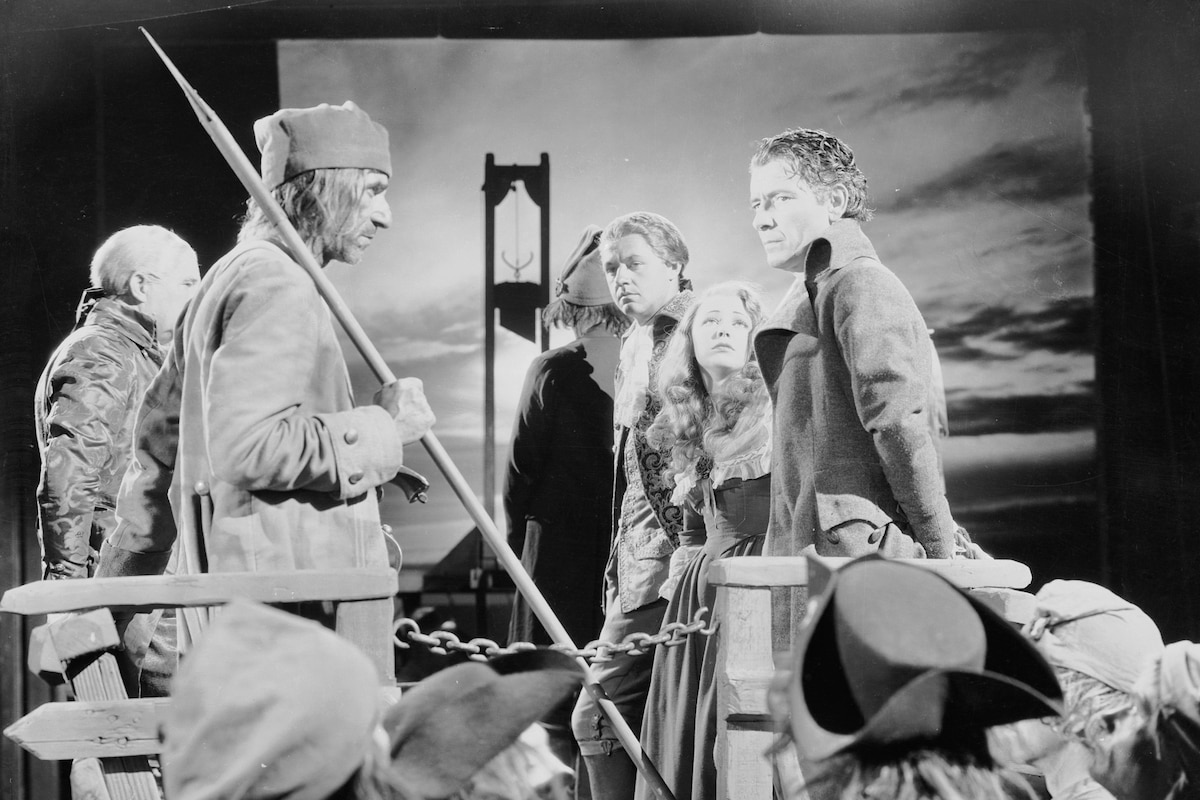
Revolution, giving it even stronger treatment in Jack Conway's marvelous 1935 version of Charles Dickens's novel
A Tale of Two Cities, starring Ronald Colman as the self-sacrificing hero. It's also in the
Masterpieces set.
It's hard to beat the story of Treasure Island, with brave young Jim Hawkins setting sail on a
pirate-infested ship in search of the legendary Captain Flint's buried hoard of gold and jewels. The best asset of
MGM's uneven 1934 version is the supporting cast, especially Nigel Bruce as likable Squire Trelawney and Lionel
Barrymore as Captain Billy Bones, the rowdy buccaneer who sets the tale in motion. The leads are less impressive,
owing to MGM's not-so-great idea of re-teaming the stars of The Champ, a big hit three years earlier. Jackie
Cooper expostulates "Bless my soul!" so often you want to hang him from the yardarm, and Wallace Beery makes Long
John Silver more cuddly than a self-respecting pirate would ever want to be. The adventure was directed by Victor
Fleming, and there's little to suggest he was just five years away from putting his signature on Gone With the
Wind in 1939.
The Personal History, Adventures, Experience, & Observation of David Copperfield, the Younger, released
in 1935, has always gotten extra points for featuring W.C. Fields as Mr. Micawber, a role he was born to play. In
other respects, though, this is one of Hollywood's weaker Charles Dickens adaptations, and one of George Cukor's
least memorable directing achievements. Picturesque posing carries more weight than sharp character sketching, and
the atmosphere of Victorian England rarely comes alive. Solid work by Basil Rathbone and Jessie Ralph, as Mr.
Murdstone and Nurse Peggotty, is overshadowed by lackluster acting from the likes of Roland Young and Lewis Stone,
whose Uriah Heep and Mr. Wickfield make sadly wan impressions. Even the inimitable Fields gets weighed down by the
screenplay, which cares more about the novel's catch-phrases than the context they need. What should have been a
sparkling comedy-drama becomes a period piece that seems longer than its title, which at least has a truly
Dickensian ring.
Each of the five Motion Picture Masterpieces discs has offbeat DVD extras. Some are connected with the
features-versions of David Copperfield and A Tale of Two Cities made for 1930s radio-but the most
fascinating are unrelated MGM shorts and animations from the period. Shorts like Two Hearts in Wax Time,
about a drunk and a pair of mannequins, and The Spectacle Maker, about a magic monocle, are so bizarre it's
hard to imagine what the filmmakers could have been thinking of. Ditto for a cartoon like Poor Little Me,
starring Stinky, a skunk. There's also an "oddity" from Pete Smith that will make you look at stunt bowling in a
whole new way, if you've ever looked at it in the first place. Singular items like these are worth the DVD price by
themselves.
For more information about Motion Picture Masterpieces, visit Warner
Video. To order Motion Picture Masterpieces, go to
TCM
Shopping.
by Mikita Brottman and David Sterritt
Motion Picture Masterpieces - 5 MGM Favorites on DVD Including "David Copperfield" & "Pride and Prejudice"
by Mikita Brottman and David Sterritt | November 17, 2006
SIGN UP FOR OUR NEWSLETTERS

CONNECT WITH TCM