In October 2006, news reports circulated that an American researcher had positively identified the site of Sgt. Alvin C. York's WWI heroics - the exact place where York, behind enemy lines with a small squad, used his rifle and his Colt .45 to pick off German machine gunners and charging soldiers, only to then singlehandedly capture 132 more. The general area in France's Argonne forest had always been known, but the specific location had been lost to history. Using metal detectors, the researcher found a concentration of empty Colt .45 cartridges as well as hundreds of German rifle and machine gun rounds and bits of gunbelt debris - items which were consistent with the facts of York's achievement. News of the discovery was carried by major papers around the world, showing that even today, York's heroics cast a spell.
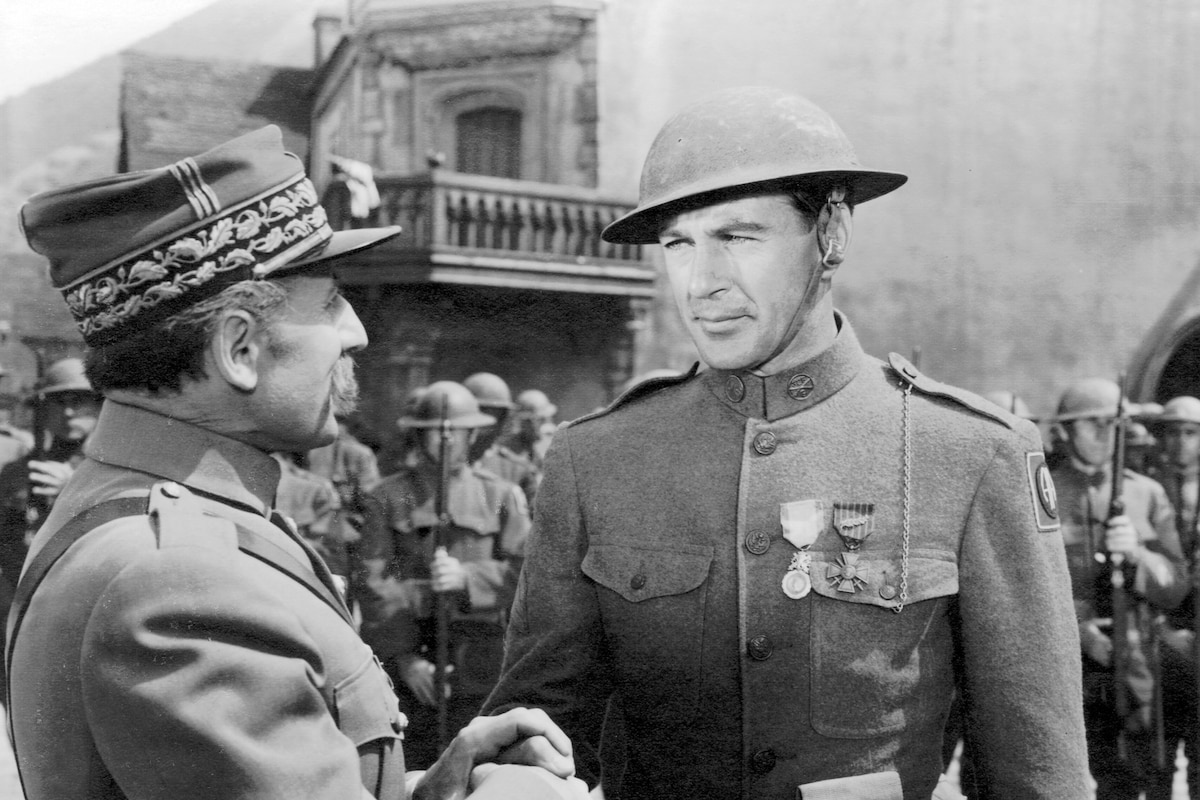
Of course, the movie Sergeant York (1941) already ensured that no one would ever forget York's feat. A huge commercial and critical hit in its day, the movie has endured as a beloved classic of the studio era - a classic that has finally found its way onto DVD. For some strange reason, Warner Home Video has never before released it in the format. To the studio's credit, however, they have now issued it with the proper attention it deserves: a two-disc special edition with a fascinating commentary track, documentaries on York and star Gary Cooper, and a short subject and cartoon of the era. The picture itself is beautifully crisp - the best this film has ever looked on the small screen - and the extras are quite satisfying.
For viewers who haven't seen Sergeant York in a while (or ever), it may come as a surprise that the combat sequences take up very little screen time and don't even begin until well into the film's second hour. Most of the movie deals with establishing York's character in rural Tennessee (well-evoked by the Warner Bros. art department, which sent researchers to the state) and his developing religious convictions which cause him to declare himself a conscientious objector.
That conflict between religious beliefs and war is subtly established in the film right from the get-go, as our introduction to York - shooting wildly and drunkenly from atop a horse - comes while Pastor Pile (Walter Brennan) is delivering a sermon. This is one of many keen observations offered by Jeanine Basinger on her commentary track. Basinger offers everything a viewer could want and more. She relates facts about York and the film's making but also lends context and insight into how the movie works on the level of craft, citing specifics of the screenplay, production design, acting styles and so on, in an accessible way that enriches one's understanding of the movie.
Basinger is an expert in war movies, having written a book on the subject (to which this reviewer made a contribution), and she is particularly interesting on how WWI movies of the late 1930s became less pacifistic as a way of prepping Americans for WWII - of conditioning them to accept the fact that war was sometimes necessary. Sergeant York drove the point home harder than any of those films in that it was blatantly about such a shift. "The change York underwent from pacifist to war hero," Basinger says, "paralleled the change America itself would also have to go through during the year 1941, ...[from] isolationism to involvement." It's quite a persuasive argument. Listening to all this, one becomes aware of the power of the moviegoing experience in the old days. A lot more people went to the movies back then, and popular movies could become strong, vital pieces of the American social fabric because they were shared experiences in a way that no movie today could ever duplicate - simply because the number of moviegoers can't compare. Of course, the craftsmanship of all those involved in making Sergeant York had a vital role in making such a powerful effect possible, and again, Basinger delves into many examples throughout her commentary.
The documentaries on Disc 2 are well worth watching. The first is a making-of featurette narrated by Liam Neeson which details how York was convinced to allow the film to be made, and which lends insight into director Howard Hawks' working methods. Joan Leslie, now 81, appears on-camera to offer some delightful reminiscences and shows herself to be still beautiful and still spry. The second is a documentary on Gary Cooper which was originally made for TNT by Richard Schickel. Narrated by Clint Eastwood, the piece is laden with clips from Cooper's entire career and even shows some home movies. It's all extremely well-edited and moves quickly.
Rounding out the DVD are a short subject, Lions For Sale, and a Porky Pig cartoon, Porky's Preview, which contains a cartoon-within-a-cartoon.
Sergeant York is available as a stand-alone purchase or as part of Warner Home Video's Gary Cooper: The Signature Collection. The other titles in the collection are The Fountainhead (1948), Dallas (1950), Springfield Rifle (1952) and The Wreck of the Mary Deare (1959).
Look fast for Elisha Cook, Jr., playing the piano in a bar fight scene.
For more information about Sergeant York, visit Warner Video. To order Sergeant York, go to
TCM Shopping.
by Jeremy Arnold
Gary Cooper in Sergeant York on DVD
by Jeremy Arnold | November 16, 2006
SIGN UP FOR OUR NEWSLETTERS

CONNECT WITH TCM