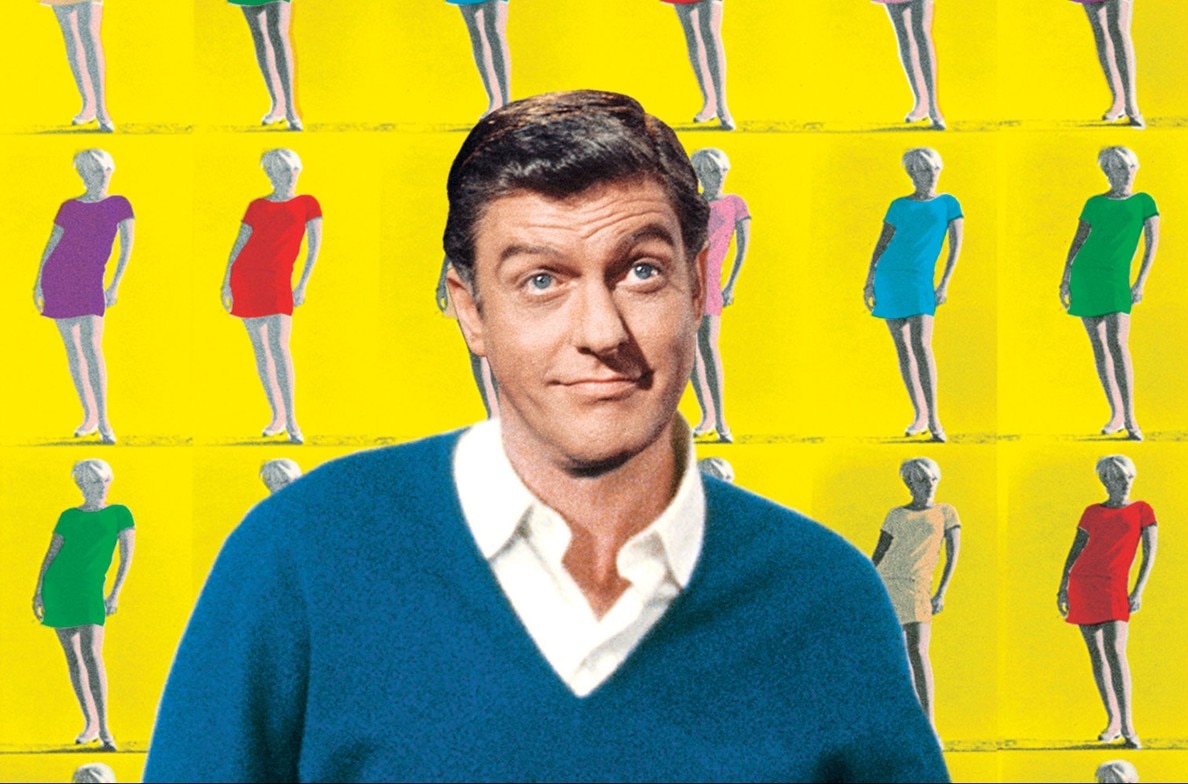
Dick Van Dyke stars as Jack Albany, a second-rate TV actor rushing across town in his gangster costume when he's mistaken by a young thug for an out-of-town hit man, in Never a Dull Moment (1968), Van Dyke's third and final feature for Walt Disney Productions. Forced to play out the role of San Francisco hired gun Ace Williams, he puts on his best tough guy bluff in front of the gang as they plot a major art heist while sneaking away to convince the crime boss' comely art teacher (Dorothy Provine) that they are both in danger. The script is based on the Jack Albany stories of John Godey (the pen name of Morton Freedgood), best known as the author of The Taking of Pelham One Two Three, a bestseller that was made into two feature films and a TV movie. Needless to say, it's all played for comedy here, with Van Dyke showcasing his gangly physical comedy chops for a drunk act (when he discovers that Ace is a notorious drinker) between sneers and stare downs with the gang.
Taking second billing as aging mobster Leo Smooth is Edward G. Robinson, who made his name over 35 years before with the iconic gangster classic Little Caesar (1931). When production began on Never a Dull Moment in 1967, the 73-year-old Hollywood legend was reduced to playing gangsters in supporting roles and cameo bits in European crime dramas and heist pictures. Robinson's first and only Disney picture gave him his biggest role in years, though once again he plays an elder statesman of crime, this time a veteran who plots a heist simply to make his reputation for decades to come. According to Dick Van Dyke, Robinson was quite hard of hearing by this time. When asked if he had tried a hearing aid, Robinson showed him a bag of devices that failed to help. "Why don't you get them fixed?" asked Van Dyke to which Robinson replied, "Sorry, can't hear you."
Dorothy Provine made her screen debut in the title role of the energetic B movie The Bonnie Parker Story (1958) but found more success on the small screen, starring in the TV shows The Alaskans and The Roaring 20's, where she could showcase both her singing and knack for light comedy. Never a Dull Moment became her swan song. The actress married British directed Robert Day and, apart from a couple of TV appearances, retired from the screen for good.
Filling out the gang is Tony Bill as a punk kid constantly getting slapped down by Smooth, veteran bad guy Henry Silva as a cold-eyed thug who clashes with the fake Ace, rodeo rider turned actor Slim Pickens ("who showed me how to throw a punch," remembered Van Dyke), and Jack Elam as the real Ace. Elam's career took an interesting turn from playing grizzled villains in Westerns and crime movies to spoofing his image in such Westerns as Support Your Local Sheriff! (1969) and Disney's Hot Lead and Cold Feet (1978). Never a Dull Moment was one of his first comic turns.
Director Jerry Paris had been actor on The Dick Van Dyke Show playing Rob Petrie's next-door neighbor. In the show's second season, he stepped behind the camera for the first time and made the leap to director. He helmed over 80 episodes of the series and won an Emmy Award for his efforts. Never a Dull Moment, his first big screen project, reunited him with his friend and colleague Dick Van Dyke. "We laughed every day on the set," recalled Van Dyke in his memoir. But Paris didn't give up acting entirely. He gave himself cameos in his directorial efforts and in Never a Dull Moment he appears in an uncredited role as a police photographer.
It was one of the first Disney films produced after the death of studio founder Walt Disney. Ron Miller, Disney's son-in-law, had graduated from assistant director to co-producer. Never a Dull Moment marked Miller's first solo producer credit. Disney composer Robert F. Brunner channels the distinctive jazz-inflected style of Lalo Schifrin, who wrote the memorable opening theme for Mission: Impossible and the scores for Cool Hand Luke (1967) and Bullitt (1968), for the clever opening. And for Disney trivia buffs, note that the giant "Astro Pooch" comic strip prominently showcased in the art museum set was created for the film by Floyd Gottfredson, a veteran animator and cartoonist who wrote and drew the "Mickey Mouse" daily comic strip for 45 years.
The film was released in the summer of 1968 with the Oscar-winning 1933 cartoon classic Three Little Pigs as the short subject. "The Disney team has uncorked a good-natured one," wrote film critic Howard Thompson in his review of the feature for The New York Times, while the review in England's Monthly Film Bulletin proclaimed, "With no pretensions to being anything but a rollicking farce, this slight but intermittently amusing comedy largely succeeds on its own modest level."
Van Dyke jumped immediately into production on Chitty Chitty Bang Bang (1968), a massive musical fantasy from James Bond producer Albert "Cubby" Broccoli, while Edward G. Robinson returned to Europe for one last flurry of international caper films before returning home for good, spending his final years taking TV roles between periodic big screen appearances.
Meanwhile, Never a Dull Moment received a second life when it was rereleased by Disney in 1977 on a double bill with a reedited version of the 1944 animated feature The Three Caballeros.
Sources:
Little Caesar: A Biography of Edward G. Robinson, Alan L. Gansberg. Scarecrow Press, 2004.
The Complete Films of Edward G. Robinson, Alvin H. Marill. Citadel Press, 1990.
My Lucky Life In and Out of Show Business, Dick Van Dyke. Crown Archetype, 2011.
"Never a Dull Moment" (film review), Howard Thompson. The New York Times, Thursday, August 15, 1968.
"Never a Dull Moment" (film review). Monthly Film Bulletin, August, 1968.
IMDb
By Sean Axmaker
Never a Dull Moment (1968)
by Sean Axmaker | June 10, 2019
SIGN UP FOR OUR NEWSLETTERS

CONNECT WITH TCM